


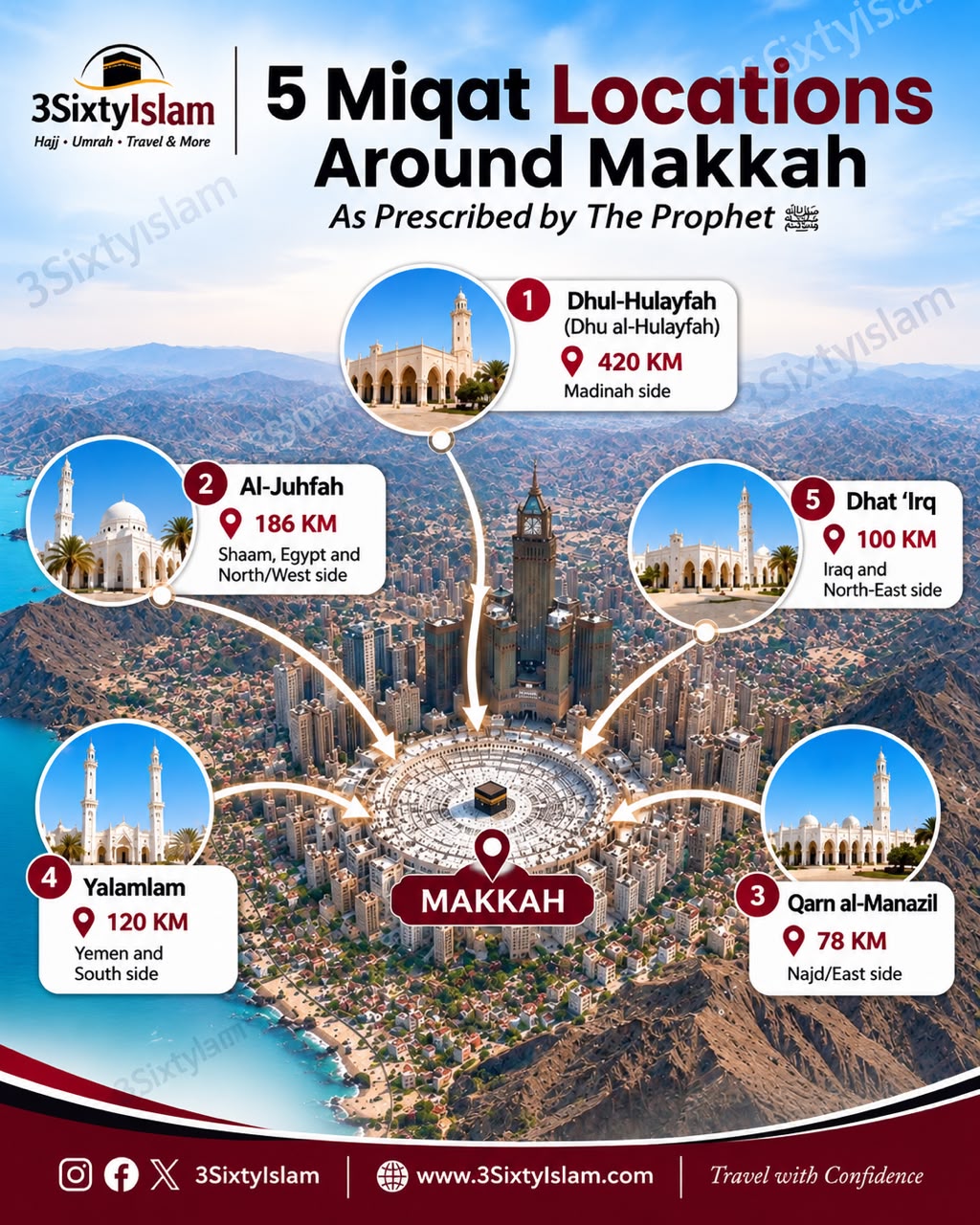
For every Muslim preparing to perform Hajj or Umrah, understanding the Miqat is an important part of preparing for the sacred journey. Before entering Makkah to perform the pilgrimage, there are specific boundaries that pilgrims must observe. These boundaries are known as Miqat.
The Miqat marks the designated points at which pilgrims intending to perform Hajj or Umrah must enter the sacred state of Ihram before proceeding towards Makkah. It is an important part of the pilgrimage, and crossing the designated boundary without observing the necessary requirements can have religious consequences.
For first-time pilgrims, the concept of Miqat may seem confusing, particularly when travelling by air or coming from different parts of the world. Questions often arise about where to wear Ihram, when to make the intention, what happens if someone crosses the Miqat without entering Ihram and which Miqat applies to people travelling from Nigeria.
Understanding these rules can help pilgrims avoid unnecessary mistakes and prepare for their journey with confidence.
In this guide, we explore the meaning of Miqat, its different types, the five designated Miqat locations, and what every intending Hajj and Umrah pilgrim should know.
WHAT IS MIQAT IN ISLAM?
Miqat is an Arabic term that refers to an appointed time or designated boundary.
In the context of Hajj and Umrah, Miqat refers to the specific locations and times established by Islamic law for pilgrims to enter the state of Ihram.
These boundaries were designated by Prophet Muhammad (peace and blessings be upon him) for Muslims travelling to Makkah from different directions.
A pilgrim intending to perform Hajj or Umrah must enter Ihram before crossing the applicable Miqat boundary.
Ihram is not simply the clothing worn during pilgrimage. It is a sacred state of worship that involves making the intention to perform Hajj or Umrah and observing certain restrictions.
For men, Ihram generally consists of two unstitched pieces of cloth, while women wear ordinary modest Islamic clothing that fulfils the requirements of Islamic dress.
The Miqat therefore serves as an important starting point for the formal rites of pilgrimage.
WHY IS MIQAT IMPORTANT FOR HAJJ AND UMRAH?
The Miqat is important because it establishes the point at which pilgrims must begin observing the requirements of Ihram.
It reminds Muslims that Hajj and Umrah are acts of worship that must be performed according to the guidance of the Qur’an and Sunnah.
There are several reasons why Miqat is significant:
1. It is an instruction established by the Prophet Muhammad (PBUH).
The designated Miqat locations were identified by the Prophet Muhammad (peace and blessings be upon him). Observing them is part of following his Sunnah.
2. It prepares pilgrims spiritually.
Entering Ihram reminds Muslims that they are leaving behind many worldly comforts and distractions to concentrate on worshipping Allah.
3. It establishes the beginning of the pilgrimage rites.
The Miqat ensures that pilgrims intending to perform Hajj or Umrah enter the state of Ihram at the appropriate boundary.
4. It encourages discipline and obedience.
Following the Miqat requirements demonstrates the importance of observing Allah’s commands and the teachings of His Messenger.
THE FIVE DESIGNATED MIQAT LOCATIONS
Prophet Muhammad (peace and blessings be upon him) designated five main Miqat locations for Muslims travelling towards Makkah from different directions.
These locations are associated with the different geographical routes leading to the holy city.
In an authentic narration recorded in Sahih al-Bukhari and Sahih Muslim, Abdullah ibn Abbas (RA) reported that the Prophet Muhammad (PBUH) designated the Miqat boundaries for the people of different regions.
The five locations are:
1. DHUL-HULAYFA (ABYAR ALI)
Dhul-Hulayfah is the Miqat designated for people travelling from Madinah towards Makkah.
It is located approximately 9 kilometres southwest of the Prophet’s Mosque in Madinah, although the distance varies depending on the point of measurement.
Today, the location is commonly known as Abyar Ali and is one of the most recognised Miqat stations.
Muslims visiting Madinah before travelling to Makkah usually enter Ihram at this location if they intend to perform Hajj or Umrah.
Dhul-Hulayfah is the furthest of the five original Miqat locations from Makkah.
2. AL-JUHFAH
Al-Juhfah is the Miqat designated for people travelling from the direction of Syria and the surrounding regions, including parts of North Africa and other western routes.
It is located northwest of Makkah.
Today, many pilgrims use Rabigh, a town located near the historical Miqat area, as the practical point for entering Ihram.
Pilgrims travelling from Europe, parts of Africa and other regions may be directed to observe this Miqat depending on their route.
3. QARN AL-MANAZIL (AS-SAYL AL-KABIR)
Qarn al-Manazil is the Miqat designated for people travelling from the direction of Najd and eastern regions.
It is commonly associated with As-Sayl al-Kabir, northeast of Makkah.
Pilgrims travelling from parts of central and eastern Saudi Arabia and other routes passing this boundary observe this Miqat.
It is one of the important Miqat locations used by pilgrims travelling overland towards Makkah.
4. YALAMLAM
Yalamlam is the Miqat designated for people travelling from the direction of Yemen and the southern routes towards Makkah.
It is situated southeast of Makkah.
Pilgrims travelling from Yemen and other southern routes observe this Miqat.
For some pilgrims travelling from African countries, including Nigeria, the applicable Miqat may be Yalamlam or another boundary depending on their flight path.
It is important to understand that the correct Miqat is determined by the route of travel, not simply by the pilgrim’s nationality.
5. DHAT IRQ
Dhat Irq is the Miqat designated for people travelling from the direction of Iraq and the northeastern routes.
It is located northeast of Makkah.
Although pilgrims travelling through this route may be fewer than those using some of the other Miqat locations, it remains one of the five designated boundaries.
These five locations ensure that Muslims approaching Makkah from different directions observe the requirements of Ihram.
WHAT ARE MIQAT ZAMANI AND MIQAT MAKANI?
Islamic scholars explain Miqat in two categories: Miqat Zamani and Miqat Makani.
Understanding the difference between them is important, particularly for pilgrims preparing for Hajj.
MIQAT ZAMANI: THE APPOINTED TIME FOR HAJJ
Miqat Zamani refers to the prescribed period during which Hajj can be performed.
Unlike Umrah, which can generally be performed throughout the year, Hajj has specific appointed days in the Islamic month of Dhul-Hijjah.
The main rites of Hajj take place between the 8th and 13th of Dhul-Hijjah, although scholars discuss the broader timeframe for entering Ihram for Hajj.
Allah says in Surah Al-Baqarah:
“Hajj is [during] well-known months.”
(Qur’an 2:197)
The well-known months are understood by the majority of scholars to include Shawwal, Dhul-Qa’dah and Dhul-Hijjah.
MIQAT MAKANI: THE APPOINTED PLACE FOR IHRAM
Miqat Makani refers to the geographical boundaries established for pilgrims entering Ihram.
These are the five locations discussed earlier.
A pilgrim approaching Makkah from outside the Miqat boundaries with the intention of performing Hajj or Umrah must enter Ihram before crossing the applicable boundary.
This distinction is important because a pilgrim must observe both the appropriate time requirements and the geographical requirements of the pilgrimage.
WHEN SHOULD YOU ENTER IHRAM AT THE MIQAT?
One of the most common questions among intending pilgrims is when exactly they should enter Ihram.
The answer depends on the journey and the type of pilgrimage being performed.
A pilgrim should prepare for Ihram before reaching the designated Miqat.
This preparation includes:
- Taking a bath (Ghusl), where possible.
- Cleaning and trimming the nails and removing unwanted body hair before entering Ihram, where needed.
- Wearing the appropriate Ihram clothing.
- Applying permissible fragrance before entering the state of Ihram.
- Making the intention to perform Hajj or Umrah.
- Reciting the appropriate Talbiyah.
The intention marks the beginning of Ihram. Simply wearing the Ihram garments does not, by itself, place a person in the sacred state.
For Umrah, the pilgrim makes the intention for Umrah and begins reciting the Talbiyah.
For Hajj, the intention depends on the type of Hajj being performed: Ifrad, Qiran or Tamattu.
The important point is that the intention must be made before crossing the applicable Miqat.
WHAT IF YOU ARE TRAVELLING BY AIR?
Air travel presents a particular challenge because many pilgrims do not physically stop at a Miqat station.
Instead, they fly directly towards Jeddah or another Saudi destination.
This raises an important question: where should passengers enter Ihram when travelling by plane?
The general rule is that a pilgrim intending to perform Hajj or Umrah must enter Ihram before the aircraft crosses the applicable Miqat boundary.
Airlines carrying pilgrims on these routes may announce when the aircraft is approaching the Miqat.
However, passengers should not depend entirely on an announcement, as it may be made with limited notice.
It is advisable to:
- Wear the Ihram garments before boarding the aircraft or during an earlier convenient stage of the journey.
- Prepare mentally and spiritually before reaching the Miqat.
- Ask the airline or Hajj group about the expected Miqat crossing.
- Make the intention and begin the Talbiyah before crossing the boundary.
Men should already be wearing their two Ihram garments, while women should be dressed in suitable modest clothing.
Can you wear Ihram before reaching Miqat?
Yes. A pilgrim may wear the Ihram garments and even enter the state of Ihram before reaching the Miqat. However, the pilgrim must observe all Ihram restrictions from the moment the intention is made.
For this reason, many scholars advise pilgrims travelling by air to prepare early and make their intention before the aircraft crosses the boundary.
WHICH MIQAT APPLIES TO NIGERIAN PILGRIMS?
For Nigerian Muslims travelling to Saudi Arabia for Hajj or Umrah, understanding the Miqat is particularly important.
Nigeria is located in West Africa, and flights from the country may follow different routes depending on the airline, departure airport and flight arrangements.
There is no single Miqat that automatically applies to every Nigerian pilgrim.
The applicable Miqat depends on the route taken by the aircraft.
For example, a flight may approach Makkah through a route corresponding to Al-Juhfah or another designated Miqat boundary.
Pilgrims should therefore obtain guidance from their airline, authorised Hajj operator or knowledgeable Islamic scholar about the exact route and the appropriate point for entering Ihram.
Nigerian pilgrims travelling for Hajj should also pay attention to instructions provided by the National Hajj Commission of Nigeria (NAHCON) and their respective state Muslim Pilgrims Welfare Boards.
The most important thing is to ensure that Ihram is established before crossing the applicable Miqat, rather than assuming that all flights from Nigeria use the same boundary.
WHAT HAPPENS IF YOU CROSS THE MIQAT WITHOUT ENTERING IHRAM?
This is one of the most important questions concerning Miqat.
A person who intends to perform Hajj or Umrah and crosses the applicable Miqat without entering Ihram has failed to observe an important pilgrimage requirement.
The appropriate response depends on the circumstances.
If the person can return to the Miqat:
The person should return to the applicable Miqat and enter Ihram there before proceeding to Makkah.
If the person has already entered Makkah:
If returning to the Miqat is possible, the person should do so.
If returning is not possible or the person proceeds without returning, the ruling may involve a compensatory sacrifice (Dam), according to the applicable scholarly rulings.
There are differences in the details of these rulings, particularly where there is forgetfulness, ignorance or a genuine inability to return.
Pilgrims should therefore seek guidance from a qualified scholar rather than assuming that every situation has the same ruling.
CAN YOU ENTER IHRAM FROM JEDDAH?
Another common question concerns pilgrims who arrive in Jeddah without having entered Ihram.
Jeddah is not one of the five original Miqat locations designated by the Prophet Muhammad (PBUH).
For someone travelling from outside the Miqat who intends to perform Hajj or Umrah, arriving in Jeddah does not generally remove the obligation to have entered Ihram before crossing the applicable Miqat.
However, the ruling differs for people who are already inside the Miqat boundaries and intend to perform Umrah.
For example, a resident of Jeddah intending to perform Umrah may enter Ihram from their place of residence.
Similarly, someone already within the Miqat boundaries who intends to perform Umrah generally goes outside the Haram boundary, such as to Masjid Aishah at Tan’im, and enters Ihram there.
This is why it is important to distinguish between the Miqat boundary and the boundary of the Haram.
They are not the same thing.
WHAT IS THE DIFFERENCE BETWEEN MIQAT AND THE HARAM BOUNDARY?
Many pilgrims confuse the Miqat with the Haram boundary, but they serve different purposes.
The Miqat is the designated boundary beyond which someone intending to perform Hajj or Umrah from outside must not pass without entering Ihram.
The Haram boundary, on the other hand, marks the sacred sanctuary surrounding Makkah, within which particular restrictions apply.
A person who is already inside the Haram and wishes to perform Umrah generally needs to go outside the Haram boundary before entering Ihram.
For example, Masjid Aishah at Tan’im is a well-known location used by residents and visitors already in Makkah who wish to enter Ihram for another Umrah.
Understanding this difference helps pilgrims avoid confusion when planning their journey.
COMMON MISTAKES PILGRIMS MAKE ABOUT MIQAT
Despite its importance, some pilgrims make mistakes because they are unfamiliar with the rules.
Here are some common mistakes to avoid:
1. Assuming that wearing Ihram clothing is enough
Wearing the two white garments does not automatically place a man in Ihram. The intention is essential.
2. Waiting until reaching Makkah before entering Ihram
Pilgrims intending to perform Hajj or Umrah from outside the Miqat must enter Ihram before crossing the applicable boundary.
3. Depending entirely on airline announcements
Passengers should prepare ahead of time instead of waiting until the last minute to enter Ihram.
4. Assuming all Nigerian pilgrims have the same Miqat
The applicable Miqat depends on the actual travel route, not nationality alone.
5. Confusing Miqat with the Haram boundary
The two boundaries have different religious purposes and requirements.
6. Making the intention too late
Pilgrims should ensure that their intention is made before crossing the applicable Miqat.
Avoiding these mistakes can make the pilgrimage journey easier and help pilgrims fulfil the requirements of Hajj and Umrah correctly.
FINAL THOUGHTS: PREPARE FOR YOUR PILGRIMAGE BY UNDERSTANDING THE MIQAT
The Miqat is an important part of the Hajj and Umrah journey. It represents the designated boundary at which pilgrims must enter the sacred state of Ihram before proceeding towards Makkah.
From Dhul-Hulayfah to Al-Juhfah, Qarn al-Manazil, Yalamlam and Dhat Irq, each of the five Miqat locations serves Muslims approaching Makkah from different directions.
Understanding these boundaries, knowing when to enter Ihram and learning the rules surrounding them can help pilgrims avoid unnecessary mistakes.
For first-time pilgrims, particularly those travelling by air from countries such as Nigeria, preparation and proper guidance are essential.
Hajj and Umrah are acts of worship that require sincerity, patience and obedience to Allah. Understanding the Miqat is one of the practical steps towards performing these sacred journeys correctly.
May Allah make the journey easy for every intending pilgrim, accept their Hajj and Umrah, forgive their shortcomings and grant every Muslim the opportunity to visit His Sacred House.
Ameen.
