


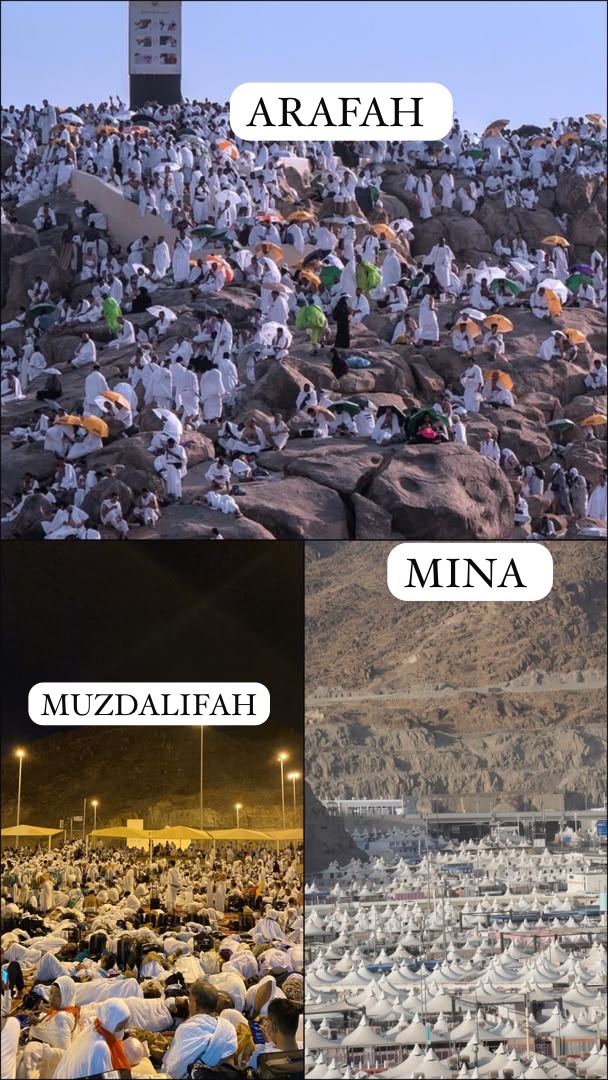
Every year, millions of Muslims from different parts of the world travel to Makkah to fulfil one of the greatest obligations in Islam: Hajj. For many pilgrims, the journey is a once-in-a-lifetime opportunity to seek Allah’s forgiveness, renew their faith and experience the unity of the Muslim Ummah.
While the Ka’bah and Masjid al-Haram are the most recognised symbols of the pilgrimage, three other locations play an equally important role in the Hajj experience: Mina, Arafah and Muzdalifah.
These sacred locations are central to the rites of Hajj. Each has its own significance, history and spiritual lessons. From spending the night in Mina to standing before Allah on the plain of Arafah and resting beneath the open sky in Muzdalifah, every stage reminds pilgrims of their purpose, their dependence on Allah and the temporary nature of worldly life.
But what makes these three places so important? What happens in each location during Hajj, and what lessons can Muslims learn from them?
Let’s explore the history, significance and spiritual importance of Mina, Muzdalifah and Arafah.
MINA: THE VALLEY OF SACRIFICE AND REMEMBRANCE
Mina is a valley located approximately five kilometres east of Masjid al-Haram in Makkah. It is one of the principal locations of Hajj and is particularly recognised for its large collection of pilgrim tents and the Jamarat complex, where pilgrims perform the ritual of stoning.
Often called the City of Tents, Mina becomes home to millions of pilgrims during the Hajj season.
The significance and history of Mina
Mina is closely associated with the story of Prophet Ibrahim (AS), his son Prophet Ismail (AS) and the command to sacrifice his beloved son.
According to Islamic tradition, Prophet Ibrahim (AS) saw in a dream that he was sacrificing his son. Understanding this as a command from Allah, he spoke to Ismail (AS), who responded with remarkable faith and willingness to obey Allah.
Allah ultimately replaced Ismail (AS) with a great sacrifice, demonstrating the importance of submission, trust and obedience.
This event is remembered by Muslims around the world during Eid al-Adha through the act of Qurbani.
Mina is also associated with the stoning of the Jamarat, which commemorates Prophet Ibrahim’s rejection of Satan’s attempts to discourage him from obeying Allah.
What happens in Mina during Hajj?
Pilgrims first travel to Mina on the 8th of Dhul-Hijjah, known as Yawm al-Tarwiyah or the Day of Tarwiyah.
On this day, pilgrims enter or remain in the state of Ihram and travel from Makkah to Mina. They spend the day and night there, engaging in prayer, remembrance of Allah and preparation for the journey to Arafah the following morning.
The main activities in Mina include:
1. Spending the Day of Tarwiyah
Pilgrims spend the 8th of Dhul-Hijjah in Mina, offering their prescribed prayers and preparing spiritually for the most important day of Hajj.
2. Stoning the Jamarat
On the 10th of Dhul-Hijjah, Eid al-Adha, pilgrims return to Mina to stone Jamrat al-Aqabah by throwing seven small pebbles, declaring Allahu Akbar with each throw.
During the following Days of Tashreeq, pilgrims stone all three Jamarat: Jamrat al-Ula, Jamrat al-Wusta and Jamrat al-Aqabah.
3. Offering the sacrifice
Pilgrims performing Hajj Tamattu or Qiran generally offer an animal sacrifice as part of their pilgrimage obligations, subject to the applicable rules.
This sacrifice commemorates the obedience of Prophet Ibrahim (AS) and his son Ismail (AS).
4. Shaving or trimming the hair
After the sacrifice, male pilgrims shave their heads or trim their hair, with shaving being more virtuous according to the Sunnah. Female pilgrims cut a small portion of their hair.
5. Spending the Days of Tashreeq
Pilgrims remain in Mina during the 11th, 12th and, for those who choose to stay longer, the 13th of Dhul-Hijjah.
During these days, they continue the stoning ritual and engage in the remembrance of Allah.
The spiritual lessons of Mina
Mina teaches Muslims several important lessons:
- Obedience to Allah: The story associated with Mina reminds believers that obedience to Allah should take priority over personal desires.
- Sacrifice: True devotion sometimes requires giving up things we love for the sake of Allah.
- Patience: Living in shared tents, navigating large crowds and following a demanding schedule require patience and consideration for others.
- Unity: Muslims from different countries, cultures and social backgrounds gather together as one Ummah.
Mina is therefore more than a temporary settlement for pilgrims. It is a place where faith, sacrifice and submission become practical expressions of worship.
ARAFAH: THE MOST IMPORTANT DAY OF HAJJ
Arafah is a vast plain located approximately 20 kilometres east of Makkah. It is regarded as the most important location during Hajj because standing at Arafah, known as Wuquf, is an essential pillar of the pilgrimage.
The 9th of Dhul-Hijjah, known as the Day of Arafah, is one of the most significant days in the Islamic calendar.
For pilgrims, it is a day dedicated to prayer, repentance, remembrance of Allah and seeking forgiveness.
The historical and religious significance of Arafah
Arafah holds a special place in Islamic history.
It is associated with the Prophet Muhammad’s (peace and blessings be upon him) Farewell Pilgrimage, during which he delivered his famous Farewell Sermon.
The sermon addressed important principles of Islam, including the sanctity of human life and property, the rights and responsibilities of Muslims, equality among believers and the importance of holding firmly to the teachings of Islam.
Arafah is also associated with the revelation of the verse in which Allah says:
“This day I have perfected for you your religion and completed My favour upon you and have approved for you Islam as religion.”
Qur’an 5:3
This verse was revealed during the Prophet’s Farewell Pilgrimage, giving the Day of Arafah an additional significance in Islamic history.
What happens at Arafah during Hajj?
After spending the night in Mina, pilgrims travel to Arafah on the morning of the 9th of Dhul-Hijjah.
They remain within the boundaries of Arafah until sunset, dedicating their time to worship and supplication.
The major activities include:
1. Standing at Arafah (Wuquf)
Standing at Arafah is the central pillar of Hajj. Without fulfilling this essential rite within its prescribed time, Hajj is not valid.
The Prophet Muhammad (peace and blessings be upon him) said:
“Hajj is Arafah.”
This hadith highlights the central importance of the standing at Arafah.
2. Offering Dhuhr and Asr prayers
Pilgrims generally combine and shorten the Dhuhr and Asr prayers at Arafah, according to the Sunnah and the applicable rules of Hajj.
3. Making Du’a and seeking forgiveness
The Day of Arafah is an opportunity for pilgrims to turn sincerely to Allah.
They spend much of the day making Du’a, reciting the Qur’an, engaging in Dhikr and asking Allah to forgive their sins.
The Prophet Muhammad (peace and blessings be upon him) said:
“The best supplication is the supplication on the Day of Arafah.”
Reported in Jami’ at-Tirmidhi.
4. Visiting Jabal al-Rahmah
Jabal al-Rahmah, also known as the Mount of Mercy, is a well-known landmark in Arafah.
It is associated with the Farewell Pilgrimage of the Prophet Muhammad (peace and blessings be upon him). However, climbing the mountain is not a requirement of Hajj, and pilgrims do not need to stand on its summit for their pilgrimage to be valid.
The entire designated plain of Arafah is the place of standing.
Why is the Day of Arafah so special?
The Day of Arafah is not only significant for pilgrims. Muslims who are not performing Hajj are also encouraged to fast on this day.
The Prophet Muhammad (peace and blessings be upon him) explained that fasting on the Day of Arafah expiates the sins of the previous year and the coming year, as reported in Sahih Muslim.
This virtue applies to those who are not performing Hajj. Pilgrims generally do not fast on this day because they need strength for the demanding activities of Hajj.
The spiritual lessons of Arafah
Arafah offers profound lessons for every Muslim:
- Repentance: No matter how many mistakes a person has made, the door of repentance remains open.
- Humility: Standing together before Allah reminds Muslims that wealth, status and nationality have no superiority in the sight of Allah except through righteousness.
- Accountability: The gathering of millions of people reminds believers of the Day of Judgement, when every human being will stand before Allah.
- Hope in Allah’s mercy: Arafah teaches Muslims never to despair of Allah’s forgiveness and compassion.
For many pilgrims, standing at Arafah is the emotional highlight of their Hajj journey. It is a moment to reflect on life, seek forgiveness and make sincere commitments to become better Muslims.
MUZDALIFAH: A NIGHT UNDER THE OPEN SKY
After sunset on the 9th of Dhul-Hijjah, pilgrims leave Arafah and travel to Muzdalifah.
Muzdalifah is an open area situated between Arafah and Mina. It is the third major location visited during the central stages of Hajj.
Unlike Mina, where pilgrims stay in organised tent camps, Muzdalifah offers a different experience. Pilgrims spend the night in an open area, often resting on mats or directly on the ground.
This experience reminds them of humility, simplicity and the temporary nature of worldly possessions.
The significance of Muzdalifah
Muzdalifah is mentioned in the Qur’an in Surah Al-Baqarah.
Allah says:
“But when you depart from Arafat, remember Allah at al-Mash’ar al-Haram. And remember Him, as He has guided you, for indeed you were before that among those astray.”
Qur’an 2:198
Al-Mash’ar al-Haram is associated with Muzdalifah, where pilgrims remember Allah after leaving Arafah.
The location is therefore closely connected with Dhikr, gratitude and obedience to Allah.
What happens in Muzdalifah during Hajj?
After completing their standing at Arafah, pilgrims proceed to Muzdalifah after sunset.
The activities include:
1. Combining Maghrib and Isha prayers
Upon reaching Muzdalifah, pilgrims generally combine Maghrib and Isha prayers, performing them together in accordance with the Sunnah.
Maghrib is offered as three Rak’ahs, while Isha is shortened to two Rak’ahs.
2. Spending the night in Muzdalifah
Pilgrims spend the night in Muzdalifah, remembering Allah and resting in preparation for the following day’s activities.
This is an important part of the Hajj journey, although certain concessions apply to pilgrims with valid excuses.
3. Collecting pebbles for the Jamarat
Pilgrims collect small pebbles for the stoning ritual in Mina.
The pebbles should be small, and there is no need to collect unusually large stones.
The number and timing required depend on the particular day and the pilgrim’s Hajj arrangements.
4. Performing Fajr prayer
Pilgrims wake up before dawn to perform Fajr prayer.
They engage in remembrance and supplication before proceeding to Mina according to the Hajj schedule and applicable instructions.
The spiritual lessons of Muzdalifah
Muzdalifah teaches Muslims that:
- Worldly possessions are temporary: Spending the night on the ground reminds pilgrims that material comfort is not the purpose of life.
- Humility is essential: Every pilgrim, regardless of wealth or status, experiences the simplicity of the journey.
- Remembrance of Allah should be constant: Worship does not end after the emotional experience of Arafah.
- Preparation is important: The night in Muzdalifah prepares pilgrims for the remaining obligations of Hajj.
Muzdalifah is a reminder that a Muslim’s relationship with Allah should not depend on comfort, luxury or convenience.
HOW MINA, ARAFAH AND MUZDALIFAH ARE CONNECTED
Although these locations have different roles, they form one continuous journey during Hajj.
Understanding their order helps pilgrims appreciate the significance of each stage.
The Hajj journey through the three sacred locations
8th of Dhul-Hijjah – Mina
Pilgrims travel from Makkah to Mina, where they spend the day and night in prayer and preparation.
9th of Dhul-Hijjah – Arafah
Pilgrims leave Mina for Arafah, where they perform Wuquf, the essential standing of Hajj. They spend the day making Du’a and seeking Allah’s forgiveness.
Night of the 9th – Muzdalifah
After sunset, pilgrims travel to Muzdalifah, combine Maghrib and Isha prayers, spend the night and prepare for the next stage.
10th of Dhul-Hijjah – Return to Mina
Pilgrims return to Mina, stone Jamrat al-Aqabah, offer the required sacrifice where applicable, and shave or trim their hair.
They then perform Tawaf al-Ifadah and the other remaining rites according to their Hajj type and schedule.
11th and 12th of Dhul-Hijjah – Mina
Pilgrims stone all three Jamarat each day.
Those who remain until the 13th of Dhul-Hijjah also perform the stoning on that day.
This sequence demonstrates how the three locations work together to complete the central stages of the Hajj pilgrimage.
IMPORTANT THINGS PILGRIMS SHOULD KNOW BEFORE VISITING THESE LOCATIONS
For first-time pilgrims, the movement between Mina, Arafah and Muzdalifah can be physically demanding.
Proper preparation can make the experience more manageable.
Here are some important things to remember:
1. Follow your Hajj group’s instructions
Pilgrims should always follow their authorised Hajj operator’s instructions and the official movement schedules provided by the Saudi authorities.
Transport arrangements and departure times can differ.
2. Carry essential items
Useful items include:
- Ihram garments and comfortable footwear.
- Identification documents and Hajj identification cards.
- A small bag for personal belongings.
- Unscented toiletries where needed.
- Drinking water.
- Essential prescribed medication.
- A phone and portable charger.
- A small prayer mat.
3. Stay hydrated
The heat and physical demands of Hajj can cause dehydration.
Drink water regularly, seek shade where possible and follow official health advice.
4. Know your location
Pilgrims should familiarise themselves with their tent numbers, camp locations and meeting points.
It is also advisable to keep their group’s contact information readily available.
5. Be patient and considerate
Millions of people are moving through the same locations within a short period.
Avoid pushing, rushing or creating unnecessary congestion. Give elderly pilgrims, people with disabilities and those who need assistance the necessary consideration.
6. Do not become distracted by unnecessary activities
The main purpose of visiting these locations is worship.
Although taking photographs and recording memories may be tempting, pilgrims should prioritise their prayers, remembrance of Allah and fulfilment of the Hajj rites.
WHAT IS THE DIFFERENCE BETWEEN MINA, ARAFAH AND MUZDALIFAH?
For quick reference, here is a comparison of the three locations:
| Location | Main significance | Main activity |
|---|---|---|
| Mina | Sacrifice and the Jamarat rituals | Stoning and spending the Days of Tashreeq |
| Arafah | Central pillar of Hajj | Standing, Du’a and seeking forgiveness |
| Muzdalifah | Remembrance and preparation | Combining prayers and spending the night |
Each location has a distinct role, but all contribute to the spiritual and physical journey of Hajj.
FINAL THOUGHTS: A JOURNEY OF FAITH, PATIENCE AND SUBMISSION
Mina, Arafah and Muzdalifah are more than geographical locations in the Kingdom of Saudi Arabia. They represent important moments in the spiritual journey of every Hajj pilgrim.
Mina reminds Muslims of sacrifice and obedience to Allah. Arafah offers an extraordinary opportunity for repentance, forgiveness and renewed faith. Muzdalifah teaches humility, simplicity and the importance of remembering Allah in every circumstance.
Together, these locations remind Muslims that Hajj is not simply a journey from one place to another. It is a journey of the heart, one that requires sincerity, patience, discipline and complete submission to Allah.
For those preparing to perform Hajj, understanding the significance of these sacred locations can make the experience more meaningful.
May Allah accept the Hajj of every pilgrim, forgive their shortcomings, ease their journey and grant every Muslim who longs to visit His Sacred House the opportunity to do so.
Ameen.
