


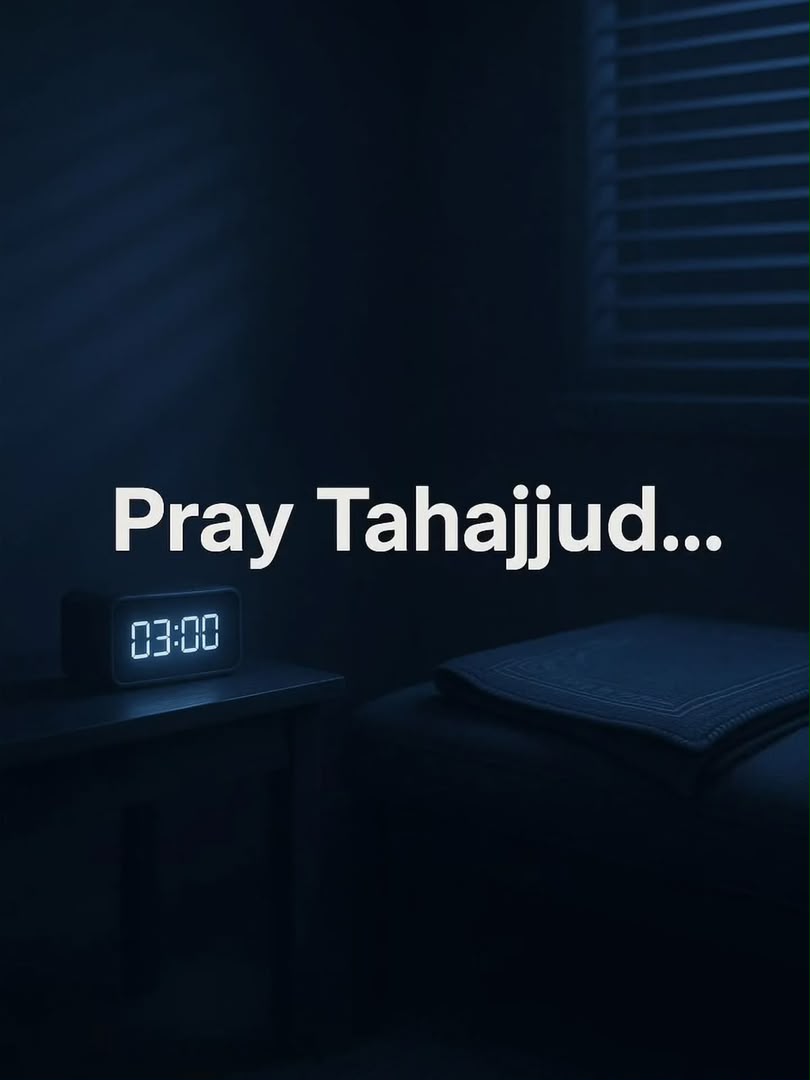
There is something deeply special about standing before Allah when the world is quiet. During the day, life is filled with responsibilities, conversations, work, distractions and constant movement. But at night, when everything becomes still, a Muslim has the opportunity to step away from the noise and stand privately before the One who created him.
This is the beauty of Tahajjud.
Tahajjud is a voluntary night prayer that a Muslim performs after sleeping and waking up during the night. It is not obligatory like the five daily prayers, but it is one of the greatest voluntary acts of worship a Muslim can establish in his or her life.
Allah describes the righteous believers as those who spend part of the night in worship:
“They used to sleep but little of the night.”
— Qur’an 51:17
The night therefore has a special place in Islamic worship. While most people are asleep, the believer can use those quiet hours to pray, make dua, seek forgiveness and reconnect with Allah.
Tahajjud is not simply about praying extra rak’ahs. It is about creating a private moment with Allah.
During the day, we may make dua while surrounded by people. We may remember Allah while working, travelling or going about our responsibilities. But Tahajjud gives a Muslim an opportunity to deliberately leave the comfort of sleep and stand before Allah with humility.
The Prophet Muhammad ﷺ regularly prayed at night. Aishah رضي الله عنها narrated that the Prophet ﷺ would stand in prayer at night until his feet became swollen. When she asked why he exerted himself when Allah had forgiven his previous and future shortcomings, he replied:
“Should I not be a grateful servant?”
This shows us that night prayer was not merely about asking Allah for things. It was also an expression of gratitude and servitude.
One of the greatest misconceptions about Tahajjud is that a person has to pray for a very long time for it to count as meaningful worship. That can discourage people unnecessarily.
A person who struggles to wake up can begin with something manageable. Even two rak’ahs prayed sincerely are better than abandoning the practice because one believes that Tahajjud requires a long prayer every night.
Consistency is important in voluntary worship. The Prophet ﷺ taught that the deeds most beloved to Allah are those that are done consistently, even if they are small.
This is why someone who wants to establish Tahajjud should focus first on making it sustainable.
You may start by sleeping a little earlier, setting an alarm and waking up perhaps 20 or 30 minutes before Fajr. Perform wudu, pray two rak’ahs and spend a few minutes making sincere dua. As the habit becomes established, you can increase your prayer gradually.
The last third of the night is particularly significant. Allah’s Messenger ﷺ taught that Allah descends to the lowest heaven during the last third of the night and calls upon His servants to ask Him for what they need and seek His forgiveness.
This makes the final portion of the night a precious opportunity for dua and istighfar.
Imagine having something weighing heavily on your heart. You have spoken to family members, friends and people around you, but eventually you realise that the person you most need to turn to is Allah.
You wake up before Fajr, perform wudu, stand on your prayer mat and speak to Allah.
Nobody else has to know.
You can ask Him for guidance. You can ask Him to forgive you. You can ask Him to strengthen your iman, protect your family, bless your halal efforts, help you overcome a sin, grant you righteous companionship or guide you through a difficult decision.
That private conversation with Allah is one of the beautiful dimensions of Tahajjud.
However, Tahajjud should not become another source of guilt for Muslims who are struggling with their five daily prayers. The obligatory prayers come first. A person should not become obsessed with voluntary night prayer while neglecting Fajr, Dhuhr, Asr, Maghrib or Isha.
The goal is not to appear exceptionally religious. The goal is to become closer to Allah.
And this is why Tahajjud can change more than a person’s prayer schedule. It can gradually change the relationship between a Muslim and Allah.
When someone repeatedly wakes up simply because they know Allah is worthy of worship, it develops sincerity. When they stand before Allah while nobody is watching, it develops ikhlas. When they raise their hands and ask Allah for help, it develops tawakkul. When they continue praying despite not immediately seeing the results they want, it develops sabr.
Tahajjud therefore connects several important qualities of a believer.
You do not need a perfect life before you begin praying Tahajjud. You do not need to have solved every problem. You do not need to feel spiritually perfect.
Sometimes the person who needs Tahajjud most is precisely the person who feels distant from Allah.
Start small. Sleep with the intention of waking up. Set your alarm. When you wake up, do not negotiate with yourself for too long. Get up, make wudu and pray.
Even if it is only two rak’ahs.
Then sit for a few moments and speak to Allah sincerely.
Over time, those quiet moments can become some of the most valuable moments of your day.
Tahajjud is not about showing people that you are pious. In fact, its beauty is partly found in its privacy. It is you standing before Allah when there is no audience, no applause and no social media post.
Just a servant and his Lord.
And sometimes, the most important changes in a Muslim’s life begin in exactly those moments when nobody else is watching.
