
Beauty is something many people care about. Whether it is improving our appearance, taking care of our skin, enhancing our facial features, or wanting to look more attractive, the desire to feel beautiful is a natural part of being human.
Today, beauty enhancement has become increasingly popular. From skincare treatments and cosmetic surgery to Botox, fillers, teeth whitening, eyelash extensions, wigs, artificial nails, and other cosmetic procedures, there are countless ways people choose to change or enhance their appearance.
But as Muslims, an important question arises: Is beauty enhancement permissible in Islam, or are some forms of beautification considered Haram?
Can a Muslim woman get Botox? Is getting a nose job allowed? Can someone use fillers to enhance their lips? What about whitening teeth, wearing artificial eyelashes, or getting cosmetic surgery after an accident?
These are questions many Muslims have, especially in a world where beauty standards are constantly changing.
The truth is that Islam does not prohibit looking beautiful or taking care of yourself. However, it provides guidelines about modesty, natural appearance, avoiding harm, and not changing Allah’s creation for impermissible reasons.
Not every beauty treatment has the same Islamic ruling. Some are permissible, some are prohibited, and others depend on their purpose, ingredients, effects, and the circumstances surrounding them.
Let’s explore the different rulings and what Muslims should understand before undergoing beauty enhancement procedures.
1. DOES ISLAM ALLOW PEOPLE TO BEAUTIFY THEMSELVES?
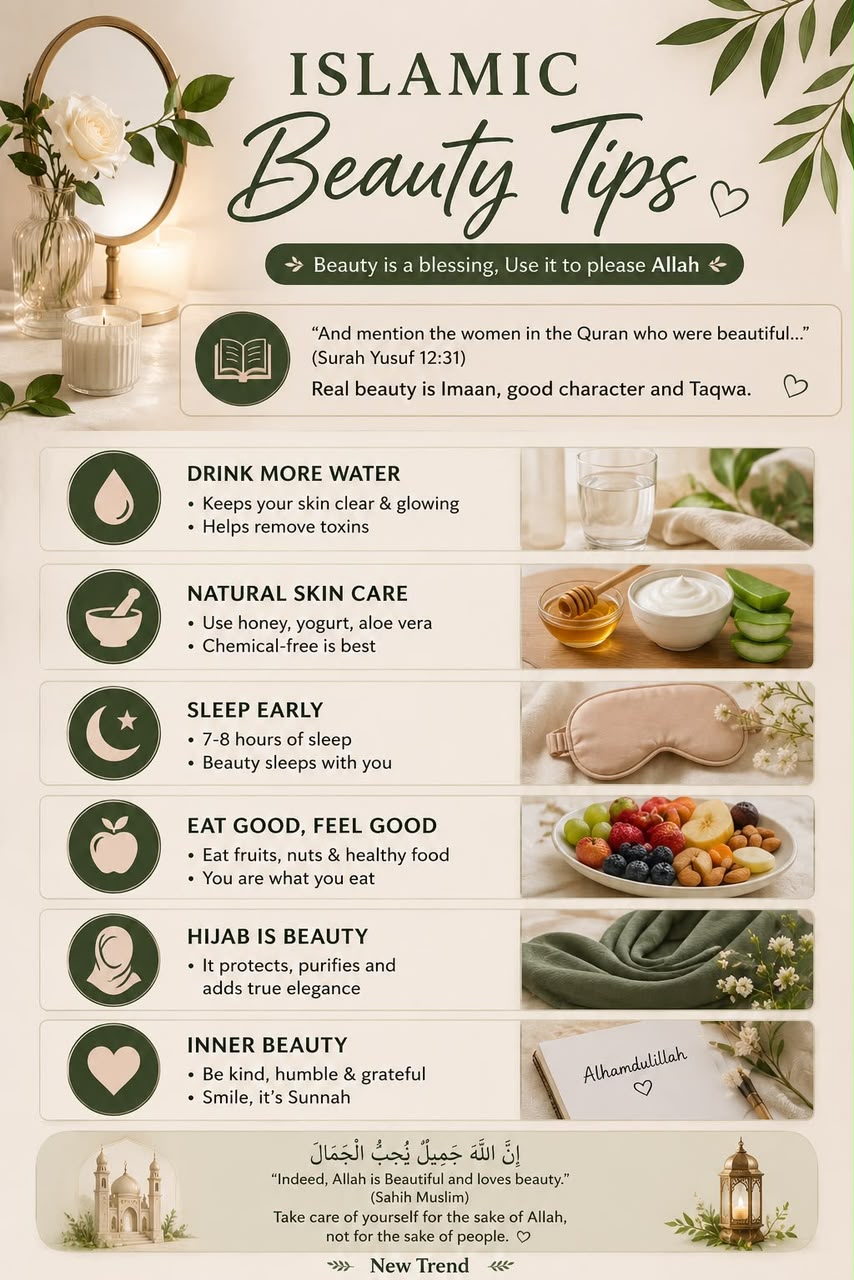
Before discussing individual beauty treatments, it is important to understand that Islam does not teach that looking attractive is wrong.
Muslims are encouraged to maintain cleanliness, personal hygiene, and good appearance.
Allah says:
“O children of Adam, take your adornment at every masjid…”
(Qur’an 7:31)
The Prophet Muhammad (peace and blessings be upon him) also explained that Allah is Beautiful and loves beauty.
(Sahih Muslim 91)
This shows that beauty itself is not forbidden in Islam.
There is nothing inherently wrong with:
- Maintaining healthy skin.
- Wearing clean and attractive clothing.
- Using permissible skincare products.
- Keeping your hair neat.
- Maintaining good personal hygiene.
- Wearing permissible makeup and adornments.
- Taking care of your teeth.
- Looking presentable for your spouse.
However, there is a difference between caring for your appearance and undergoing procedures that Islamic teachings prohibit.
The important question is not simply whether something makes you look more beautiful. It is whether the method is Islamically permissible.
2. COSMETIC SURGERY: WHEN IS IT HALAL OR HARAM?
Cosmetic surgery is one of the most discussed topics when it comes to beauty enhancement in Islam.
Some people undergo surgery because they want to change a feature they dislike, while others need surgery because of an accident, injury, birth defect, or medical condition.
Islamic scholars generally distinguish between surgery intended to correct a defect or restore normal function and surgery intended purely to change normal features for additional beauty.
Cosmetic surgery for medical or corrective reasons
Procedures intended to correct a genuine physical defect, restore normal function, or repair damage are generally considered permissible, provided the procedure itself is safe and medically appropriate.
Examples include:
- Reconstructing the face after an accident.
- Repairing a cleft lip.
- Correcting a congenital physical abnormality.
- Reconstructing the breast after cancer surgery.
- Correcting a feature that causes significant physical impairment.
- Repairing severe burns or injuries.
The purpose is not simply to pursue an ideal beauty standard but to restore or improve a person’s physical condition.
A relevant Hadith concerns a companion whose nose was injured in battle. The Prophet Muhammad (peace and blessings be upon him) permitted him to use a replacement nose made of gold after a silver replacement caused problems.
(Sunan Abi Dawud 4232; Jami’ at-Tirmidhi 1770)
This is among the evidences scholars discuss when considering corrective procedures.
Cosmetic surgery purely for beautification
Procedures performed solely to change normal physical features for additional attractiveness are generally prohibited by many scholars.
Examples often discussed include:
- Changing the natural shape of the nose without a medical or corrective need.
- Undergoing surgery simply to achieve a particular facial appearance.
- Altering normal facial features to imitate a beauty trend.
- Surgically changing healthy body features solely because they do not match personal beauty preferences.
The discussion is connected to the Hadith in which the Prophet Muhammad (peace and blessings be upon him) condemned certain forms of beautification involving altering Allah’s creation.
(Sahih al-Bukhari 5931; Sahih Muslim 2125)
However, not every procedure labelled cosmetic is automatically prohibited. The reason for the procedure, the degree of abnormality, the harm involved, and the scholarly assessment all matter.
3. BOTOX: IS IT PERMISSIBLE IN ISLAM?
Botox is widely used to reduce the appearance of wrinkles and fine lines.
Some people use it for cosmetic purposes, while others receive it for medical conditions such as certain muscle disorders or excessive sweating.
Its Islamic ruling depends on the purpose, ingredients, safety, and the nature of the treatment.
- Medical use: Treatment for a genuine medical condition may be permissible when medically appropriate.
- Cosmetic use: Scholars differ in their assessment of injections intended purely to reduce normal signs of ageing. Some consider them impermissible when they involve unnecessary alteration of normal features, while others assess temporary treatments differently.
- Safety: The treatment must not involve unacceptable harm or prohibited ingredients.
It is important to understand that temporary treatments are not automatically permissible simply because their effects eventually wear off.
Likewise, the fact that a treatment is injectable does not automatically make it Haram.
Ask a qualified scholar about the specific treatment and consult a licensed medical professional about its safety.
4. DERMAL FILLERS: CAN MUSLIMS GET LIP OR CHEEK FILLERS?
Dermal fillers are used to add volume to different areas of the face.
Some people use them to enhance their lips, define their jawline, or restore facial volume.
But are they permissible?
There is no single ruling that automatically covers every filler procedure.
Scholarly assessments may consider:
- Whether the treatment corrects a genuine defect.
- Whether it restores lost volume or changes normal features.
- Whether it is temporary or permanent.
- Whether its ingredients are permissible.
- Whether it presents a medical risk.
- Whether it involves unnecessary alteration for beautification alone.
For example, restoring facial volume following an injury or illness may be treated differently from enlarging naturally normal lips simply to follow a beauty trend.
Do not assume that because fillers are temporary, they are automatically halal.
5. TEETH WHITENING: IS IT HALAL?
Teeth whitening is generally considered permissible when it is safe and does not involve prohibited ingredients or harmful procedures.
Islam encourages cleanliness and oral hygiene.
The Prophet Muhammad (peace and blessings be upon him) strongly encouraged the use of the Siwak.
(Sahih al-Bukhari 887; Sahih Muslim 252)
Muslims can generally:
- Brush their teeth.
- Use permissible whitening toothpaste.
- Undergo safe professional teeth whitening.
- Maintain regular dental appointments.
- Remove stains caused by food and drinks.
However, there is an important distinction between whitening teeth and undergoing unnecessary procedures that significantly alter healthy teeth.
For example, filing healthy teeth down purely to create a particular appearance raises different Islamic concerns.
If a dental procedure is needed to correct damage, disease, or a genuine abnormality, its ruling may be different.
6. EYELASH EXTENSIONS: ARE THEY PERMISSIBLE?
Eyelash extensions are popular among women who want fuller and longer-looking eyelashes.
However, this is an area where Muslims should exercise caution.
There is an authentic Hadith in which the Prophet Muhammad (peace and blessings be upon him) prohibited hair extensions and those who apply them.
(Sahih al-Bukhari 5933; Sahih Muslim 2122)
Scholars discuss whether particular modern eyelash products fall under the same prohibition, depending on their construction and method of application.
Other considerations include:
- Whether artificial lashes are attached in a way that resembles prohibited extensions.
- Whether the adhesive contains impermissible ingredients.
- Whether the procedure causes harm.
- Whether it prevents water from reaching the natural eyelashes during Wudu.
Temporary decorative lashes and permanent or semi-permanent extensions should not automatically be treated as identical.
It is best to ask a knowledgeable scholar about the exact product and application method.
7. WEARING WIGS AND HAIR EXTENSIONS
Hair is an important part of personal appearance, and many people use wigs or extensions for different reasons.
However, Islamic teachings contain specific prohibitions concerning hair extensions.
The Prophet Muhammad (peace and blessings be upon him) prohibited hair extensions and the practice of attaching additional hair to natural hair.
(Sahih al-Bukhari 5933; Sahih Muslim 2122)
Therefore, conventional hair extensions made by attaching additional hair to natural hair are generally considered prohibited.
Wigs can involve additional scholarly discussion, particularly when used to cover hair loss caused by illness, burns, or medical treatment.
The reason for wearing the wig, its material, and the way it is used may affect the ruling.
Do not assume that every hairpiece has the same ruling. Seek a specific scholarly assessment.
8. EYEBROW SHAPING AND MICROBLADING
Eyebrow grooming is another important topic in Islamic discussions about beauty.
There is an authentic Hadith in which the Prophet Muhammad (peace and blessings be upon him) condemned those who pluck eyebrows for beautification and those who have this done.
(Sahih al-Bukhari 5931; Sahih Muslim 2125)
This practice is commonly discussed under the term Nams.
Many scholars prohibit plucking or reshaping the eyebrows for beautification.
However, scholars discuss exceptions involving abnormal growth, significant defects, and hair that causes genuine difficulty.
What about microblading?
Microblading involves depositing pigment into the skin to create the appearance of fuller eyebrows.
Its ruling requires additional consideration because it involves a form of cosmetic pigmentation and may resemble tattooing.
Permanent tattooing is prohibited in authentic Hadith.
(Sahih al-Bukhari 5937; Sahih Muslim 2124)
Temporary techniques, their depth, duration, and method may be assessed differently by scholars.
A Muslim should not assume that microblading is permissible simply because it is marketed as semi-permanent rather than permanent.
9. TATTOOS AND PERMANENT MAKEUP
Permanent tattoos are prohibited according to authentic Hadith.
The Prophet Muhammad (peace and blessings be upon him) condemned tattooing and those who seek to be tattooed.
(Sahih al-Bukhari 5937; Sahih Muslim 2124)
This includes tattooing performed for decorative purposes, regardless of whether the design is considered attractive.
Permanent makeup may also fall under the ruling on tattooing when pigment is inserted into the skin through tattooing techniques.
However, temporary surface-level makeup is different from permanent tattooing.
For anyone considering cosmetic pigmentation, it is important to establish exactly how the procedure works before assuming that it is permissible.
10. ARTIFICIAL NAILS AND NAIL POLISH
<AsyncImage query=”Elegant manicure natural nail polish hands beauty salon” aspectRatio=”16:9″ width=”100%”/>
Artificial nails and nail polish are common beauty practices, but they raise important questions about Wudu and Ghusl.
The main issue is whether the product forms a barrier that prevents water from reaching the natural nails.
For Wudu and Ghusl to be valid, water must reach the required parts of the body.
Therefore, conventional nail polish and artificial nails that prevent water from reaching the natural nails must be removed before performing Wudu or Ghusl.
There are also differences in scholarly discussions about wearing artificial nails and their resemblance to prohibited forms of alteration.
Some scholars are stricter about artificial nails, particularly where they involve deception, harm, or unnecessary alteration.
Breathable or water-permeable nail polish is another debated subject. A marketing claim that a product is breathable does not automatically establish that water reaches the nail sufficiently for Wudu.
The safest approach is to use products that do not create a barrier when purification is required.
11. SKINCARE, FACIALS, AND BEAUTY TREATMENTS
The good news is that most ordinary skincare practices are permissible in Islam, provided the ingredients are halal and the treatment is not harmful.
Examples include:
- Using moisturisers.
- Applying sunscreen.
- Using facial cleansers.
- Treating acne.
- Using safe exfoliating products.
- Applying face masks.
- Receiving ordinary facials.
- Treating hyperpigmentation.
- Using medically appropriate skincare products.
Islam does not prohibit taking care of your skin.
However, Muslims should be careful about products containing prohibited substances or treatments that cause significant harm.
Also, changing the natural skin colour purely to imitate a particular racial or beauty standard raises different ethical and scholarly considerations from treating a medical skin condition or removing pigmentation.
The aim should be healthy skin rather than feeling pressured to reject the appearance Allah created for you.
12. SKIN BLEACHING: WHAT DOES ISLAM SAY?
Skin bleaching is a sensitive subject, particularly because of the pressure many people experience to have lighter skin.
There is a difference between treating a skin condition and attempting to change one’s natural complexion.
For example:
- Treating melasma or medically diagnosed hyperpigmentation may be permissible.
- Treating uneven pigmentation may be permissible.
- Using medically appropriate products to restore skin affected by a condition may be permissible.
- Using dangerous bleaching products that damage the skin is not permissible.
Islam prohibits causing harm to oneself.
The Prophet Muhammad (peace and blessings be upon him) said:
“There should be neither harming nor reciprocating harm.”
(Sunan Ibn Majah 2340)
Some skin-lightening products contain dangerous ingredients, including mercury or improperly used potent corticosteroids.
These can cause serious health problems.
Before using a skin-lightening treatment, consult a qualified dermatologist and understand its ingredients.
Your natural skin colour is not a defect that needs to be corrected.
13. BODY ENHANCEMENT AND BODY SCULPTINGBody enhancement procedures include liposuction, tummy tucks, breast augmentation, breast lifts, and other treatments designed to change body shape.
Their Islamic rulings depend on the purpose and circumstances.
For example:
- Surgery to repair damage following an accident may be permissible.
- Surgery to address significant physical deformity may be permissible.
- Procedures to restore the body after medical treatment may be permissible.
- Purely elective surgery to alter normal features for additional beauty is generally treated more restrictively by scholars.
There may also be differences when a procedure addresses a significant physical or psychological difficulty.
A qualified Islamic scholar should assess the circumstances, while a medical professional should evaluate the risks and alternatives.
Never undergo a procedure simply because social media has convinced you that your body is not good enough.
14. IS IT HARAM TO WANT TO LOOK BEAUTIFUL?
Absolutely not.
Wanting to look beautiful does not automatically mean that someone is vain, ungrateful, or dissatisfied with Allah’s creation.
Islam recognises that people naturally appreciate beauty.
A woman can want healthy skin, beautiful clothing, neat hair, and a presentable appearance.
A man can also take care of his appearance, maintain his grooming, and dress well.
The important thing is to avoid prohibited methods, arrogance, extravagance, and harmful beauty practices.
There is also a danger in allowing society to determine your self-worth.
You do not need to have a particular nose, body shape, skin tone, or facial structure to be beautiful.
Your worth as a Muslim is not determined by how closely you resemble someone else’s appearance.
15. A SIMPLE GUIDE TO THE DIFFERENT BEAUTY ENHANCEMENT RULINGS
The following table gives a general overview. These are not individual fatwas, and some procedures have scholarly differences depending on their exact method and purpose.
| Beauty practice | General Islamic assessment |
|---|---|
| Ordinary skincare and moisturisers | Generally permissible |
| Sunscreen and acne treatment | Generally permissible |
| Safe teeth whitening | Generally permissible |
| Corrective surgery after an injury | Generally permissible |
| Repairing congenital defects | Generally permissible |
| Permanent decorative tattoos | Prohibited |
| Conventional hair extensions | Generally prohibited |
| Eyebrow plucking for beautification | Generally prohibited by many scholars |
| Nose surgery purely for beautification | Generally prohibited by many scholars |
| Botox for medical treatment | May be permissible |
| Botox for cosmetic purposes | Scholarly differences |
| Lip and cheek fillers | Depends on purpose and circumstances |
| Microblading | Requires scholarly assessment |
| Artificial eyelashes | Scholarly differences |
| Nail polish that blocks water | Must be removed for valid Wudu and Ghusl |
| Medical treatment for hyperpigmentation | Generally permissible |
| Harmful skin bleaching | Prohibited |
16. QUESTIONS TO ASK BEFORE UNDERGOING ANY BEAUTY PROCEDURE
Before spending money on a cosmetic treatment, ask yourself these important questions.
1. What is my intention?
Am I correcting a genuine defect, treating a condition, or simply following a beauty trend?
2. Does the procedure involve changing a normal feature?
Some procedures raise concerns because they permanently alter healthy features for additional beautification.
3. Is it medically safe?
Have I consulted a qualified medical professional? Do I understand the potential complications?
4. Are the ingredients permissible?
Does the procedure involve substances that are prohibited or questionable?
5. Does it affect my Wudu or Ghusl?
Will it create a barrier that prevents water from reaching the required parts of my body?
6. What do qualified Islamic scholars say?
Have I sought guidance about the exact procedure rather than relying on beauty influencers or advertisements?
7. Am I doing this because I feel pressured?
Am I genuinely making a personal choice, or am I trying to meet unrealistic beauty standards?
These questions can help you make a more informed decision.
FINAL WORDS: BEAUTY IS A BLESSING, BUT IT SHOULD NOT COME AT THE EXPENSE OF YOUR DEEN
In today’s world, beauty enhancement is becoming increasingly common.
People are constantly encouraged to change their faces, bodies, skin, and natural features to meet society’s expectations.
But as Muslims, we must remember that not every popular beauty trend is compatible with Islamic teachings.
Islam does not forbid looking beautiful. It encourages cleanliness, personal care, modesty, and good appearance.
However, it also teaches us to respect the limits set by Allah, avoid harmful practices, and remain mindful of our intentions.
Some beauty treatments are permissible. Others are prohibited. Some require further scholarly assessment because their rulings depend on the purpose, ingredients, method, and potential harm.
Do not make decisions about your body based solely on what celebrities, influencers, or beauty professionals recommend.
And most importantly, do not allow beauty standards to make you feel ashamed of the appearance Allah has given you.
Take care of yourself, appreciate your natural features, and seek knowledge before undergoing procedures that may affect your body or religious obligations.
May Allah grant us contentment with His creation, protect us from harmful beauty practices, guide us towards what is Halal, and make our inner beauty greater than our outward appearance.
Ameen Ya Rabbal Alameen.
FREQUENTLY ASKED QUESTIONS (FAQs)
1. Is beauty enhancement Haram in Islam?
Not all beauty enhancement is Haram. Ordinary grooming and skincare are generally permissible. However, some procedures involving unnecessary alteration of normal features, tattooing, prohibited hair extensions, or harm may be prohibited.
2. Can Muslim women wear makeup?
Generally, yes. Makeup is permissible, subject to Islamic guidelines concerning modesty, ingredients, harm, and the context in which it is worn.
3. Is Botox Haram?
There are scholarly differences concerning cosmetic Botox. Medical use for a genuine condition may be permissible when appropriate. Cosmetic use requires consideration of its purpose, safety, and whether it involves impermissible alteration.
4. Are lip fillers permissible in Islam?
The ruling depends on the circumstances. Correcting a genuine defect may be treated differently from enlarging naturally normal lips purely for beautification. Ask a qualified scholar about the specific procedure.
5. Is rhinoplasty allowed in Islam?
Rhinoplasty to correct a genuine deformity, injury, or functional problem may be permissible. Surgery solely to make a normal nose more attractive is generally considered impermissible by many scholars.
6. Is teeth whitening Haram?
Ordinary safe teeth whitening is generally permissible, provided it does not cause harm or involve prohibited ingredients.
7. Can Muslim women get eyelash extensions?
There are scholarly discussions about modern eyelash extensions and whether they fall under the prohibition of hair extensions. Their materials, attachment method, and effects on purification should be considered.
8. Is microblading Haram?
Microblading raises concerns because it involves inserting pigment into the skin and may resemble tattooing. Its exact method and permanence should be assessed by a qualified scholar.
9. Is skin bleaching allowed in Islam?
Treating skin conditions and hyperpigmentation may be permissible. Harmful bleaching and dangerous products are not permissible. Changing natural skin colour purely to satisfy beauty standards also raises important ethical and scholarly concerns.
10. Can I undergo cosmetic surgery to correct something I have disliked about my appearance for years?
The fact that you have disliked a feature for a long time does not automatically make surgery permissible. Scholars consider whether there is a genuine defect, the degree of distress, the purpose, the medical risks, and the procedure involved.
11. Does Islam require women to remain completely natural?
No. Islam permits many forms of grooming and beautification. However, it establishes boundaries around certain procedures and practices.
12. What should I do if I am unsure whether a beauty treatment is halal?
Find out exactly how the procedure works, check its ingredients and medical risks, and consult a qualified Islamic scholar who understands contemporary cosmetic treatments. Avoid relying solely on social media opinions.
