


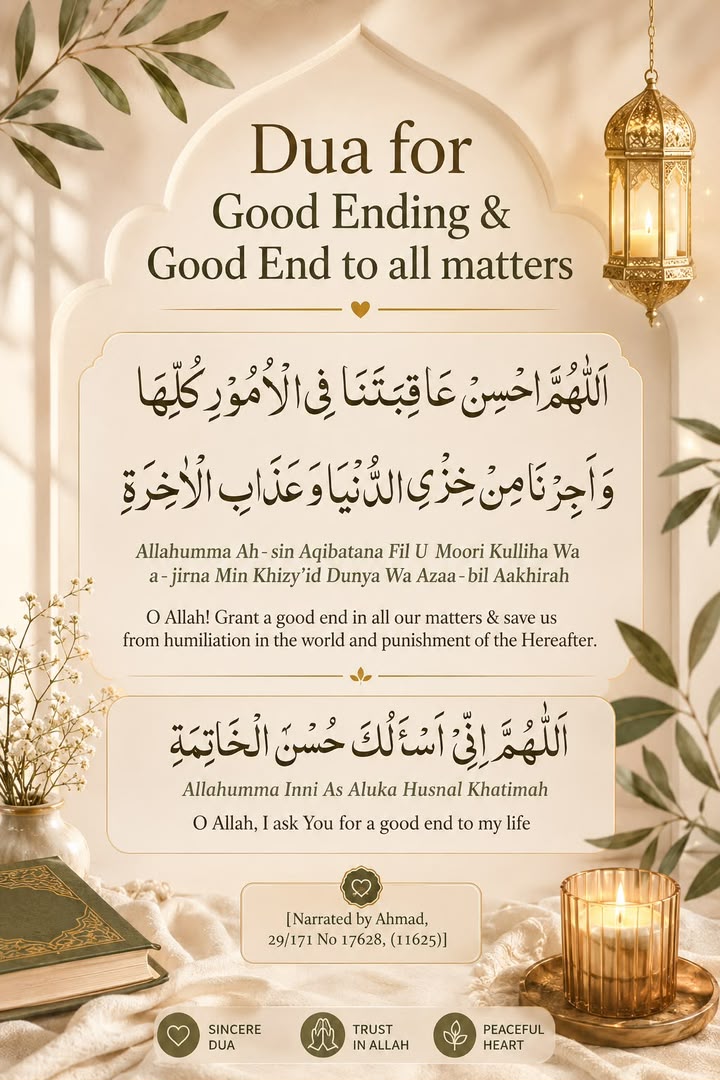
One of the greatest blessings a Muslim can ask Allah for is to have a good ending to their life. In Islam, this is known as Husnul Khatimah (حُسْنُ الْخَاتِمَةِ).
Every human being will eventually die. It does not matter how wealthy, successful, beautiful, famous, or powerful someone becomes. Death is a reality that nobody can escape.
But beyond how we live our lives, there is something even more important to think about: How will we leave this world?
Will our final moments be spent remembering Allah? Will we die with faith in our hearts? Will our final words be words of Tawheed? Will Allah be pleased with the way we lived?
These are important questions every Muslim should reflect upon.
Having a good ending does not mean living a life without mistakes or sins. It means being blessed with a faithful conclusion to your life, dying upon Islam, and having Allah’s mercy and forgiveness.
Let’s understand what Husnul Khatimah means, its signs, and how we can prepare ourselves for it.
1. WHAT IS HUSNUL KHATIMAH?
Husnul Khatimah is an Arabic expression that means a good ending or a beautiful conclusion.
In Islamic understanding, it refers to a person dying upon faith in Allah, holding firmly to Islam, and being in a state that pleases Allah.
It is the opposite of Su’ul Khatimah, which means a bad ending.
A person with Husnul Khatimah is someone whose final moments are blessed with faith and whose life concludes upon righteousness.
This does not necessarily mean that the person was perfect throughout their lifetime.
They may have made mistakes, struggled with sins, experienced difficulties, or gone through periods of spiritual weakness.
However, they continued returning to Allah, seeking forgiveness, and trying to live according to His guidance.
What matters is that they are granted the blessing of remaining upon faith until death.
Allah says in the Qur’an:
“O you who believe! Be mindful of Allah in the way He deserves, and do not die except in a state of full submission to Him.”
(Qur’an 3:102)
This verse reminds Muslims that our faith should not be something we practise only when life is comfortable. We should strive to remain devoted to Allah throughout our lives.
2. WHY IS HAVING A GOOD ENDING SO IMPORTANT IN ISLAM?
Many people spend their lives worrying about their appearance, careers, businesses, marriages, finances, and achievements.
While these things may be important in our worldly lives, none of them can guarantee success in the Hereafter.
A person may be wealthy today and gone tomorrow. Someone may be famous during their lifetime but forgotten after death.
However, the condition in which a person meets Allah has consequences that extend beyond this temporary world.
The Prophet Muhammad (peace and blessings be upon him) said:
“Verily, deeds are judged by their endings.”
(Sahih al-Bukhari 6607)
This hadith teaches us an important lesson: the conclusion of our lives matters greatly.
It is not enough to begin practising Islam enthusiastically. We should continuously ask Allah to keep us steadfast until our final breath.
Someone who has made mistakes can still repent and finish their life upon righteousness.
Likewise, someone who appears religious should never become arrogant or feel guaranteed a good ending.
We should live between hope in Allah’s mercy and fear of falling into wrongdoing.
3. WHAT ARE THE SIGNS OF HUSNUL KHATIMAH?
Islamic teachings mention certain signs that give hope of a good ending.
However, it is important to understand that these signs are not a guarantee that we can use to judge someone’s final destination. Allah alone knows the true condition of every soul.
Here are some signs mentioned in authentic Islamic teachings.
1. Dying while believing in Allah
The greatest foundation of a good ending is dying upon Tawheed: believing in the oneness of Allah and associating no partners with Him.
A Muslim should continuously strengthen their belief, avoid Shirk, and seek Allah’s forgiveness.
Our greatest hope is to meet Allah with sincere faith.
2. Having the Shahadah as your final words
One of the beautiful signs of Husnul Khatimah is having La ilaha illallah as one’s final words.
The Prophet Muhammad (peace and blessings be upon him) said:
“Whoever’s last words are La ilaha illallah will enter Paradise.”
(Sunan Abi Dawud 3116)
This hadith highlights the importance of Tawheed and remembering Allah.
However, we should not assume that simply repeating these words without sincere faith guarantees salvation. Their meaning and the belief behind them are essential.
3. Dying while performing a righteous deed
Imagine someone performing Salah, fasting, giving charity, reciting the Qur’an, or helping another person when death comes.
Dying while engaged in an act of obedience is among the hopeful signs of a good ending.
It reminds us why we should make righteousness part of our everyday lives.
We never know when our final moment will arrive.
4. Dying on a Friday or Thursday night
There is a narration in which the Prophet Muhammad (peace and blessings be upon him) said that a Muslim who dies on Friday or its night will be protected from the trial of the grave.
(Jami’ at-Tirmidhi 1074)
Scholars have discussed the authenticity and interpretation of this narration. It is mentioned among the hopeful signs, but dying on Friday alone should not be treated as an automatic guarantee of Paradise.
A good ending is fundamentally about faith and Allah’s mercy.
5. Dying as a martyr
Martyrdom is among the great honours in Islam.
The Prophet Muhammad (peace and blessings be upon him) mentioned several categories of people who receive the reward of martyrdom, including those who die from certain illnesses and circumstances.
(Sahih al-Bukhari 2829; Sahih Muslim 1914)
This teaches us that Allah’s mercy and reward extend beyond what people may recognise as outwardly heroic acts.
6. Having a heart attached to Allah
A person who regularly remembers Allah, repents, performs Salah, and tries to obey Him is building a life of faith.
Such habits are valuable because they help a Muslim remain connected to Allah.
However, we should remember that outward religious behaviour alone does not allow us to declare with certainty that someone will have a good ending.
We ask Allah to accept our deeds and grant us steadfastness.
4. WHAT IS SU’UL KHATIMAH (A BAD ENDING)?
Su’ul Khatimah refers to a bad ending, particularly dying in a state of disbelief or with a spiritual condition that displeases Allah.
It is a frightening subject, but Muslims should learn about it to understand the importance of protecting their faith.
A person should be concerned about:
- Persistently neglecting the obligations of Islam.
- Becoming comfortable with sins without seeking repentance.
- Allowing worldly desires to overpower their commitment to Allah.
- Becoming arrogant and believing they no longer need Allah’s guidance.
- Neglecting the Hereafter and living as though death will never come.
These behaviours are spiritual dangers, but we should not use them to declare that a particular person will die upon a bad ending.
People can repent, change, and become better Muslims.
Someone who has lived a sinful life may sincerely return to Allah, while someone who appears righteous must never become complacent.
That is why we should constantly ask Allah for a good ending.
5. CAN SOMEONE WHO HAS COMMITTED MANY SINS STILL HAVE HUSNUL KHATIMAH?
Absolutely.
This is one of the most beautiful aspects of Islam.
Perhaps you have made mistakes that you deeply regret. Maybe you abandoned Salah for years, struggled with certain sins, hurt people, or spent a long time away from practising Islam.
You may even feel that you are not worthy of asking Allah for a good ending.
But never allow your past to make you despair of His mercy.
Allah says:
“Indeed, Allah loves those who are constantly repentant and loves those who purify themselves.”
(Qur’an 2:222)
This verse reminds us that repentance is something beloved to Allah.
The important thing is to recognise your mistakes, sincerely repent, and make a genuine effort to change.
Do not assume that because you have sinned, you are destined for a bad ending.
You do not know what Allah has written for your future.
Instead, make your present life an opportunity to return to Him.
A person who sincerely repents may become better than someone who has become proud of their own religious achievements.
6. HOW CAN YOU PREPARE YOURSELF FOR HUSNUL KHATIMAH?
Having a good ending is not something we should only think about when we become old or seriously ill.
We should prepare for it throughout our lives.
Here are important ways to work towards a good ending.
1. Guard your five daily Salah
Salah is one of the most important obligations in Islam.
If you want to meet Allah with faith, make your prayers a priority.
Do not deliberately abandon Fajr because you are tired. Do not postpone Dhuhr unnecessarily because of work. Do not neglect your other prayers because you are distracted by worldly activities.
Build a consistent relationship with Salah.
2. Make sincere Tawbah every day
Nobody is free from mistakes.
Even when you try your best, you may fall short in your words, actions, or responsibilities.
Make it a habit to seek Allah’s forgiveness.
Say:
Astaghfirullah wa atubu ilayh.
This means: I seek Allah’s forgiveness and repent to Him.
Do not wait until Ramadan or until you experience a difficult situation before remembering repentance.
3. Keep your tongue busy with Dhikr
Remembering Allah throughout the day helps strengthen your connection with Him.
Make time for:
- SubhanAllah.
- Alhamdulillah.
- Allahu Akbar.
- La ilaha illallah.
- Astaghfirullah.
- Sending Salawat upon Prophet Muhammad (peace and blessings be upon him).
You can remember Allah while walking, travelling, cooking, resting, or going about your daily activities.
4. Read and understand the Qur’an
The Qur’an is guidance for humanity.
Do not limit your relationship with it to Ramadan alone.
Read a few verses daily, learn their meanings, reflect on their lessons, and try to apply them in your life.
Even a small amount of consistent Qur’an reading can help strengthen your faith.
5. Avoid becoming comfortable with sin
Everyone makes mistakes, but there is a difference between struggling with a sin and becoming comfortable with it.
When you fall into wrongdoing, acknowledge it and repent.
Do not defend what Allah has prohibited or allow repeated disobedience to harden your heart.
Keep working towards becoming a better Muslim.
6. Treat people well
Islam is not only about personal acts of worship.
Your relationship with other people matters too.
Avoid backbiting, dishonesty, oppression, arrogance, and deliberately hurting others.
Respect your parents, fulfil your responsibilities, forgive when you can, and return people’s rights.
A Muslim should strive to have both a sound relationship with Allah and good character towards His creation.
7. Keep good company
The people around you can influence your habits, behaviour, and faith.
Spend time with people who remind you of Allah, encourage you to pray, and inspire you to become a better person.
Choose companions who help you remember the Hereafter rather than constantly pulling you towards wrongdoing.
8. Ask Allah for steadfastness
One of the most important things you can do is ask Allah to keep your heart firm upon Islam.
The Prophet Muhammad (peace and blessings be upon him) frequently made this supplication:
Ya Muqallibal-qulub, thabbit qalbi ‘ala dinik.
Meaning:
“O Turner of the hearts, keep my heart firm upon Your religion.”
(Jami’ at-Tirmidhi 2140)
This beautiful Dua reminds us that remaining steadfast is a blessing we should continuously ask Allah for.
7. BEAUTIFUL DUAS TO ASK ALLAH FOR A GOOD ENDING
If you desire Husnul Khatimah, make Dua regularly.
Here are some beautiful supplications you can include in your daily worship.
Dua 1: Asking Allah to keep your heart firm
يَا مُقَلِّبَ الْقُلُوبِ ثَبِّتْ قَلْبِي عَلَى دِينِكَ
Ya Muqallibal-qulub, thabbit qalbi ‘ala dinik.
“O Turner of the hearts, keep my heart firm upon Your religion.”
Dua 2: Asking for a good ending
اللَّهُمَّ إِنِّي أَسْأَلُكَ حُسْنَ الْخَاتِمَةِ
Allahumma inni as’aluka husnal-khatimah.
“O Allah, I ask You for a good ending.”
This is a permissible personal supplication. It is not a specific prophetic narration.
Dua 3: Asking Allah for forgiveness and mercy
رَبَّنَا اغْفِرْ لَنَا ذُنُوبَنَا وَإِسْرَافَنَا فِي أَمْرِنَا وَثَبِّتْ أَقْدَامَنَا
Rabbana-ghfir lana dhunubana wa israfana fi amrina wa thabbit aqdamana.
“Our Lord, forgive us our sins and our excesses in our affairs, make our steps firm…”
(Qur’an 3:147)
Dua 4: Asking Allah for a good life and a good death
اللَّهُمَّ أَحْيِنِي مَا كَانَتِ الْحَيَاةُ خَيْرًا لِي، وَتَوَفَّنِي إِذَا كَانَتِ الْوَفَاةُ خَيْرًا لِي
Allahumma ahyini ma kanatil-hayatu khayran li, wa tawaffani idha kanatil-wafatu khayran li.
“O Allah, keep me alive as long as life is better for me, and cause me to die when death is better for me.”
(Sahih al-Bukhari 5671; Sahih Muslim 2680)
This is a prophetic supplication teaching us to entrust our affairs to Allah’s wisdom.
8. DOES A GOOD ENDING MEAN YOU WILL NOT EXPERIENCE PAIN BEFORE DEATH?
No.
Having Husnul Khatimah does not necessarily mean that someone will die peacefully in their sleep or without experiencing illness, pain, or difficulty.
Some righteous people experience severe illnesses and difficult final moments.
Others may die suddenly.
The circumstances surrounding death are not, by themselves, proof of whether someone had a good or bad ending.
A person’s final state of faith and their relationship with Allah are what matter.
Therefore, never assume that someone who dies after a long illness had a bad ending or that someone who dies peacefully must automatically have had a good one.
We should leave the unseen matters to Allah and ask Him to grant every Muslim a beautiful ending.
9. WHAT SHOULD YOU DO WHEN SOMEONE DIES?
When a Muslim passes away, we should remember that death is a reminder for those who remain alive.
Instead of spreading rumours about the person’s final condition, we should make Dua for them.
The Prophet Muhammad (peace and blessings be upon him) taught that when a person dies, their deeds come to an end except for three: ongoing charity, beneficial knowledge, and a righteous child who prays for them.
(Sahih Muslim 1631)
This hadith reminds us to invest in deeds that continue benefiting us even after death.
When someone dies, we should:
- Make Dua for their forgiveness and mercy.
- Participate in their Janazah prayer if possible.
- Support their family.
- Settle their outstanding debts and obligations where appropriate.
- Remember our own mortality and prepare for the Hereafter.
Rather than judging the deceased, ask Allah to forgive them and grant them Jannatul Firdaus.
10. DO NOT WAIT UNTIL OLD AGE TO SEEK A GOOD ENDING
One of the biggest mistakes people make is assuming that they have plenty of time to become better Muslims.
They say:
“I will start praying when I get older.”
“I will stop committing sins when I get married.”
“I will become more religious when I have settled down.”
“I will repent when I am ready.”
But the reality is that nobody knows when their time will come.
Death does not wait for someone to reach retirement age.
Young people die. Healthy people die. Wealthy people die. People with plans for tomorrow sometimes never get to see tomorrow.
This is why a Muslim should prepare for death while still living.
Do not postpone your relationship with Allah.
If you have neglected Salah, start praying.
If you have wronged someone, seek to make things right.
If you have committed sins, repent.
If you have abandoned the Qur’an, return to it.
You do not need to have a perfect past to start building a better future.
Every new day is another opportunity to seek Allah’s pleasure.
FINAL WORDS: MAY ALLAH GRANT US HUSNUL KHATIMAH
At the end of the day, one of the greatest things we should ask Allah for is not simply a long life, a successful career, a beautiful home, or worldly achievements.
We should ask Him for a life filled with faith and a death upon Islam.
Imagine leaving this world with your heart firm upon Tawheed, your tongue remembering Allah, and your hope resting in His mercy.
That is a blessing worth praying for.
Do not become arrogant because you are currently practising Islam. Do not despair because you have made mistakes.
Keep repenting. Keep praying. Keep remembering Allah. Keep doing good deeds, even when nobody is watching.
And above everything else, never stop asking Allah to keep you steadfast until your final breath.
May Allah grant us all Husnul Khatimah, forgive our sins, protect us from Su’ul Khatimah, make our final words La ilaha illallah, illuminate our graves, and grant us the highest level of Jannatul Firdaus.
Ameen Ya Rabbal Alameen.
FREQUENTLY ASKED QUESTIONS (FAQs)
1. What does Husnul Khatimah mean in Islam?
Husnul Khatimah means having a good ending. It refers to dying upon sincere faith in Allah and Islam, with Allah’s mercy and forgiveness.
2. What is the opposite of Husnul Khatimah?
The opposite is Su’ul Khatimah, which means a bad ending, particularly dying in a state of disbelief or upon a condition that displeases Allah.
3. How do I know if I will have a good ending?
Nobody can know with certainty how their life will end. However, you can work towards a good ending by maintaining Salah, repenting, avoiding sins, doing righteous deeds, and asking Allah for steadfastness.
4. Can a sinful person have Husnul Khatimah?
Yes. A person who has committed many sins can sincerely repent, change their ways, and die upon faith. Never despair of Allah’s mercy.
5. Is dying on Friday a sign of Husnul Khatimah?
There is a narration in Jami’ at-Tirmidhi mentioning protection from the trial of the grave for a Muslim who dies on Friday or its night. However, it should not be treated as an automatic guarantee of Paradise.
6. What Dua should I make for a good ending?
You can say: “Allahumma inni as’aluka husnal-khatimah” (O Allah, I ask You for a good ending). You should also regularly recite: “Ya Muqallibal-qulub, thabbit qalbi ‘ala dinik.”
7. Can someone who does not pray still have a good ending?
Deliberately abandoning Salah is an extremely serious matter in Islam. Its implications are discussed among Islamic scholars. Such a person should sincerely repent, return to prayer immediately, and seek guidance rather than assume they are beyond Allah’s mercy.
8. Why should Muslims constantly ask for Husnul Khatimah?
Because nobody knows when or how they will die. Asking Allah for a good ending is an expression of humility, faith, and dependence on His mercy.
9. Can I have Husnul Khatimah even if I am not perfect?
Yes. Islam does not require you to be sinless. It encourages sincere repentance, obedience, and continuous efforts to improve. What matters is that you keep returning to Allah and ask Him to grant you steadfastness until death.
