

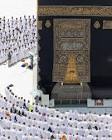
No matter where you are in the world, Muslims perform their prayers facing one direction. Whether they are in Nigeria, Indonesia, Canada, South Africa or Australia, they all turn towards the Ka’bah in Makkah.
This direction is known as the Qiblah, and it is one of the most visible signs of Muslim unity. But why do Muslims pray towards the Ka’bah? Is it because they worship the building?
The answer is no.
DO MUSLIMS WORSHIP THE KA’BAH?
This is one of the most common misconceptions about Islam.
Muslims do not worship the Ka’bah.
They worship Allah alone.
The Ka’bah is simply the direction that Allah commanded Muslims to face during Salah. Just as people face a particular direction during certain ceremonies or events, Muslims face the Ka’bah because it is Allah’s command, not because the building itself has divine power.
DID MUSLIMS ALWAYS FACE THE KA’BAH?
Interestingly, no.
During the early years of Islam in Madinah, Muslims prayed facing Jerusalem (Bayt al-Maqdis).
This continued for about sixteen or seventeen months after the Prophet Muhammad ﷺ migrated from Makkah to Madinah.
The Prophet ﷺ hoped that Allah would direct the Muslims to face the Ka’bah, the House originally built by Prophet Ibrahim (AS) and Prophet Isma’il (AS) for the worship of Allah.
Allah later revealed verses in the Qur’an commanding the Prophet ﷺ and the Muslims to turn towards the Sacred Mosque in Makkah.
From that day onwards, the Ka’bah became the permanent Qiblah for Muslims everywhere.
WHY WAS THE QIBLAH CHANGED?
The change of the Qiblah carried several important purposes.
It distinguished the Muslim community with its own direction of worship.
It also reaffirmed the connection between Islam and Prophet Ibrahim (AS), who built the Ka’bah as a place dedicated to the worship of one God.
The Qur’an makes it clear that this change was a command from Allah and a test of obedience for the believers.
HOW DO MUSLIMS KNOW WHICH DIRECTION TO FACE?
Today, finding the Qiblah is easier than ever.
Mosques are built with a Mihrab, a niche in the wall that indicates the direction of Makkah.
Many Muslims also use smartphone applications, compasses or maps to determine the Qiblah when travelling.
If someone genuinely does not know the direction and makes their best effort, Islam does not burden them with what is beyond their ability.
WHAT HAPPENS IF SOMEONE CANNOT FACE THE QIBLAH?
There are situations where facing the Qiblah is not possible.
For example, a person may be seriously ill, unable to move, or travelling under circumstances where changing direction is impossible.
In such cases, Islam provides flexibility.
Allah does not place hardship upon believers, and they pray according to their ability.
A SYMBOL OF UNITY
Perhaps the most beautiful aspect of the Qiblah is what it represents.
Every day, more than a billion Muslims pray in different countries, speak different languages and belong to different cultures.
Yet, at the time of Salah, they all face the same direction.
This simple act symbolises the unity of the Muslim Ummah.
Rich and poor, young and old, leaders and ordinary people all stand shoulder to shoulder, turning towards one Qiblah and worshipping one Lord.
A LESSON BEYOND DIRECTION
Facing the Ka’bah is not about the building itself.
It is about obedience to Allah.
The Qiblah reminds Muslims that unity is achieved when believers follow the guidance of their Creator.
Every prayer, wherever it is offered in the world, is connected by a single direction. It is a daily reminder that despite our differences in nationality, language and culture, Muslims remain one Ummah, united in worshipping Allah alone.
