


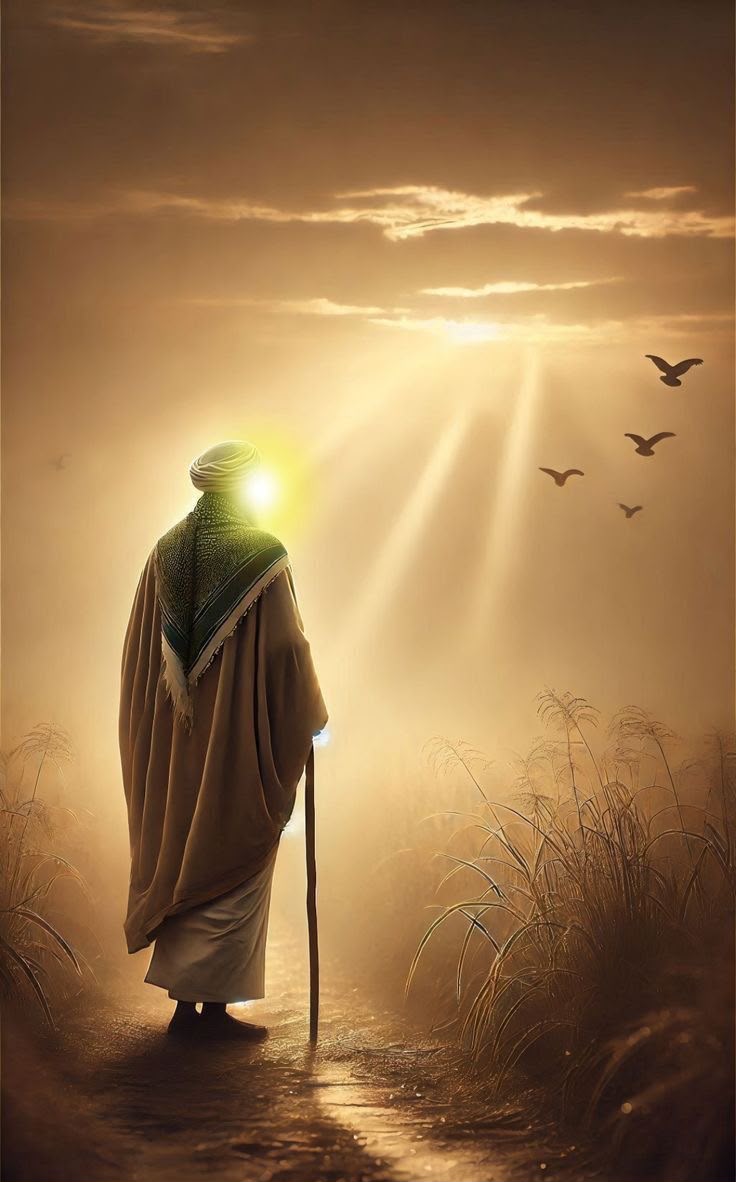
He travelled across lands, left behind his family, endured slavery and suffered years of uncertainty. He searched through different religious communities, determined to find the truth about his Creator. His journey eventually led him to Prophet Muhammad (peace and blessings be upon him), where he discovered the faith he had spent much of his life searching for. This is the extraordinary story of Salman Al-Farisi (may Allah be pleased with him).
Imagine being born into a wealthy and respected family, having everything you need and living a comfortable life, yet feeling that something is missing.
You have been raised with a particular religious tradition. Your family expects you to follow it, and your community believes that its way of life is the correct one.
But one day, you encounter something that makes you question everything you have been taught.
Instead of ignoring your questions, you decide to search for the truth.
You leave behind your familiar surroundings, travel to unfamiliar lands and seek guidance from people who may know more than you.
You experience betrayal, hardship, loneliness and even slavery.
Yet, despite everything, you refuse to abandon your search.
This was the extraordinary journey of Salman Al-Farisi, one of the beloved companions of Prophet Muhammad (peace and blessings be upon him).
His story is not simply about travelling from one country to another. It is about a heart that refused to settle for what it did not believe was the truth.
It teaches us that the journey towards guidance can sometimes be long, difficult and unexpected, but Allah can open doors for those who sincerely seek Him.
So, who was Salman Al-Farisi? Why did he leave his home? What did he discover during his journey? And how did he eventually become one of the most respected companions of the Prophet?
Let’s explore his remarkable story.
1. BORN INTO A WEALTHY FAMILY IN PERSIA
Salman Al-Farisi was originally from Persia, in the region of present-day Iran.
His birth name is commonly reported in historical accounts as Ruzbeh.
He grew up in a Zoroastrian family and, according to his own account recorded in the Hadith literature, his father held an important position and cared deeply about him.
His father was so protective that he kept Salman close to home and gave him responsibilities connected to their religious traditions.
Salman described his father as being so devoted to their religious practices that he was concerned about losing his son.
At this stage of his life, Salman enjoyed a comfortable existence.
He had a family, a home and a place within his community.
However, his life was about to change after an unexpected encounter.
2. THE ENCOUNTER THAT CHANGED EVERYTHING
One day, Salman was sent out by his father to attend to an errand.
During his journey, he came across a Christian place of worship.
He heard the people praying and was deeply interested in what he witnessed.
Something about their worship caught his attention.
He entered and observed their religious practices.
Salman later explained that he was impressed by what he saw and felt that there was something meaningful in their way of worship.
He asked about the origins of their religion and was told that its roots were in the region of Syria.
This encounter awakened a desire within him.
He began questioning the religious tradition in which he had been raised.
When he returned home, he told his father about what he had discovered.
His father was deeply unhappy and became worried that Salman would abandon their religion.
But Salman had already begun a journey that would take him far beyond the boundaries of his hometown.
His experience teaches us an important lesson.
Sometimes, a single encounter can open our minds to questions we had never considered before.
The important thing is to approach those questions sincerely and seek answers through knowledge and reflection.
3. HE LEFT HIS HOME IN SEARCH OF THE TRUTH
Salman’s interest in Christianity continued to grow.
Eventually, he asked about travelling to Syria so that he could learn more.
His father strongly opposed the idea.
According to Salman’s narration, his father restricted him and attempted to prevent him from leaving.
However, Salman remained determined.
He eventually managed to escape and joined a group of travellers heading towards Syria.
Think about the courage this required.
He was leaving behind his family, familiar surroundings and comfortable lifestyle.
He did not know exactly what awaited him.
He only knew that he wanted to understand the truth.
When he arrived in Syria, he asked about the most knowledgeable religious person among the Christians.
He was directed to a bishop at a church.
Salman approached the bishop and expressed his desire to learn and worship alongside him.
However, the man he initially trusted turned out to be corrupt.
Rather than using the wealth given to him for charity, the bishop collected money from people and kept it for himself.
Salman later discovered what had been happening.
This was a painful disappointment.
He had travelled so far in search of spiritual guidance, only to discover that someone in a position of religious authority was abusing people’s trust.
But he did not allow this experience to destroy his search.
Instead, he continued looking for someone whose character reflected the values he was seeking.
4. THE SEARCH CONTINUED: LEARNING FROM RIGHTEOUS PEOPLE
After the death of the bishop, Salman learned about another religious leader who was respected for his righteousness and devotion.
He approached him and expressed his desire to remain with him.
This time, Salman found someone whose conduct was different.
He described this man as being devoted to worship, charity and righteous living.
Salman stayed with him and learned from him until the man’s death approached.
Before passing away, Salman asked him where he should go next.
The answer would change the direction of his journey once again.
The righteous man explained that he did not know anyone who followed the same path with the same commitment.
However, he told Salman that the time of a new Prophet was approaching.
He described signs associated with this Prophet and explained that he would appear in the land of the Arabs.
He would migrate to a place situated between two rocky areas, with date palms growing there.
The man also described characteristics that Salman should look for:
- The Prophet would accept gifts but would not consume charity.
- The seal of Prophethood would be between his shoulders.
These details became incredibly important.
Salman had spent years searching for guidance, and now he had received information that could help him recognise the Messenger when he appeared.
He was encouraged to travel towards Arabia if he could.
5. BETRAYED AND SOLD INTO SLAVERY
Salman was determined to continue his journey.
He eventually found a group of Arab travellers who agreed to take him towards the Arabian Peninsula.
However, during the journey, they betrayed him.
Instead of helping him reach his destination, they sold him into slavery.
He was purchased by a man connected to the Jewish community and eventually ended up in Yathrib, the city later known as Madinah.
Imagine what Salman must have experienced.
He had left his home in search of spiritual guidance.
He had travelled across different regions, learned from religious teachers and endured numerous difficulties.
Now, he had lost his freedom.
His situation was extremely painful, but he had unknowingly arrived in the very city where the Prophet Muhammad (peace and blessings be upon him) would eventually settle.
What appeared to be another devastating setback became part of the extraordinary journey through which Allah would guide him.
Salman continued waiting for the signs he had been told about.
He did not know exactly when the Prophet would arrive, but he had not forgotten what he had learned.
6. THE ARRIVAL OF PROPHET MUHAMMAD IN MADINAH
When Prophet Muhammad (peace and blessings be upon him) migrated from Makkah to Madinah, Salman began hearing news about his arrival.
The moment he had spent years anticipating was approaching.
He wanted to know whether this man was truly the Messenger described by the righteous teacher in Syria.
Salman carefully observed what was happening.
He approached the Prophet with food that he presented as charity.
The Prophet accepted it and instructed his companions to eat, but he did not eat from it himself.
Salman noticed this.
Later, Salman returned with another offering, this time presenting it as a gift.
The Prophet ate from it.
This was the second sign.
Salman now had one final sign to confirm.
He needed to see the seal of Prophethood between the Prophet’s shoulders.
He approached him and observed the mark.
When he recognised it, he was overcome with emotion.
The signs he had spent years searching for had finally come together.
He leaned towards the Prophet, kissed him and wept.
After years of travelling, hardship and uncertainty, Salman had finally found the Messenger of Allah.
His journey had reached its destination.
7. THE MOMENT HE FINALLY ACCEPTED ISLAM
Salman explained his long journey to the Prophet and the companions.
He told them about his childhood in Persia, his encounters with Christian worshippers, the religious teachers he had followed, the betrayal he experienced and the circumstances that led him to Madinah.
The Prophet listened to his story.
Salman then embraced Islam.
Consider what this moment represented.
He had spent years searching for religious truth.
He had sacrificed his family connections, lost his freedom and endured countless difficulties.
Yet, when he finally encountered the Messenger of Allah, he recognised what he had been searching for.
His conversion reminds us that guidance is one of the greatest blessings a person can receive.
Allah says:
“And whoever believes in Allah – He will guide his heart.”
(Qur’an 64:11)
Salman’s journey is a beautiful example of the importance of sincere seeking and the blessing of guidance.
8. THE PROPHET HELPED HIM GAIN HIS FREEDOM
Although Salman had embraced Islam, he was still enslaved.
His journey was not yet complete.
The Prophet Muhammad (peace and blessings be upon him) encouraged his companions to help Salman secure his freedom.
Salman entered into a contract with his enslaver to purchase his freedom.
The agreement involved planting a specified number of date palms and paying a quantity of gold.
The companions helped him obtain the necessary resources.
The Prophet himself participated in planting the date palms.
According to the narration, the Prophet planted the palms, and they all took root except one, which was later replanted by the Prophet.
Salman eventually fulfilled the financial obligation and gained his freedom.
This episode demonstrates the compassion and brotherhood that existed within the early Muslim community.
Salman had arrived in Madinah as an enslaved man from Persia.
But Islam gave him a community in which his dignity, faith and contribution mattered.
His story also reminds us that Islam places great importance on freeing people from slavery and treating human beings with dignity.
9. SALMAN’S CONTRIBUTION AT THE BATTLE OF THE TRENCH
One of the most famous contributions Salman Al-Farisi made to Islamic history came during the Battle of the Trench, also known as the Battle of Al-Khandaq.
By this time, the Muslim community in Madinah faced a serious threat.
A large coalition of opposing forces was preparing to attack the city.
The Muslims needed a strategy to protect Madinah.
Salman suggested an approach that was familiar in Persian military practice: digging a trench around the vulnerable areas of the city.
This was not a common defensive strategy among the Arabs at the time.
The Prophet accepted Salman’s suggestion.
The Muslims worked together to dig the trench.
The work was physically demanding, and the community faced hunger, exhaustion and fear.
But they continued working together.
Salman’s suggestion became an important part of the Muslim defence.
This episode demonstrates that Islam values beneficial knowledge and wisdom, regardless of where a person comes from.
Salman was Persian, but his background did not make him an outsider whose ideas should be ignored.
His experience became an asset to the Muslim community.
It also teaches us that good ideas should be recognised on their merits rather than rejected because they come from someone of a different nationality or culture.
10. THE PROPHET’S LOVE AND RESPECT FOR SALMAN
Salman Al-Farisi became deeply respected among the companions.
His background was different from that of many of the early Muslims, but Islam brought them together through faith.
One famous report associated with the early Muslim community describes the Prophet declaring:
“Salman is one of us, the people of the household.”
This report is widely cited in accounts of Salman’s status, although scholars have discussed the strength and transmission of its various narrations.
Regardless, Salman’s position among the companions is firmly established through his authentic narrations and his important contributions to the Muslim community.
He was respected for his knowledge, wisdom, humility and devotion.
His story reminds us that Islam does not measure people by their ethnicity, nationality or family background.
Allah says:
“Indeed, the most noble of you in the sight of Allah is the most righteous of you.”
(Qur’an 49:13)
Salman came from Persia, yet he became one of the most respected companions of the Prophet.
His life demonstrates that the Muslim Ummah is not defined by one race, tribe or nationality.
It is united by faith.
11. SALMAN’S HUMILITY DESPITE HIS GREAT STATUS
Despite everything he had experienced and the respect he received, Salman remained known for his humility.
He had experienced wealth, hardship, slavery and eventually freedom.
He had travelled across different lands and played an important role in the development of the Muslim community.
Yet, he did not allow his achievements to make him arrogant.
His life reminds us that knowledge should increase humility rather than pride.
A person who has learned more should become more aware of how much there is still to learn.
A person who has experienced hardship should become more compassionate towards others.
And someone who has received blessings should remember the One who provided them.
Salman understood that his journey was not about personal recognition.
It was about finding and serving the truth.
12. WHAT SALMAN AL-FARISI’S STORY TEACHES MUSLIMS TODAY
Salman’s journey contains lessons that remain relevant to Muslims across generations.
1. Never stop seeking knowledge.
Salman travelled across different regions and learned from different teachers because he wanted to understand the truth.
We should never become satisfied with ignorance when opportunities to learn are available.
2. Do not follow people blindly.
Salman discovered that one of the religious leaders he trusted was corrupt.
His experience reminds us to evaluate people’s character and actions rather than accepting everything simply because someone holds a religious position.
3. Hardship does not mean Allah has abandoned you.
Salman experienced betrayal, slavery and separation from his family.
Yet his journey eventually led him to the Prophet.
We may not understand every difficulty we experience, but we should never lose hope in Allah.
4. Guidance is more valuable than worldly comfort.
Salman gave up a comfortable life because he wanted something greater.
His story reminds us that faith is worth more than temporary possessions.
5. Wisdom can come from different cultures and backgrounds.
His suggestion to dig the trench demonstrates the importance of recognising beneficial knowledge wherever it comes from.
6. Never look down on someone because of their nationality or background.
Salman was not Arab, but he became one of the respected companions.
Islam teaches that righteousness, not ethnicity, determines a person’s honour before Allah.
7. Remain humble regardless of your achievements.
Salman experienced extraordinary events, but his life is remembered for his faith and character rather than worldly status.
13. THE IMPORTANCE OF SEARCHING FOR TRUTH IN OUR OWN LIVES
Perhaps the most powerful lesson from Salman’s journey is that seeking the truth requires sincerity.
Today, many people are surrounded by information.
We have access to books, lectures, scholars, educational resources and countless discussions about religion.
Yet, having access to information does not automatically mean we possess knowledge.
Some people follow religious opinions without understanding their foundations.
Others allow social media personalities to influence their beliefs without checking whether what they hear is authentic.
Some become discouraged when they encounter disagreements or discover that someone they admired has behaved wrongly.
Salman’s journey teaches us to seek knowledge carefully.
Ask questions respectfully.
Learn from qualified and trustworthy scholars.
Read the Qur’an with reflection.
Study the authentic teachings of the Prophet.
Do not allow the mistakes of individuals to make you abandon the truth itself.
Most importantly, ask Allah to guide you.
The journey towards knowledge should bring us closer to humility, sincerity and obedience.
CONCLUSION: HE SEARCHED FOR YEARS, AND ALLAH GUIDED HIM TO THE TRUTH
Salman Al-Farisi’s story is one of the most remarkable journeys in Islamic history.
He began life in Persia, surrounded by family and comfort.
He encountered a different religious tradition and began questioning what he had always known.
He travelled to Syria, learned from religious teachers, experienced betrayal and eventually became enslaved.
He arrived in Madinah without knowing that the destination of his long search was waiting there.
When Prophet Muhammad (peace and blessings be upon him) arrived, Salman recognised the signs he had been told about.
He embraced Islam, gained his freedom and became one of the most respected companions.
He later contributed valuable knowledge to the Muslim community, including the strategy of digging the trench during the Battle of Al-Khandaq.
His story reminds us that the search for truth may not always be easy.
There may be disappointments, unexpected difficulties and moments when we feel lost.
But we should never stop asking Allah for guidance.
Sometimes, the path we take may be very different from the one we originally imagined.
What matters is that we continue seeking what is right and remain sincere in our intentions.
Salman Al-Farisi spent years searching for the truth. His story leaves us with a question: Are we making the same effort to understand our faith, or have we become comfortable simply following what we have always known?
May Allah guide our hearts, increase us in beneficial knowledge, protect us from falsehood and make us among those who recognise the truth and follow it.
May Allah be pleased with Salman Al-Farisi and all the companions of Prophet Muhammad (peace and blessings be upon him).
Ameen.
