


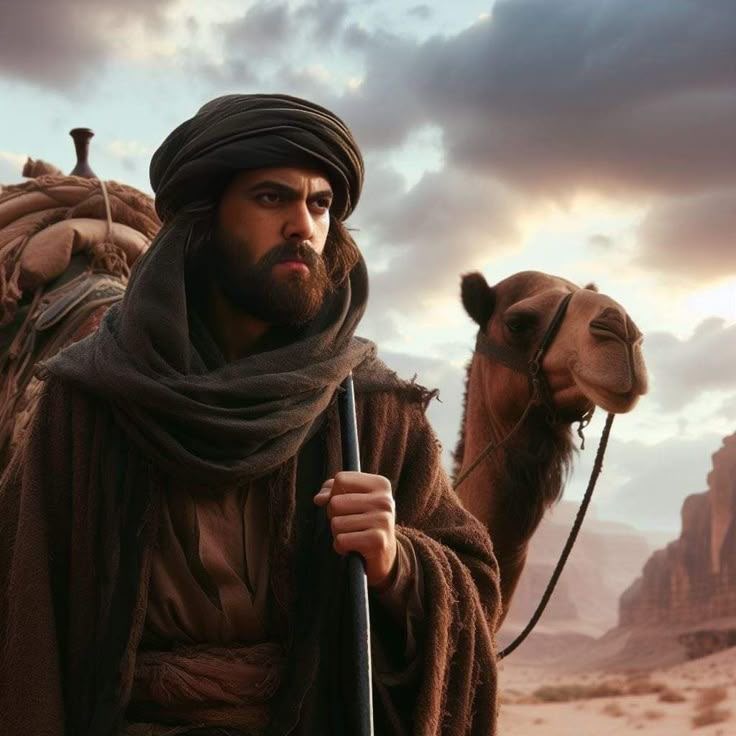
He was once among the most fashionable, wealthy and admired young men in Makkah. He wore the finest clothes, enjoyed luxury and lived a life many people envied. But when Islam entered his heart, he gave up everything he had for the sake of Allah. This is the remarkable story of Mus’ab ibn Umayr, the young companion who chose faith over fortune.
Imagine being young, wealthy and admired by everyone around you.
You have access to the finest clothes, the best perfumes and every comfort your society can offer. People recognise you wherever you go. Your family is wealthy, your future appears secure and you have very little reason to worry about your material needs.
Then, one day, you discover something that changes your entire life.
You hear the message of Islam. You learn about the oneness of Allah, the purpose of human existence and the message brought by Prophet Muhammad (peace and blessings be upon him).
Suddenly, everything you once considered important begins to look different.
You understand that wealth cannot replace faith, popularity cannot replace guidance and worldly comfort cannot compare to the pleasure of Allah.
But there is a price to pay.
Your family opposes your decision. Your privileges disappear. The people who once admired you begin to look at you differently.
Would you still choose Islam?
This was the extraordinary test faced by Mus’ab ibn Umayr (may Allah be pleased with him), one of the earliest companions of Prophet Muhammad (peace and blessings be upon him).
His story is not simply about a young man who became Muslim. It is about a young man who discovered his purpose, sacrificed his comfort and became one of the most important figures in the early history of Islam.
Let’s explore his remarkable journey.
1. THE YOUNG MAN EVERYONE ADMIRED
Before embracing Islam, Mus’ab ibn Umayr was known for his exceptional appearance, fashionable clothing and privileged lifestyle.
He belonged to a wealthy family in Makkah and enjoyed the comforts that came with his background.
Historical Islamic accounts describe him as a young man who paid great attention to his appearance and was particularly admired for his clothing and fragrance.
He was not someone who grew up struggling for basic necessities.
He had the opportunity to enjoy a comfortable life, and his family was able to provide him with many luxuries.
In a society where wealth and family status carried considerable influence, Mus’ab was among the young men who attracted attention.
But his story reminds us of something important.
A person can have everything the world offers and still be searching for something deeper.
Mus’ab’s life was about to change in a way that would redefine his understanding of happiness, success and purpose.
2. THE MESSAGE THAT CHANGED HIS LIFE
When Prophet Muhammad (peace and blessings be upon him) began calling people to Islam, his message challenged the religious and social traditions of Makkah.
He called people to worship Allah alone, abandon idolatry, practise righteousness and prepare for accountability in the Hereafter.
As news of this message spread, some people responded with hostility, while others recognised its truth.
Mus’ab became interested in the message of Islam.
He eventually went to meet the Prophet (peace and blessings be upon him) and accepted Islam.
His conversion was a turning point.
The young man who had once enjoyed the privileges of Makkah’s wealthy society now belonged to a small community of believers facing opposition and persecution.
But he had found something he considered more valuable than everything he had previously possessed: faith in Allah.
Imagine the courage required to make such a decision when you know that your family and society may not accept it.
Mus’ab understood that becoming Muslim would change his life, but he remained committed to the truth.
3. WHEN HIS FAMILY BECAME HIS GREATEST CHALLENGE
One of the most painful aspects of Mus’ab’s story was the opposition he experienced from his family.
His mother, Khunas bint Malik, was a woman of strong personality and influence.
When she discovered that her son had embraced Islam, she was deeply unhappy with his decision.
Historical accounts describe how Mus’ab faced restrictions and confinement because of his new faith.
The comfortable life he once enjoyed was taken away from him.
He could no longer live as freely as before.
His family did not welcome his decision, and the young man who had once enjoyed their material support now faced a difficult choice.
Should he abandon Islam to regain his former privileges?
Or should he remain faithful, even if it meant losing everything?
Mus’ab chose Islam.
This is one of the most important lessons from his life.
Faith is not always tested by strangers. Sometimes, the greatest tests come through people we love.
However, his story should not be understood as permission to mistreat our parents or abandon good family conduct.
Islam commands Muslims to treat their parents with kindness, even when they disagree with their beliefs.
Allah says:
“But if they endeavour to make you associate with Me that of which you have no knowledge, do not obey them, but accompany them in this world with appropriate kindness.”
(Qur’an 31:15)
Mus’ab’s example teaches us that remaining committed to Allah and treating our families respectfully are responsibilities that should go together.
4. HE LOST HIS COMFORT, BUT HE NEVER LOST HIS FAITH
As Mus’ab became more committed to Islam, his material circumstances changed dramatically.
The young man who had once enjoyed expensive clothing and luxury now experienced hardship.
He no longer had access to the privileges that had previously defined his lifestyle.
Some historical reports describe the visible changes in his appearance as he experienced poverty and the difficulties faced by early Muslims.
Think about the contrast.
He had once been admired because of what he wore and the lifestyle he enjoyed.
Now, his greatness came from what he believed and what he was willing to sacrifice.
His story challenges the way many people measure success today.
We often judge people by their appearance, income, possessions and social position.
But Mus’ab’s life teaches us that these things are not the ultimate measures of a person’s worth.
A person may lose wealth but gain something far greater.
A person may lose popularity but become beloved through their righteousness.
A person may experience hardship while remaining rich in faith.
Mus’ab’s life reminds us that the value of a believer is not determined by the price of their clothes or the size of their bank account.
5. THE PROPHET GAVE HIM A SPECIAL RESPONSIBILITY
One of the most remarkable chapters of Mus’ab’s life began when Prophet Muhammad (peace and blessings be upon him) entrusted him with an important mission.
The Prophet needed someone to travel to Yathrib, later known as Madinah, to teach the people about Islam and prepare the community for the arrival of the Muslims.
Mus’ab was selected for this responsibility.
This was a significant appointment.
He was still a relatively young man, but the Prophet recognised his ability, character and dedication.
Mus’ab travelled to Yathrib and became one of the earliest Muslim teachers and callers to Islam in the city.
He worked alongside the believers there, teaching the Qur’an and explaining the message of the Prophet.
His mission would become a turning point in Islamic history.
Before the Hijrah, Madinah was not yet the centre of the Muslim community. Mus’ab’s work helped prepare the ground for the establishment of the first Muslim society there.
Imagine being entrusted with such an important responsibility while still young.
Mus’ab did not allow his age to become an excuse for inactivity.
He used his abilities in the service of Islam.
6. THE POWER OF HIS DA’WAH: HOW HE HELPED SPREAD ISLAM IN MADINAH
Mus’ab’s success in Madinah was not based on force, wealth or political authority.
He taught through knowledge, patience, wisdom and good character.
One of the most famous accounts of his Da’wah involves two influential men from the Aws tribe: Usayd ibn Hudayr and Sa’d ibn Mu’adh.
When Mus’ab began teaching Islam in Madinah, Usayd approached him with hostility after hearing that he was calling people to a new religion.
However, Mus’ab responded calmly.
Rather than arguing aggressively, he invited Usayd to sit and listen.
He explained that if Usayd liked what he heard, he could accept it, and if he did not, Mus’ab would stop speaking.
Usayd listened to the message of Islam and was moved by it.
He eventually embraced Islam.
He then went to Sa’d ibn Mu’adh and explained what had happened.
Sa’d also approached Mus’ab, initially with strong objections. But after listening to the message, he too accepted Islam.
These conversions had a tremendous impact because both men held important positions within their community.
Their acceptance of Islam helped open the door for many others to learn about the faith.
This account, preserved in the early Islamic historical tradition, demonstrates an important principle of Da’wah.
Mus’ab understood that guidance comes from Allah, and his responsibility was to communicate the message with wisdom and good character.
Allah says:
“Invite to the way of your Lord with wisdom and good instruction, and argue with them in a way that is best.”
(Qur’an 16:125)
This verse offers an important lesson for Muslims today.
We do not need to insult people, humiliate them or force them to accept our views.
We should communicate the truth with knowledge, patience, wisdom and compassion.
7. MUS’AB HELPED PREPARE MADINAH FOR THE HIJRAH
Mus’ab’s work in Madinah was far more significant than simply teaching a few individuals.
His efforts helped establish a growing Muslim community before the Prophet’s migration from Makkah.
Through his Da’wah, more people became familiar with Islam and accepted the message.
The city gradually became a place where Muslims could find support and establish a community based on faith.
This was important because the early Muslims in Makkah were experiencing severe persecution.
The Hijrah to Madinah would provide them with a new opportunity to practise Islam and build a society founded upon Islamic teachings.
Mus’ab’s mission was therefore an important part of the preparation for this historic migration.
His story teaches us that great contributions are not always made through public recognition.
Sometimes, the work someone does quietly before a major event becomes the foundation upon which future generations build.
Mus’ab was not the ruler of Madinah, nor was he a wealthy businessman or military commander.
He was a young Muslim teacher whose dedication helped change the future of an entire city.
8. THE BATTLE OF UHUD: THE DAY MUS’AB GAVE HIS LIFE
After the Muslims migrated to Madinah, the community faced several serious challenges.
One of the most significant was the Battle of Uhud.
Mus’ab ibn Umayr participated in the battle and carried the Muslim standard.
He was entrusted with an important responsibility because the Muslim banner represented the army’s unity and identity.
During the battle, the Muslim forces experienced a difficult situation after some archers left their assigned positions, allowing the opposing army to attack from another direction.
Amid the confusion and fighting, Mus’ab remained committed to his duty.
He defended the Muslim standard.
He was eventually killed during the battle.
Mus’ab ibn Umayr had once been one of the most fashionable young men in Makkah.
Now, he had given his life in the service of the faith he had chosen.
His death was a tremendous loss to the Muslim community.
But perhaps one of the most moving parts of his story is what happened when his body was prepared for burial.
9. THE SHROUD THAT COULD NOT COVER HIS ENTIRE BODY
After the Battle of Uhud, the Muslims began burying their fallen companions.
When they came to Mus’ab ibn Umayr, they discovered that there was not enough cloth to cover his entire body.
The available burial cloth was too short.
If they covered his head, his feet would remain exposed. If they covered his feet, his head would remain uncovered.
The Prophet Muhammad (peace and blessings be upon him) instructed that his head should be covered with the cloth and that his feet should be covered with Idhkhir, a type of plant.
This moving account is recorded in Sahih al-Bukhari.
Think about the contrast between the beginning and end of Mus’ab’s life.
He had once enjoyed some of the finest clothing available in Makkah.
Yet, when he died, there was not enough cloth to cover his entire body.
The young man who had once been admired for his appearance left this world with very little material wealth.
But his legacy was enormous.
He had helped spread Islam in Madinah, supported the Prophet and remained faithful until his final moments.
His story reminds us that the value of our lives is not measured by what we leave behind materially, but by the good we do and the faith with which we meet Allah.
10. WHAT MUS’AB’S STORY TEACHES MUSLIM YOUTH TODAY
Mus’ab’s life is particularly relevant to young Muslims.
Many young people today face pressure to pursue wealth, popularity, fashion, social recognition and material success.
There is nothing inherently wrong with dressing well, earning money or enjoying the blessings Allah has provided.
The problem begins when these things become more important than our faith.
Here are some important lessons from Mus’ab’s life.
1. Do not allow your background to determine your commitment to Allah.
Mus’ab came from a wealthy family, but he did not allow his privileged background to prevent him from accepting the truth.
Whether you are wealthy or struggling financially, your responsibility to Allah remains.
2. True success is not measured by material possessions.
Mus’ab lost his luxurious lifestyle, but his spiritual legacy became greater than the wealth he had once enjoyed.
Do not allow society to convince you that money is the only measure of achievement.
3. Young Muslims have important roles to play.
Mus’ab was entrusted with a major responsibility while still young.
You do not need to wait until you are old to contribute meaningfully to your community.
Learn, teach, serve and use your abilities to benefit others.
4. Knowledge and good character are powerful tools of Da’wah.
Mus’ab did not build the Muslim community in Madinah through aggression.
He used wisdom, patience and knowledge.
Your conduct can influence people more than your arguments.
5. Family opposition should not make you abandon your faith.
Mus’ab faced serious difficulties because of his decision to become Muslim.
His example reminds us to remain firm while continuing to treat family members with kindness.
6. Do not become excessively attached to worldly comfort.
The things we own are temporary.
Use your wealth responsibly, enjoy permissible blessings and remember that your ultimate destination is the Hereafter.
7. Leave behind a meaningful legacy.
Mus’ab’s contribution continued to benefit the Muslim community long after his death.
Ask yourself what you are doing today that could benefit others tomorrow.
11. THE DIFFERENCE BETWEEN WHAT THE WORLD CELEBRATES AND WHAT ALLAH REWARDS
There is a lesson in Mus’ab’s life that deserves particular reflection.
The world often celebrates people because of their wealth, influence, physical appearance and achievements.
But Islam teaches us that our ultimate success is determined by our relationship with Allah.
Someone may be admired by thousands of people and yet have little concern for their Hereafter.
Another person may be unknown to society but possess tremendous sincerity and righteousness.
Mus’ab’s life challenges us to reconsider our priorities.
He was once celebrated for his appearance, but his lasting legacy became his faith and service to Islam.
His story encourages us to pursue excellence in our worldly responsibilities without allowing those responsibilities to replace our religious obligations.
We can study, build careers, establish businesses and enjoy permissible wealth while remaining committed to Allah.
The lesson is not that Muslims must reject all material comfort.
It is that material comfort should never become more important than faith.
CONCLUSION: HE LOST THE WORLD, BUT HIS LEGACY LIVES ON
Mus’ab ibn Umayr’s story is one of the most inspiring reminders that faith can completely transform a person’s priorities.
He began life surrounded by luxury and admiration.
He accepted Islam and faced opposition from his family.
He lost the privileges he once enjoyed but gained an opportunity to serve a cause greater than himself.
He travelled to Madinah, taught people about Islam and helped prepare the city for one of the most important events in Islamic history.
Finally, he gave his life at Uhud while carrying the Muslim standard.
The young man who once wore the finest clothes in Makkah was buried with a cloth that could not cover his entire body.
Yet, his contribution to Islam was far greater than the material wealth he left behind.
His story leaves us with an important question:
If choosing Allah required you to give up something you deeply loved, would your faith remain strong?
Mus’ab’s example reminds us that life is not simply about accumulating wealth, receiving admiration or enjoying temporary pleasures.
It is about discovering our purpose, remaining faithful to Allah and using the opportunities we have been given to serve what is good.
May Allah be pleased with Mus’ab ibn Umayr, grant him the highest levels of Jannatul Firdaus and allow us to learn from his courage, sacrifice and dedication.
May Allah make our young people firm upon Islam, grant us sincere hearts and help us leave behind legacies that continue to benefit others.
Ameen.
