


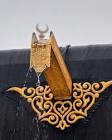
When Muslims look at the Ka’bah, they usually notice its black Kiswa, the Black Stone, and its golden door. However, there is another important feature that many pilgrims overlook a golden gutter projecting from the roof of the Ka’bah.
This feature is known as the Mizab al-Rahmah, which means “The Gutter of Mercy.” Although it may appear to be a simple drainage pipe, it has an interesting history and serves an important purpose.
WHAT IS THE MIZAB AL-RAHMAH?
The Mizab al-Rahmah is the gold-coloured water spout attached to the roof of the Ka’bah. Its primary function is to drain rainwater that collects on the flat roof.
Instead of allowing water to flow over the walls of the Ka’bah, the gutter directs it towards the semi-circular area beside the Ka’bah known as the Hijr Isma’il.
Although it is beautifully decorated, the gutter was installed for a practical reason to protect the structure from water damage.
WAS THERE ALWAYS A GUTTER?
No.
When Prophet Ibrahim (AS) and Prophet Isma’il (AS) rebuilt the Ka’bah, historical reports do not mention a gutter because the structure was much simpler.
The gutter was added centuries later when the Ka’bah underwent reconstruction. As the building developed over time, a proper drainage system became necessary, especially because Makkah occasionally experiences heavy rainfall.
Since then, every major reconstruction has included a gutter.
WHY IS IT MADE OF GOLD?
Many people assume the gutter is made entirely of solid gold. In reality, it is constructed from strong metal and covered with gold.
The use of gold is intended to honour the Sacred House and preserve one of the most important buildings in Islam. Like the golden door of the Ka’bah, it reflects the care given to maintaining the House of Allah.
WHERE DOES THE WATER FALL?
The water from the gutter falls directly into the Hijr Isma’il.
During periods of rain, pilgrims often gather in this area. Some people believe that standing beneath the flowing rainwater is a Sunnah or has special religious merit.
However, there is no authentic hadith stating that standing under the water flowing from the gutter carries any specific reward.
If someone happens to be there during rainfall, there is nothing wrong with making dua, but Muslims should avoid believing that the gutter itself possesses any special blessing.
WHAT IS THE HIJR ISMA’IL?
The Hijr Isma’il is the semi-circular area enclosed by a low white wall next to the Ka’bah.
Many Muslims do not realise that this area was originally part of the Ka’bah built by Prophet Ibrahim (AS). When the Quraysh rebuilt the Ka’bah before the Prophethood of Muhammad ﷺ, they did not have sufficient lawful funds to complete the structure on its original foundations.
As a result, they left this section outside the main building and marked it with a curved wall.
For this reason, praying inside the Hijr Isma’il is regarded as praying inside the Ka’bah itself.
A COMMON MISCONCEPTION
Some visitors try to touch or point towards the gutter, believing it has special spiritual powers.
There is no evidence in the Qur’an or authentic Sunnah to support this belief.
The Mizab al-Rahmah is an important historical and architectural feature of the Ka’bah, but Muslims worship Allah alone and do not attach acts of worship to objects without evidence.
WHAT CAN WE LEARN?
The golden gutter reminds us that every part of the Ka’bah has a history. Some features were added for practical reasons, while others reflect centuries of care and maintenance.
Learning about these details helps us appreciate the history of Islam and better understand the Sacred Mosque when we perform Hajj or Umrah.
The next time you see the Ka’bah, look above the golden door. You will notice the Mizab al-Rahmah extending from the roof a small feature with a long and fascinating history that many pilgrims pass by without ever knowing its purpose.
