


Banking has become an essential part of modern life. From opening savings accounts and receiving salaries to taking loans, buying homes and running businesses, financial institutions play a significant role in how people manage their money.
However, for Muslims, participating in the modern banking system raises an important religious question: How much of what happens in conventional banking is permissible under Islamic teachings?
At the centre of this discussion is Riba, commonly translated as interest or usury. Islam places significant emphasis on financial justice, fairness and the prohibition of exploitative transactions. Yet, many Muslims remain uncertain about what constitutes Riba, how it operates in modern banking and whether ordinary banking activities conflict with Islamic principles.
Understanding Riba is therefore not simply a matter of religious knowledge. It is an important step towards making informed financial decisions that reflect one’s faith.
What Exactly Is Riba?
Riba is an Arabic term that refers to an increase, addition or excess. In Islamic financial jurisprudence, it describes prohibited forms of increase in certain financial transactions.
The prohibition of Riba is clearly established in the Qur’an.
Allah says:
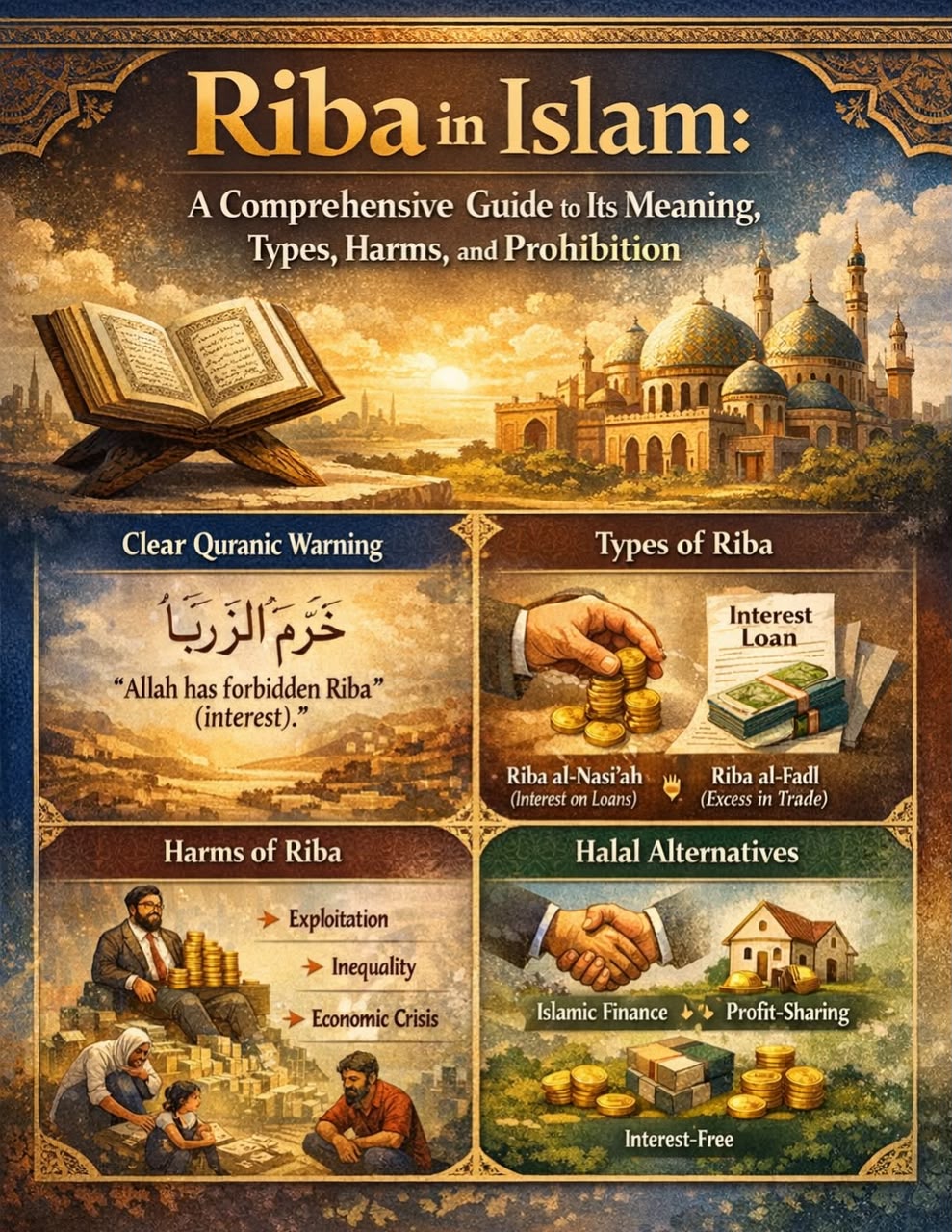
“Allah has permitted trade and has forbidden interest.”
(Qur’an 2:275)
This verse establishes an important distinction between legitimate commercial transactions and prohibited interest-based arrangements.
Islam does not prohibit Muslims from making profits, investing money or engaging in business. Rather, it prohibits certain forms of financial gain that involve unjustified increases, exploitation or violations of the rules governing financial exchange.
The Prophet Muhammad (peace and blessings be upon him) also strongly warned against Riba.
In an authentic narration recorded in Sahih Muslim, the Prophet mentioned the one who consumes Riba, the one who pays it, the one who records it and the two witnesses to it, stating that they are all involved in the sin.
This demonstrates the seriousness with which Islam treats interest-based transactions.
The Two Major Categories of Riba
Islamic scholars commonly discuss two major categories of Riba:
1. Riba al-Nasi’ah
This refers to an increase stipulated in a debt or loan in exchange for an extension of time or as a condition of lending.
For example, imagine someone borrows ₦100,000 and agrees to repay ₦120,000 after three months.
The additional ₦20,000 is stipulated because of the loan. This is an example of Riba.
The central issue is that the lender receives a guaranteed increase simply because money was lent.
2. Riba al-Fadl
This refers to an excess in the exchange of certain specified commodities covered by the rules of Riba.
The Prophet Muhammad (peace and blessings be upon him) explained that certain commodities, including gold, silver, wheat, barley, dates and salt, must be exchanged according to specific rules.
For example, exchanging gold for gold requires equality in quantity and immediate exchange.
These rules protect fairness and prevent prohibited forms of excess and delay in transactions involving the relevant commodities.
How Does Riba Appear in Modern Banking?
Although modern banking systems are considerably more complex than the financial arrangements of earlier societies, the underlying question remains the same: Does a financial transaction involve a prohibited interest-based increase?
Here are some common examples.
1. Savings Accounts
Many conventional banks offer savings accounts that pay customers a percentage of their deposited money.
For example, a person deposits ₦500,000 and receives an additional 5% annually simply for keeping the money in the account.
Where this return is a guaranteed interest payment on a conventional deposit, mainstream Islamic scholarship generally classifies it as Riba.
Muslims seeking to avoid Riba should investigate non-interest-bearing account options or appropriately structured Islamic banking products.
2. Fixed Deposit Accounts
Fixed deposit accounts usually involve placing money with a bank for an agreed period in exchange for a predetermined interest return.
For instance, someone deposits ₦2 million for twelve months and is promised a fixed return at the end of that period.
The guaranteed increase is the central concern from an Islamic perspective.
An Islamic investment arrangement, however, may generate profit through legitimate commercial activity, provided it follows the relevant Shariah requirements and does not guarantee a return in a manner that makes it equivalent to interest on a loan.
3. Personal Loans
Conventional personal loans generally require borrowers to repay more than they received.
For example, someone borrows ₦1 million but must repay ₦1.3 million over an agreed period.
The additional amount stipulated as interest is considered Riba under mainstream Islamic jurisprudence.
This applies even when the loan is used for essential needs, although exceptional circumstances may require individual scholarly assessment.
4. Mortgage Financing
Buying a home through conventional mortgage financing often involves borrowing money and repaying it with interest over several years.
For many Muslims, this presents a difficult situation, particularly in countries where Islamic home financing alternatives are limited.
Islamic finance offers alternative structures, including Murabaha, Ijarah and diminishing Musharakah.
These arrangements are designed around sale, leasing or partnership rather than a conventional interest-bearing loan.
However, the name of a financial product alone does not establish that it is Shariah-compliant. Its actual contractual structure and implementation must be examined.
5. Credit Cards
Credit cards are another area requiring careful consideration.
Many conventional credit cards impose interest when a customer fails to pay the outstanding balance within the interest-free period.
Some also include additional charges that may be interest-based.
Muslims should examine the terms and conditions carefully rather than assuming that a credit card is permissible simply because they intend to repay the balance promptly.
Scholars differ on certain aspects of credit card use, particularly where interest clauses are present but the cardholder intends never to incur interest.
Does Islam Prohibit All Forms of Profit?
One common misunderstanding is that Islam prohibits Muslims from earning money through financial activities.
This is incorrect.
Islam encourages legitimate trade, entrepreneurship, investment and economic productivity.
Allah says:
“But Allah has permitted trade and has forbidden interest.”
(Qur’an 2:275)
The distinction is important.
Consider two situations:
- A businessperson buys goods for ₦100,000 and sells them for ₦130,000 through a legitimate commercial transaction.
- A lender gives someone ₦100,000 on the condition that they must repay ₦130,000.
Although both situations involve an additional ₦30,000, their contractual foundations are different.
In the first situation, the additional amount represents a trading profit.
In the second, it represents an increase stipulated on a loan.
Islam recognises legitimate commercial profit while prohibiting Riba.
However, not every transaction labelled as a sale or investment is automatically permissible. The underlying agreement must comply with Islamic commercial principles.
What About Bank Charges and Service Fees?
Another question Muslims frequently ask concerns ordinary bank charges.
Are account maintenance fees, ATM charges, transfer fees and other banking expenses considered Riba?
Generally, a genuine fee charged for an identifiable service is not automatically Riba.
For example, a bank may charge a customer for processing a transaction or maintaining an account.
Such charges are different from interest because they represent payment for a service rather than an increase stipulated on a loan.
Nevertheless, the nature of the charge matters. A fee that is simply interest under another name does not become permissible because it is described differently.
Muslims should distinguish genuine service charges from interest-based payments.
What Should Muslims Do About Interest Already Received?
Some Muslims discover that their conventional savings accounts have accumulated interest over several years. Others may receive interest without fully understanding how their bank operates.
What should they do?
Islamic scholars generally advise Muslims who have received prohibited interest to repent, stop knowingly participating in the interest arrangement and dispose of the interest amount without treating it as personal wealth or expecting a reward for charity.
The money may be directed towards appropriate public welfare or charitable purposes, following guidance from a knowledgeable scholar.
It is important to distinguish this situation from ordinary lawful income or legitimate investment profits.
Muslims should also avoid making assumptions about every payment received from a financial institution. The actual source and nature of the payment should be established.
Is Islamic Banking a Better Alternative?
Islamic banking was developed to provide financial services that operate according to Islamic commercial and ethical principles.
Rather than relying on conventional interest-based lending, Islamic financial institutions use structures designed around trade, leasing, partnerships and other recognised contractual arrangements.
Some commonly used Islamic finance models include:
Murabaha
This is a cost-plus sale arrangement.
For example, a customer wants to purchase a car. Instead of giving the customer an interest-bearing loan, the Islamic bank purchases the vehicle and sells it to the customer at an agreed price that includes a disclosed profit margin.
The customer pays the agreed selling price according to the contract.
Mudarabah
This is a partnership arrangement involving capital and management.
One party provides the capital while another manages the business. Profits are shared according to an agreed ratio, while financial losses are generally borne by the capital provider unless negligence, misconduct or breach of contract by the manager is established.
Musharakah
This is a partnership in which two or more parties contribute capital to a business or investment.
Profits are distributed according to an agreed arrangement, while losses are generally shared according to each party’s capital contribution.
Ijarah
Ijarah is an Islamic leasing arrangement.
An institution purchases an asset and leases it to a customer in exchange for agreed rental payments.
These models demonstrate that financial institutions can provide services without relying on conventional interest-based lending.
However, Islamic banking products must be assessed according to their actual contracts, risk arrangements and implementation. Not every product offered under an Islamic label automatically satisfies Shariah requirements.
Islamic Banking in Nigeria
For Muslims in Nigeria, understanding Riba is particularly important because conventional banking is deeply integrated into everyday economic activities.
Fortunately, Nigeria has an Islamic finance sector that provides alternatives to certain conventional banking products.
Institutions such as Jaiz Bank and other providers of non-interest financial services operate within the Nigerian financial system.
The Central Bank of Nigeria also recognises non-interest banking as part of the country’s financial framework.
These institutions offer products designed around Islamic financial principles, providing Muslims with additional options for managing their money.
Nevertheless, customers should take time to understand the contracts, fees, investment risks and Shariah governance arrangements before choosing a financial product.
The responsibility to seek knowledge does not end simply because a bank describes itself as Islamic.
What If Someone Has No Access to Islamic Banking?
Not every Muslim lives in a country with accessible Islamic financial institutions.
Some people may have limited banking options because of their location, employment arrangements or personal circumstances.
Others may find that conventional banks are the only institutions available for receiving salaries, making payments or conducting essential transactions.
Islamic scholars recognise that circumstances can differ, and discussions about necessity, hardship and available alternatives require careful consideration.
However, the absence of convenient alternatives should not become a reason to disregard the prohibition of Riba entirely.
Muslims should seek guidance from qualified scholars who understand both Islamic jurisprudence and modern financial arrangements.
Where possible, they should choose non-interest-bearing accounts and avoid knowingly entering interest-based agreements.
Practical Steps Muslims Can Take to Avoid Riba
Avoiding Riba in modern society requires awareness and deliberate financial decisions.
Here are some practical steps:
- Understand your bank accounts: Find out whether your account generates interest or contains interest-related conditions.
- Read financial agreements: Before accepting loans, mortgages, credit cards or investment products, understand the contractual terms.
- Explore Islamic banking: Investigate non-interest financial institutions and products available in your country.
- Avoid unnecessary borrowing: Do not take interest-bearing loans simply to finance unnecessary consumption.
- Learn the principles of Islamic finance: Understanding concepts such as Murabaha, Mudarabah and Musharakah can help you evaluate financial alternatives.
- Consult knowledgeable scholars: Seek guidance when a financial arrangement is complicated or its Islamic ruling is unclear.
- Teach your family: Financial awareness should be part of Islamic upbringing so that children grow up understanding the importance of halal earnings.
Why the Prohibition of Riba Matters
The prohibition of Riba is not simply a restriction intended to make financial activities difficult.
It reflects broader Islamic objectives concerning justice, compassion, responsibility and the protection of wealth.
Interest-based lending can create situations where a borrower remains financially burdened even when facing hardship.
Islam encourages financial arrangements that recognise legitimate trade, shared commercial activity, mutual responsibility and fair dealing.
Allah says:
“And if someone is in hardship, then let there be postponement until a time of ease. And if you give it as charity, it is better for you, if you only knew.”
(Qur’an 2:280)
This verse highlights the importance of compassion towards people experiencing financial difficulty.
Islam encourages creditors to give struggling debtors additional time rather than increasing their burdens.
This is a reminder that financial relationships should not be built solely around personal gain but should also reflect human dignity and concern for others.
Conclusion
Riba remains one of the most important financial issues Muslims must understand in the modern world.
From savings accounts and personal loans to mortgages and credit cards, interest-based arrangements are deeply embedded in many conventional banking systems.
However, Islam provides clear principles that help Muslims distinguish between legitimate commercial profit and prohibited interest.
Avoiding Riba requires more than simply avoiding certain financial institutions. It requires knowledge, careful decision-making and a willingness to examine the agreements governing our money.
For Muslims, the pursuit of financial stability should never be separated from the pursuit of Allah’s pleasure.
We may live in a world where interest-based transactions are common, but that does not remove our responsibility to seek halal alternatives and make informed choices.
Ultimately, our wealth is a trust from Allah, and how we earn, save, invest and spend it matters.
May Allah grant us beneficial knowledge, provide us with halal sustenance and protect us from Riba and all forms of unlawful earnings. Ameen.
