


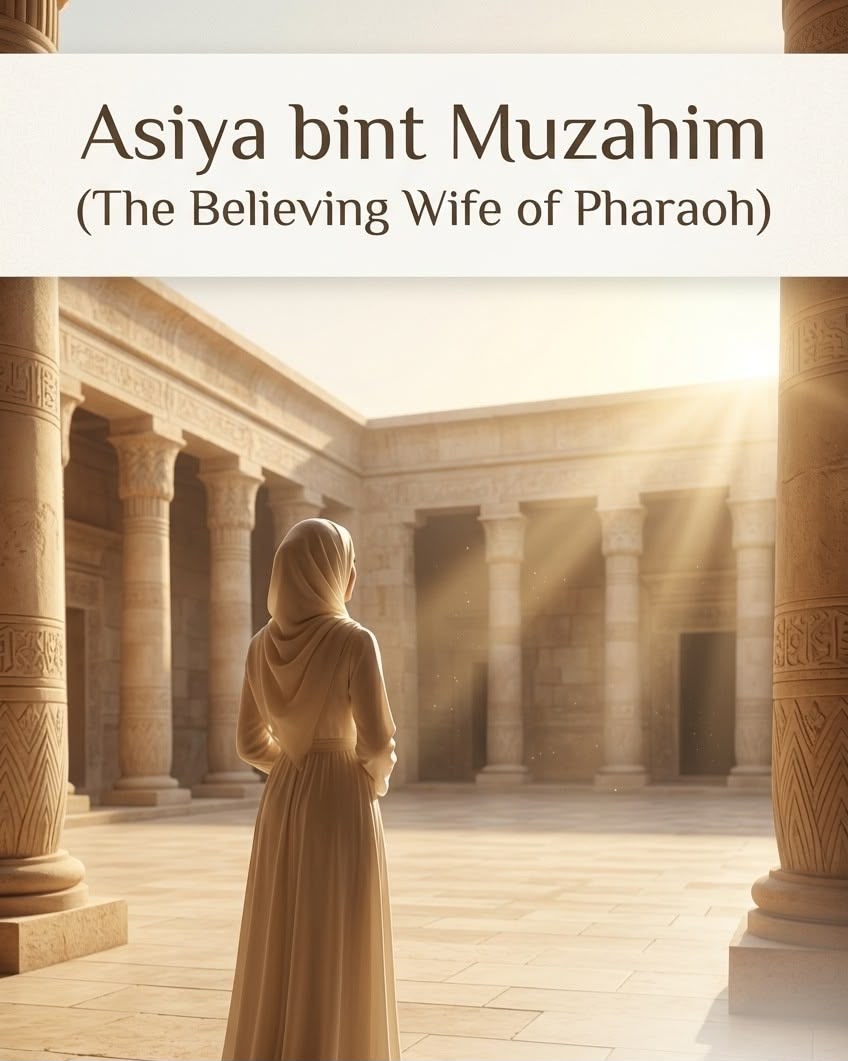
She lived in a palace filled with wealth, luxury and power, yet her heart belonged to Allah. Married to one of the most arrogant tyrants in history, Asiyah chose faith over comfort, truth over fear and Paradise over the pleasures of this world.
Imagine living in a palace where everything is available to you.
You have wealth, servants, beautiful clothes, expensive possessions and a position that many people could only dream of having. You are married to one of the most powerful rulers in the land. Nobody dares to challenge his authority, and his word is treated as law.
Yet, behind the beautiful walls of that palace, you are surrounded by oppression, arrogance and disbelief.
Your husband claims an authority that belongs only to Allah. He oppresses innocent people and demands that they submit to his power.
You have a choice: enjoy the privileges of the palace and remain silent, or stand firm upon the truth, knowing that doing so could cost you everything.
This was the extraordinary test of Asiyah, the wife of Pharaoh.
Her story is one of the most remarkable examples of faith in Islamic history. She lived in an environment where disbelief and tyranny surrounded her, yet she remained devoted to Allah.
She teaches us that a person’s environment does not have to determine their faith, that wealth cannot replace spiritual fulfilment, and that the pleasure of Allah is worth more than every worldly possession.
But who was Asiyah? How did she become a believer? What was her relationship with Prophet Musa (Moses), peace be upon him? And why did Allah preserve her story as an example for all believers?
Let’s explore the remarkable story of a woman whose faith shone even inside the palace of a tyrant.
1. WHO WAS ASIYAH, THE WIFE OF PHARAOH?
Asiyah bint Muzahim is traditionally identified in Islamic scholarship as the believing wife of Pharaoh.
Although the Qur’an does not mention her personal name, it honours her as one of the greatest examples of faith.
She lived during the time of Prophet Musa (peace be upon him), when Pharaoh ruled Egypt with extraordinary arrogance and cruelty.
Pharaoh was not simply a powerful ruler. He was a tyrant who oppressed the Children of Israel, subjected them to humiliation and even ordered the killing of their newborn sons.
His arrogance reached such an extreme that he claimed divinity.
Allah records his declaration:
“I am your lord, the most high.”
(Qur’an 79:24)
Imagine living in the household of such a man.
While Pharaoh demanded worship and obedience from others, Asiyah recognised that true authority belonged to Allah alone.
Her greatness was not determined by her husband’s position. It was determined by her faith.
She understood something that many people struggle to understand even today: being close to power does not necessarily mean being close to the truth.
2. THE BABY IN THE RIVER: HOW ASIYAH BECAME CONNECTED TO THE STORY OF MUSA
One of the most remarkable parts of Asiyah’s story is her connection to the survival of Prophet Musa (peace be upon him).
During Pharaoh’s reign, he had ordered the killing of newborn Israelite boys because of his fear of a prophecy that a boy from among the Children of Israel would bring an end to his kingdom.
Musa’s mother, fearing for her child’s life, received inspiration from Allah to place him in a chest and set him afloat on the river.
Allah says:
“And We inspired to the mother of Moses, ‘Suckle him; but when you fear for him, cast him into the river and do not fear and do not grieve. Indeed, We will return him to you and will make him one of the messengers.'”
(Qur’an 28:7)
The chest eventually reached the household of Pharaoh.
Think about the extraordinary nature of this event.
The very palace where Musa should have been in danger became the place where he was protected.
Allah had already planned his survival.
When Pharaoh’s family discovered the child, Pharaoh’s wife spoke in his defence.
Allah records her words:
“And the wife of Pharaoh said, ‘[He will be] a comfort of the eye for me and for you. Do not kill him; perhaps he may benefit us, or we may adopt him as a son.'”
(Qur’an 28:9)
This moment reveals an important aspect of Asiyah’s character.
While Pharaoh’s cruelty threatened the life of an innocent child, his wife recognised an opportunity for mercy.
The child who would eventually challenge Pharaoh’s tyranny was raised within the very household of the tyrant.
What Pharaoh believed he could control was already part of Allah’s plan.
3. ASIYAH’S FAITH WAS STRONGER THAN THE LUXURY AROUND HER
There is something particularly powerful about Asiyah’s position.
She had access to a life of extraordinary material comfort. Yet, she understood that worldly luxury was not the same as true happiness.
A palace may provide beautiful rooms, expensive possessions and servants, but none of these things can give the heart what it needs most: a genuine connection with its Creator.
Asiyah’s faith demonstrates that guidance is not determined by the environment in which someone lives.
Some people grow up in religious households but struggle to remain committed to their faith.
Others grow up surrounded by disbelief, temptation and injustice, yet Allah guides their hearts.
Asiyah was surrounded by the arrogance of Pharaoh, but she did not allow his beliefs to become hers.
Her story reminds us that we should never use our circumstances as an excuse to abandon our relationship with Allah.
You may live in an environment where people mock your religious commitment.
You may work in a place where dishonesty is considered normal.
You may belong to a family where practising Islam is difficult.
But your responsibility to Allah remains.
Your environment may influence you, but it does not have to determine your final destination.
4. WHY DID ASIYAH CHOOSE ALLAH OVER PHARAOH?
The Qur’an gives us a remarkable glimpse into Asiyah’s faith through one of the most beautiful supplications ever recorded.
Allah says:
“And Allah presents an example of those who believed: the wife of Pharaoh, when she said, ‘My Lord, build for me near You a house in Paradise and save me from Pharaoh and his deeds and save me from the wrongdoing people.'”
(Qur’an 66:11)
Read that supplication carefully.
Asiyah did not ask Allah for another palace.
She did not ask for more wealth, greater influence or a more powerful husband.
She asked for a house near Allah in Paradise.
This is one of the most powerful lessons from her story.
She understood that everything in this world is temporary.
The palace she lived in could not guarantee eternal happiness. The wealth surrounding her could not save her from accountability. Her connection to Pharaoh could not protect her from the consequences of his oppression.
She wanted something greater.
She wanted the pleasure of Allah and a home in Paradise.
Her supplication also reveals that she wanted to be separated from Pharaoh and his evil actions.
She recognised that being married to a tyrant did not require her to support his wrongdoing.
This is an important lesson for anyone who feels pressured to compromise their faith because of a relationship, family connection or social position.
No human relationship should become more important than obedience to Allah.
5. ASIYAH WAS ONE OF THE GREATEST WOMEN IN ISLAM
The status of Asiyah is not based merely on historical admiration.
Prophet Muhammad (peace and blessings be upon him) specifically mentioned her among the greatest women.
In an authentic narration, he said:
“Many men attained perfection, but among women none attained perfection except Maryam bint ‘Imran and Asiyah, the wife of Pharaoh.”
(Sahih al-Bukhari 3433; Sahih Muslim 2431)
This Hadith highlights her extraordinary spiritual status.
Consider what makes this particularly remarkable.
She lived in the household of one of history’s most arrogant rulers, yet she became an example of faith for believers throughout generations.
Her greatness was not dependent on her marriage, wealth or social standing.
It came from her devotion to Allah.
Her story also reminds us that women have always played significant roles in Islamic history.
Their contributions to faith, courage, knowledge and righteousness should never be overlooked.
6. THE SUFFERING OF ASIYAH: WHEN FAITH COMES AT A PRICE
Asiyah’s commitment to Allah came at an extraordinary cost.
Islamic historical reports and Qur’anic explanations describe Pharaoh discovering her faith and punishing her for it.
The Qur’an itself does not provide a detailed account of every event surrounding her persecution. However, classical Islamic reports describe the severe suffering she endured because of her belief.
She was subjected to torture for refusing to abandon her faith.
Imagine the circumstances.
The woman who once lived in a palace of luxury was now facing punishment from the very man who ruled that palace.
The person who could have enjoyed the privileges of royalty chose instead to remain faithful to Allah.
Her story teaches us that genuine faith is not measured only by what we say when life is comfortable.
Sometimes, our commitment becomes most visible when we face difficulties.
It is easy to speak about patience when everything is going well.
It is easy to say that we trust Allah when our plans are working.
But what happens when remaining faithful requires sacrifice?
Asiyah’s example reminds us that the pleasure of Allah is worth more than the approval of people.
7. HER FINAL SUPPLICATION: A HOUSE NEAR ALLAH IN PARADISE
Perhaps the most beautiful part of Asiyah’s story is the supplication Allah preserved in the Qur’an.
“My Lord, build for me near You a house in Paradise…”
(Qur’an 66:11)
There is something deeply moving about the way she expressed her desire.
She did not merely ask for Paradise.
She asked for a house near Allah.
The woman who had access to one of the greatest palaces of her time understood that the most valuable home was not the one built with gold, expensive decorations or worldly wealth.
It was the home Allah grants in Paradise.
Her supplication also teaches us that we should focus on our relationship with Allah rather than becoming excessively attached to worldly status.
You can have an impressive house and still lack peace.
You can have wealth and still experience emptiness.
You can be surrounded by people and still feel spiritually disconnected.
But when your heart is connected to Allah, you have something that worldly possessions cannot replace.
Asiyah’s prayer should inspire us to ask Allah for a place in Jannatul Firdaus and to make decisions that bring us closer to Him.
8. WHAT CAN MUSLIM WOMEN AND MEN LEARN FROM ASIYAH’S STORY?
Although Asiyah’s story is especially inspiring for Muslim women, its lessons apply to every believer.
Here are some important lessons we can take from her life.
1. Your environment does not determine your faith.
Asiyah lived in the household of a tyrant but remained a believer.
Never assume that your circumstances make it impossible to remain faithful to Allah.
2. Never exchange your faith for worldly comfort.
Wealth, influence and social approval are temporary.
Do not compromise your religious principles simply because doing so makes life easier.
3. Your relationship with Allah comes first.
Asiyah’s supplication demonstrates that she valued closeness to Allah above the privileges of her marriage and position.
No relationship should require you to abandon your faith.
4. A person’s righteousness is not determined by their spouse.
Asiyah was married to Pharaoh, yet she remained among the greatest believing women.
Her story reminds us that each individual is accountable for their own beliefs and actions.
5. Do not underestimate the power of Du’a.
Her supplication in Qur’an 66:11 has been preserved for generations.
When life becomes difficult, turn to Allah sincerely.
6. True success is not always visible to people.
The world may measure success through money, fame and status.
Asiyah’s story teaches us that success in the sight of Allah is far greater.
7. Stand for what is right, even when it is difficult.
Asiyah’s faith demonstrates the courage required to remain committed to the truth when surrounded by wrongdoing.
9. WHAT DOES ASIYAH’S STORY TEACH US ABOUT MARRIAGE?
There is another important lesson in Asiyah’s story that deserves attention.
She was married to Pharaoh, yet her faith was completely different from his.
This reminds us that marriage does not automatically determine a person’s spiritual condition.
A righteous person may have a spouse who does not share their faith or values.
Similarly, being married to someone wealthy, influential or respected does not guarantee that the relationship will bring you closer to Allah.
In Islam, marriage is meant to be built upon faith, kindness, responsibility and mutual respect.
Asiyah’s example also reminds us that a person’s religious identity and relationship with Allah remain their own responsibility.
No spouse, parent, employer or ruler should be allowed to become more important than Allah.
For anyone experiencing difficulties in their marriage, her story is a reminder that Allah knows what happens behind closed doors.
However, her story should not be used to pressure people to remain in abusive or dangerous relationships. Seeking protection, appropriate help and lawful solutions is compatible with preserving one’s faith.
10. WHY HER STORY STILL MATTERS TODAY
We live in a world where people are constantly encouraged to pursue wealth, influence, popularity and social recognition.
Many people measure their worth through what they own, where they live, who they know and how others perceive them.
But Asiyah’s story challenges this way of thinking.
She had access to worldly privileges that many people spend their entire lives pursuing.
Yet, she understood that those privileges were temporary.
Today, some Muslims compromise their values because they fear losing a relationship, a job, financial support or social acceptance.
Others remain silent when they witness wrongdoing because speaking up may affect their comfort.
Asiyah’s example reminds us that faith should not be something we practise only when it is convenient.
Our loyalty to Allah must remain stronger than our attachment to worldly benefits.
Her story also encourages us to look beyond outward appearances.
Someone may live in a beautiful house and still be far from Allah.
Someone may have very little in material terms and yet possess a heart filled with faith.
Ultimately, the condition of our hearts matters more than the possessions we accumulate.
CONCLUSION: THE PALACE WAS NOT HER PARADISE
Asiyah lived in a palace, but she understood that the palace was not her final home.
She had wealth, but she desired something greater.
She was married to a powerful ruler, but she refused to allow his authority to replace her devotion to Allah.
Her story is a reminder that faith can survive even in the most difficult environments.
It teaches us that our circumstances do not have to define our relationship with Allah and that the greatest form of success is not measured by what we possess in this world.
The world may admire the palace of Pharaoh, but Allah preserved the supplication of his believing wife.
What a powerful reminder of where true honour lies.
Perhaps the greatest question we should take away from her story is this:
If you were given everything the world could offer but were asked to compromise your relationship with Allah in return, what would you choose?
May Allah grant us the strength to remain firm upon our faith, protect us from oppression and arrogance, fill our hearts with sincere devotion and grant us homes in Jannatul Firdaus.
May He make us among those who choose His pleasure over the temporary attractions of this world.
Ameen.
