


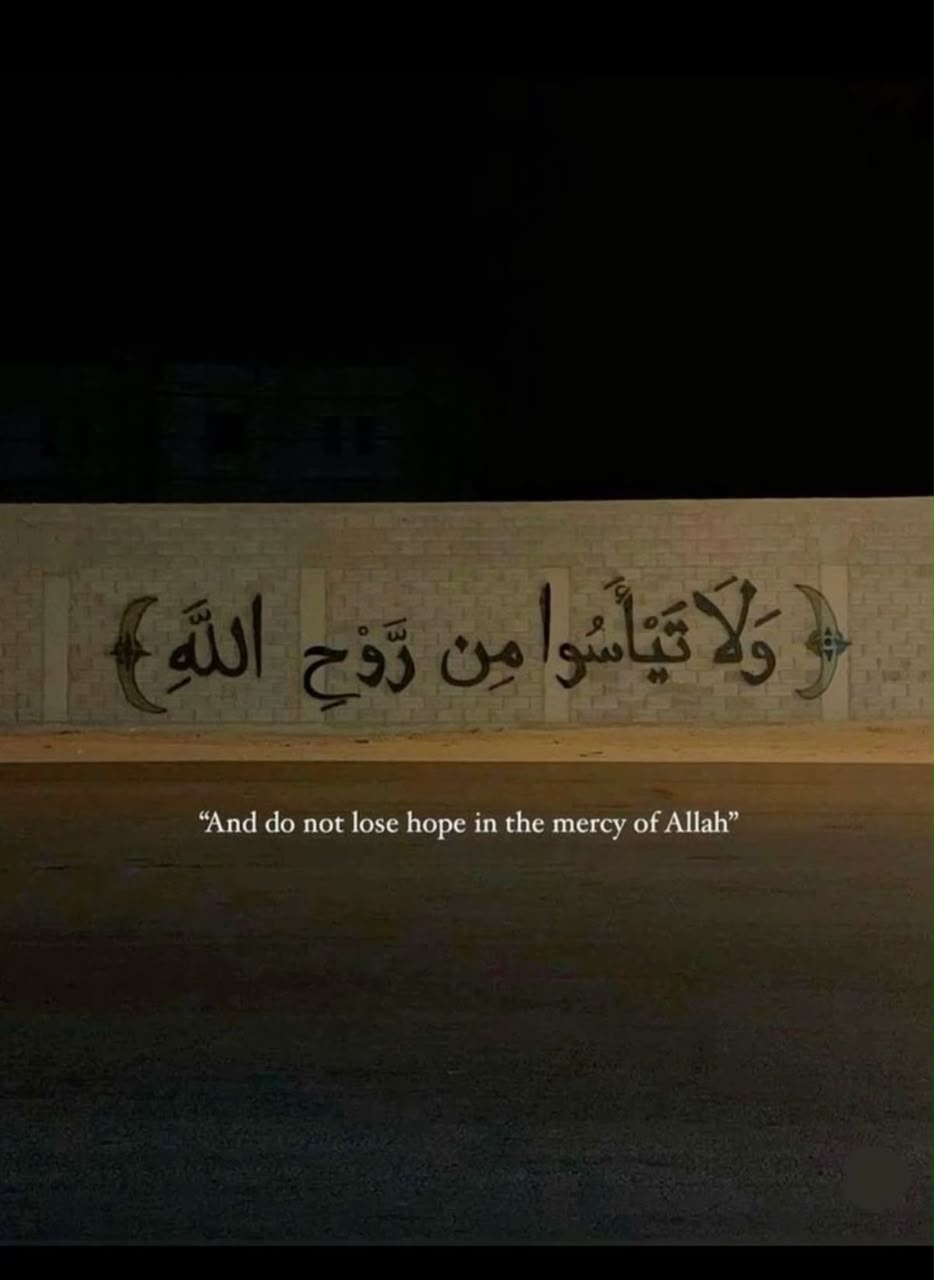
There are moments in life when hope becomes difficult. A person may make the same dua for years without seeing the answer they expected. Someone may regret mistakes from their past and wonder whether they can ever truly change. Another person may be facing financial difficulties, family problems, disappointment or uncertainty about the future. During such moments, one of the greatest things a Muslim can hold on to is hope in Allah.
In Islam, hope is not simply positive thinking. It is called rajaa, and it means having hope in Allah’s mercy, forgiveness, help and reward while continuing to turn towards Him. It is the belief that no matter how difficult the situation becomes, Allah’s mercy is greater than our circumstances and His power is greater than our problems.
Allah says in the Qur’an, “Do not despair of the mercy of Allah. Indeed, Allah forgives all sins.” (Qur’an 39:53). This is one of the most powerful reminders for anyone who feels that they have gone too far, made too many mistakes or become too distant from Allah. The verse does not tell Muslims to take sin lightly. Rather, it reminds them that sin should never convince them that returning to Allah is pointless.
One of the tricks of Shaytan is to make a person believe that they are beyond forgiveness. A person may commit a serious mistake and begin thinking, “Allah will never forgive someone like me.” Instead of making tawbah, they withdraw further from worship. They stop making dua because they feel unworthy. They stop praying because they believe their sins have made them unacceptable. The result is that guilt becomes a barrier between them and the very Lord to whom they should be turning.
Islam teaches something different. When a person sins, they should recognise the wrong, regret it, seek forgiveness and make a sincere effort not to return to it. The existence of sin does not mean the end of a person’s relationship with Allah. Tawbah itself is an act of returning, and Allah loves those who continually turn back to Him.
Hope in Allah is also important when a person is waiting for something they deeply desire. Human beings naturally want immediate answers. We make dua and hope that the situation will change quickly. When it does not, frustration can slowly replace hope. A person may begin asking, “Why has Allah not answered me?”
But the believer understands that an unanswered or delayed dua should not automatically be interpreted as rejection. Allah knows what we do not know. We see one moment; Allah knows the entire reality of our lives. We may ask for something because we believe it will make us happy, while Allah knows consequences that are completely hidden from us.
Sometimes what we desperately want is not what is best for us. Sometimes the timing is wrong. Sometimes the answer comes in a different form. Sometimes a person is given something better than what they originally asked for. And sometimes a believer continues making dua without immediately seeing the outcome, trusting that their turning to Allah is itself an act of worship.
This is why hope and patience belong together. Hope without patience can become impatience with Allah’s timing, while patience without hope can become emotional exhaustion. The believer continues to ask Allah while remaining confident in His wisdom.
Allah says, “And whoever fears Allah, He will make for him a way out and provide for him from where he does not expect.” (Qur’an 65:2–3). This does not mean that every problem will disappear immediately or that every desired outcome is guaranteed. It means that Allah is capable of creating solutions from places that a person cannot see.
There are many situations in which a person cannot imagine how things could possibly improve. Someone who has been unemployed for months may have no idea where their next opportunity will come from. A person facing a difficult family situation may not see how reconciliation can happen. Someone who has made serious mistakes may struggle to imagine becoming a better person.
Yet Allah does not need circumstances to look promising before He can change them.
This is one of the reasons believers should never underestimate the power of Allah. The same Allah who created the heavens and the earth can open a door that nobody expected. He can change circumstances, soften hearts, provide opportunities and give a person strength they did not know they possessed.
Hope also changes how a Muslim views their own future. Your past does not have to determine your future. A person who has lived carelessly can become serious about their faith. Someone who has neglected Salah can return to it. Someone who has spent years making poor decisions can begin making better ones. Someone who has been distant from the Qur’an can rebuild their relationship with it.
The past should teach you, not imprison you.
At the same time, hope in Allah should not become an excuse for continuing in sin. A person cannot deliberately persist in wrongdoing while saying, “Allah is Merciful, so everything will be fine.” Genuine hope is accompanied by action. If you hope for Allah’s forgiveness, you seek forgiveness. If you hope to become closer to Allah, you take steps towards Him. If you hope for a better life, you make the lawful effort available to you.
There is an important difference between having hope in Allah and simply wishing for things. Wishing says, “I want this to happen.” Hope in Allah says, “I want this to happen, I will do what I can, and I trust Allah with the outcome.”
That distinction becomes particularly important when life does not follow our plans.
A believer may have worked hard for an opportunity and still lose it. They may have prepared carefully for something and still experience disappointment. They may have made dua for a particular outcome and received something completely different. Hope in Allah teaches them not to conclude that everything is over simply because one door has closed.
Sometimes a closed door is simply a closed door. It does not mean every door is closed.
Hope also gives a Muslim the courage to begin again. This is especially important after failure. People sometimes allow one mistake to define their entire identity. They think, “I have already failed, so there is no point trying again.” But Islam constantly calls people towards repentance, correction and renewal.
Every new day is another opportunity to make better choices.
The believer should also remember that Allah’s mercy is not limited by human limitations. Human beings become tired of forgiving. Someone may forgive you once, twice or several times and eventually decide that they have had enough. Allah’s mercy is far beyond human mercy. This does not mean that a person should deliberately abuse that mercy. It means that sincere repentance should never be abandoned simply because a person feels ashamed of returning to Allah.
The Prophet Muhammad ﷺ narrated that Allah says, “O son of Adam, if your sins were to reach the clouds in the sky and then you asked My forgiveness, I would forgive you.” This hadith, reported by al-Tirmidhi, illustrates the vastness of Allah’s forgiveness for the person who sincerely turns back to Him.
Hope is therefore not weakness. It is a form of strength. It allows a believer to continue when circumstances are difficult. It allows them to repent after falling. It allows them to make dua after disappointment. It allows them to keep doing what is right even when the result has not appeared.
There will always be things in life that we cannot control. We cannot control exactly when opportunities will come, how other people will behave, how quickly circumstances will change or what tomorrow will bring. But we can control where we place our hope.
When your plans fail, hope in Allah. When you make a mistake, return to Allah. When your dua seems delayed, continue calling upon Allah. When you feel that you have gone too far, remember that Allah’s mercy is greater than your sins. When the future looks uncertain, remember that your future is not outside Allah’s knowledge or power.
A Muslim should never allow a difficult season to convince them that Allah has forgotten them. The believer may not know what tomorrow holds, but they know Who holds tomorrow.
That is the heart of rajaa: continuing to expect goodness from Allah while doing what is required of you. It is waking up after disappointment and still making dua. It is falling into sin and still getting back up to repent. It is facing uncertainty and refusing to surrender to despair.
Allah tells us, “And who despairs of the mercy of his Lord except those who are astray?” (Qur’an 15:56).
As long as a person is alive, the door of returning to Allah remains open. There is always another opportunity to repent, another opportunity to pray, another opportunity to make better choices and another opportunity to place your trust in Allah.
Never allow your circumstances to become bigger in your heart than your Lord. Your problem may be great, but Allah is greater. Your mistake may be serious, but Allah’s mercy is greater. Your future may be uncertain, but Allah already knows it completely.
Hope in Allah, therefore, is not about pretending that life is easy. It is about knowing that no matter how difficult life becomes, despair is never the final answer for a believer.
