


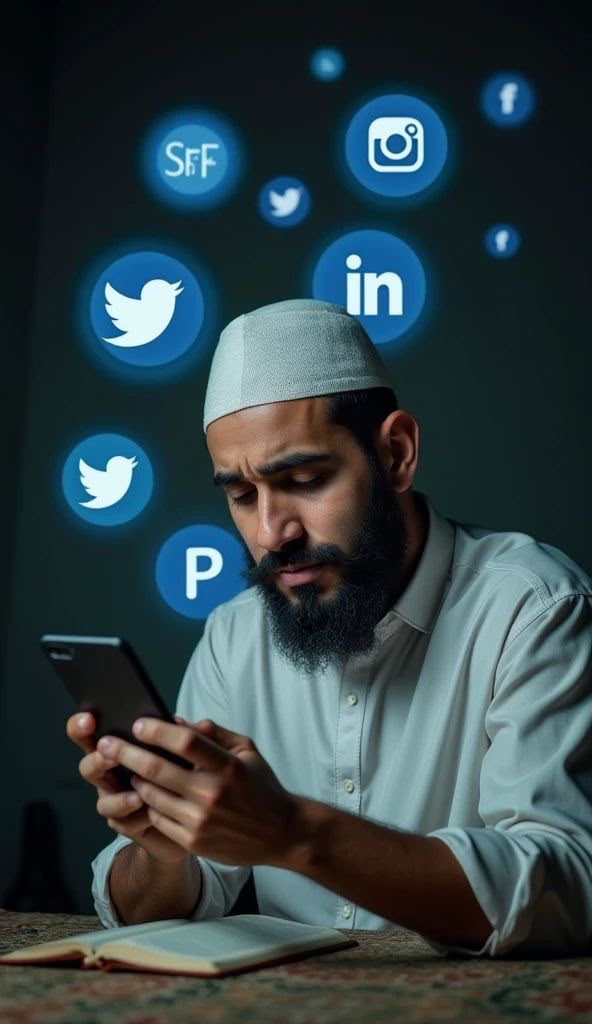
There is a strange thing about modern life: we are more connected than ever, yet many people feel increasingly disconnected from themselves.
The moment we wake up, we reach for our phones.
Before we get out of bed, we check messages.
We scroll through social media while eating.
We watch videos while travelling.
We check notifications during conversations.
We pick up our phones when we are bored, uncomfortable, lonely, anxious or simply have nothing else to do.
And before we know it, an entire day has passed.
We have consumed hundreds of images, opinions, videos, arguments and advertisements, but barely spent a few quiet minutes thinking about our own hearts.
For a young Muslim, this deserves serious reflection.
Because the question is not simply, “How much time do I spend on my phone?”
The deeper question is:
“What is my phone doing to my heart?”
YOUR HEART NEEDS QUIET
Allah tells us:
“Surely in the remembrance of Allah do hearts find comfort.”
(Qur’an 13:28)
The heart was not created to be constantly stimulated.
It needs moments of silence.
It needs reflection.
It needs remembrance of Allah.
It needs time away from the endless stream of other people’s lives.
But our phones rarely give us silence.
There is always another notification.
Another video.
Another message.
Another headline.
Another argument.
Another person showing us how successful, beautiful, wealthy or happy they supposedly are.
Eventually, we become uncomfortable with silence because we have trained ourselves to escape it.
The moment there is nothing happening, we reach for the phone.
But sometimes the silence we are trying to escape is exactly where we need to meet ourselves.
WHAT ARE YOU RUNNING FROM?
This is an uncomfortable question.
Why do you immediately reach for your phone when you are alone?
Why do you scroll when you are anxious?
Why do you watch another video when you are supposed to be sleeping?
Why do you check social media when you already know it will make you compare your life with someone else’s?
Sometimes the phone is not the problem itself.
Sometimes it is the escape.
We use it to avoid thinking.
We use it to avoid loneliness.
We use it to avoid difficult emotions.
We use it to avoid boredom.
We use it to avoid confronting the state of our relationship with Allah.
A person can spend three hours scrolling because sitting quietly for ten minutes with their own thoughts feels uncomfortable.
But a Muslim should learn how to sit with the heart.
Not every uncomfortable feeling needs to be distracted away.
Sometimes it needs to be taken to Allah.
YOUR SOUL WAS NOT CREATED FOR CONSTANT ENTERTAINMENT
The Qur’an describes the human being as more than a body that eats, works, sleeps and seeks entertainment.
Allah says:
“By the soul and the One who proportioned it, and inspired it with discernment of its wickedness and righteousness.”
(Qur’an 91:7–8)
There is an inner dimension to human life.
There is a conscience.
There is a heart.
There is a soul.
And just as your body needs food, your spiritual life needs nourishment.
If you constantly feed your eyes but neglect your heart, something eventually becomes unbalanced.
You can know every trending story and still know very little about yourself.
You can follow hundreds of people and still feel lonely.
You can consume Islamic reminders all day and still struggle to pray.
You can watch motivational videos for hours and still lack discipline.
Information is not the same as transformation.
Your heart needs something deeper.
It needs a relationship with Allah.
SOCIAL MEDIA CAN MAKE YOU FORGET YOUR OWN LIFE
One of the greatest dangers of excessive scrolling is comparison.
You see someone travelling.
Someone getting married.
Someone buying a car.
Someone starting a business.
Someone graduating.
Someone building a beautiful home.
Someone becoming successful.
Someone who seems to have everything together.
And suddenly, your own life begins to look small.
But remember this:
You are comparing your ordinary moments with someone else’s carefully selected moments.
You see their announcement.
You do not see their anxiety.
You see the achievement.
You do not see the years of struggle.
You see the wedding photographs.
You do not see what happens inside the marriage.
You see the business success.
You do not see the failures behind it.
You see the smile.
You do not know what the person is carrying privately.
Allah did not ask you to live someone else’s life.
Your provision is written by Allah.
Your journey is different.
Your test is different.
Your timing is different.
And your purpose is different.
Put the phone down sometimes and return to the life Allah actually gave you.
PROTECT YOUR EYES, BUT ALSO PROTECT YOUR HEART
Islam teaches us to lower our gaze and protect ourselves from what can corrupt the heart.
Allah says:
“Tell the believing men to lower their gaze and guard their chastity.”(Qur’an 24:30)
And the same command is given to believing women in the following verse.
This principle becomes particularly important in an age where almost anything can appear on your screen within seconds.
You may not deliberately search for something harmful.
It may simply appear.
A video.
A photograph.
A suggested account.
A provocative image.
A piece of content designed to keep you watching.
The problem is not only what enters through your eyes.
It is what remains in your heart afterward.
Some things are difficult to forget because you allowed them to enter repeatedly.
That is why digital discipline is part of spiritual discipline.
Sometimes protecting your iman means unfollowing.
Sometimes it means deleting an app.
Sometimes it means turning off notifications.
Sometimes it means refusing to click.
Sometimes it means putting the phone down.
YOUR PHONE SHOULD BE YOUR TOOL, NOT YOUR MASTER
Technology itself is not evil.
A phone can be incredibly beneficial.
You can read Qur’an.
Listen to beneficial lectures.
Study Islamic knowledge.
Stay connected with family.
Run a business.
Work remotely.
Learn a skill.
Give charity.
Communicate with people.
Access useful information.
The problem begins when the tool starts controlling the person.
If you cannot sit for ten minutes without checking your phone, ask yourself who is really in control.
If you cannot pray without checking a notification beforehand, something needs to change.
If you constantly interrupt conversations to look at your screen, something needs to change.
If you reach for your phone before reaching for the Qur’an, perhaps your priorities need to be examined.
The goal is not necessarily to throw your phone away.
The goal is to put it back in its proper place.
GIVE YOURSELF MOMENTS WITHOUT A SCREEN
Try something simple.
When you wake up, do not immediately reach for your phone.
Make your morning adhkar.
Pray Fajr.
Sit quietly.
Make du’a.
Think about what you want from the day.
When you eat, sometimes eat without a screen.
When you walk, sometimes walk without headphones.
When you are with your parents, put the phone away.
When someone is speaking to you, give them your full attention.
Before sleeping, create some distance between yourself and your screen.
And most importantly, create moments in which there is nothing competing for your attention.
Just you, your thoughts and Allah.
Those moments can be uncomfortable at first.
But they can become incredibly valuable.
USE YOUR PHONE TO REMEMBER ALLAH, NOT FORGET HIM
Imagine checking your phone dozens of times every day but rarely checking the state of your iman.
We know when our battery is low.
We know when our internet is slow.
We know when we have unread messages.
We know when someone has liked our post.
But do we notice when our heart has become hard?
Do we notice when salah starts feeling like a burden?
Do we notice when Qur’an becomes distant?
Do we notice when we stop making du’a?
Do we notice when a sin no longer bothers us?
These are spiritual notifications.
And unlike the notifications on your phone, they do not appear as little red circles on a screen.
You have to pay attention to the heart.
THE PHONE CANNOT ANSWER THE QUESTIONS OF YOUR SOUL
Your phone can tell you what is trending.
It can tell you what happened in another country.
It can show you where your friends are.
It can provide endless entertainment.
But it cannot tell you why you were created.
It cannot give you true forgiveness.
It cannot guarantee you tomorrow.
It cannot answer what happens after death.
It cannot replace salah.
It cannot replace Qur’an.
It cannot replace sincere tawbah.
It cannot give the heart the certainty that comes from knowing Allah.
There are questions that technology will never answer because they are spiritual questions.
Who am I?
Why am I here?
Where am I going?
What happens after death?
What does Allah want from me?
What kind of person am I becoming?
These questions require more than a search engine.
They require reflection.
They require revelation.
They require turning back to Allah.
YOU DO NOT NEED TO KNOW EVERYTHING HAPPENING IN THE WORLD
One of the biggest illusions of social media is that you must always be informed.
You do not have to know every argument.
You do not have to see every viral video.
You do not have to respond to every controversy.
You do not have to comment on every issue.
You do not have to keep up with everyone.
There is a difference between being informed and being mentally overwhelmed.
A Muslim should care about the world, but caring does not mean consuming everything.
Your mind needs boundaries.
Your heart needs boundaries.
Your time needs boundaries.
And your deen needs boundaries.
MAKE SPACE FOR DHIKR
Imagine replacing just a fraction of your scrolling time with dhikr.
Instead of reaching for your phone while waiting, say “SubhanAllah.”
Instead of scrolling before sleeping, make istighfar.
Instead of watching another random video, read a few verses of Qur’an.
Instead of checking your phone immediately after waking up, make du’a.
Instead of filling every quiet moment with entertainment, remember Allah.
These small changes can completely change the atmosphere of your day.
The goal is not to become disconnected from the world.
The goal is to remain connected to Allah while living in the world.
SOMETIMES YOU NEED TO LOG OFF TO WAKE UP
There is a version of you that only appears when the noise stops.
The version that thinks deeply.
The version that remembers what actually matters.
The version that notices how far you have drifted from Allah.
The version that remembers your dreams.
The version that appreciates your family.
The version that becomes grateful.
The version that finally makes the du’a you have been postponing.
You may discover that you were not actually bored.
You were simply overstimulated.
You were not necessarily lonely.
You were uncomfortable being alone with your thoughts.
You did not necessarily need another video.
You needed rest.
You did not need another person’s life.
You needed to appreciate your own.
PUT THE PHONE DOWN
Not forever.
Not because technology is evil.
Not because every form of entertainment is forbidden.
Put it down because your heart deserves your attention too.
Put it down when your mother is speaking.
Put it down when your father needs you.
Put it down when your spouse is talking to you.
Put it down when your child wants your attention.
Put it down when you are eating.
Put it down when you are praying.
Put it down when you are reading Qur’an.
Put it down when you are making du’a.
Put it down when your mind needs rest.
Put it down when you need to think.
And sometimes, simply put it down and sit quietly.
Ask yourself:
“How is my relationship with Allah?”
“Am I becoming the person I want to be?”
“What have I been feeding my heart?”
“What am I allowing into my mind every day?”
“If I continue living like this for another five years, where will I be?”
These questions may be more valuable than another hour of scrolling.
YOUR ATTENTION IS PRECIOUS
Every day, you are given a limited amount of time.
Every notification asks for a piece of it.
Every video asks for a piece of it.
Every conversation asks for a piece of it.
Every app competes for it.
But you cannot get today’s time back.
That is why a Muslim should treat attention as an amanah.
Do not give your best hours to things that leave you empty.
### 3SIXTYISLAM
At 3SixtyIslam, we believe Islamic knowledge should reach every generation. From Hajj and Umrah guidance to practical Islamic lessons for everyday life, our goal is to help Muslims learn, grow and strengthen their connection with Islam.
Follow 3SixtyIslam for more Islamic knowledge, guidance and inspiring stories for the whole family.
