


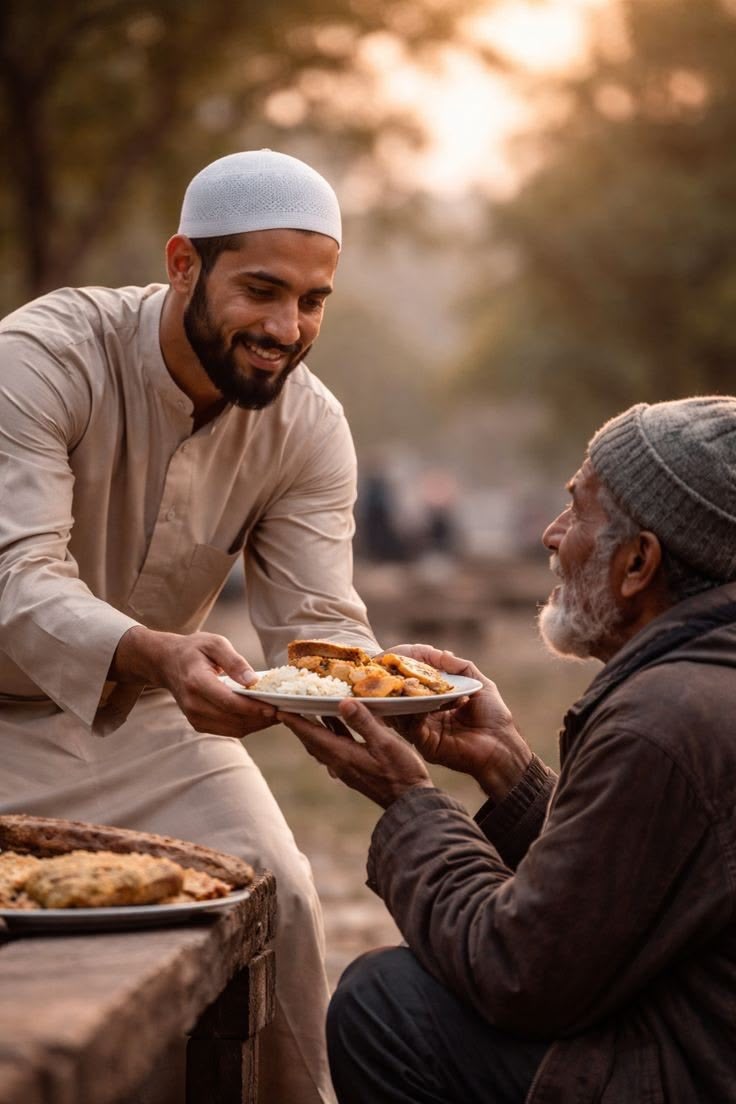
One of the greatest tests of faith is not simply how much we worship Allah, but how we treat the people around us, especially those who are struggling to meet their basic needs.
Every day, we encounter people who cannot afford three meals, parents who struggle to pay their children’s school fees, families who cannot afford proper medical care, widows raising children without support, and individuals who silently endure hardship because they are too ashamed to ask for help.
Unfortunately, it is possible to become so occupied with our personal comfort, ambitions and daily responsibilities that we forget those who are struggling around us.
We may build beautiful homes, purchase expensive clothes, enjoy comfortable lifestyles and celebrate our successes without remembering that some of our neighbours do not know where their next meal will come from.
Islam does not teach us to live only for ourselves. It teaches us to recognise the needs of others, show compassion, share our blessings and understand that wealth is a trust from Allah.
Helping the poor and needy is not merely an act of generosity. It is a responsibility that forms an important part of our faith.
1. Allah Has Made Caring for the Poor an Important Part of Faith
The Qur’an repeatedly reminds believers that righteousness is not limited to outward acts of worship. It must also be reflected in how we treat others.
Allah says:
“Righteousness is not that you turn your faces towards the east or the west, but [true] righteousness is in one who believes in Allah, the Last Day, the angels, the Book, and the prophets and gives wealth, in spite of love for it, to relatives, orphans, the needy, the traveller, those who ask [for help], and for freeing slaves…”
Surah Al-Baqarah 2:177
This verse provides an important understanding of Islamic righteousness.
A believer should not be concerned only about personal worship while remaining indifferent to the suffering of others.
Allah specifically mentions giving wealth to relatives, orphans, the needy and other vulnerable people as part of righteousness.
This teaches us that our relationship with Allah must influence our relationship with humanity.
A Muslim should therefore ask:
- Do I notice when someone around me is struggling?
- Do I make an effort to help people who genuinely need assistance?
- Am I generous with the blessings Allah has given me?
- Do I remember the poor when I spend money on myself?
Our faith should make us more compassionate, not more indifferent.
2. Wealth Is a Trust From Allah, Not Just a Personal Achievement
Many people become attached to their wealth because they see it as the result of their hard work, intelligence and personal sacrifice.
While Islam encourages lawful work, financial responsibility and the pursuit of a comfortable life, it also reminds us that everything we possess ultimately comes from Allah.
Allah says:
“And give them from the wealth of Allah which He has given you.”
Surah An-Nur 24:33
Notice how Allah describes wealth: it is wealth that He has given us.
This changes how a believer should view financial blessings.
Your salary, business profits, investments, property and other possessions are blessings for which you will be accountable.
Having wealth does not mean that a person is better than someone who is poor. Likewise, being poor does not mean that someone is less valuable in the sight of Allah.
Wealth is a test.
Allah says:
“And know that your wealth and your children are but a trial and that Allah has with Him a great reward.”
Surah Al-Anfal 8:28
Some people are tested through poverty, while others are tested through abundance.
The question is not simply how much Allah has given us, but what we do with what He has entrusted to us.
Will our wealth make us grateful and generous, or will it make us arrogant and selfish?
3. Feeding the Poor Is a Sign of True Faith
One of the clearest ways Islam demonstrates the importance of caring for the needy is through its emphasis on feeding the hungry.
Allah describes the righteous in Surah Al-Insan:
“And they give food in spite of love for it to the needy, the orphan, and the captive.”
Surah Al-Insan 76:8
These people give food even though they themselves love and value what they possess.
They do not wait until they have everything they desire before helping others.
They understand that sharing what Allah has provided is an act of worship.
Allah also warns against neglecting the hungry and vulnerable.
He says:
“Have you seen the one who denies the Recompense? For that is the one who drives away the orphan and does not encourage the feeding of the poor.”
Surah Al-Ma’un 107:1–3
This is a powerful warning.
Allah connects denying the Day of Judgment with mistreating orphans and failing to encourage the feeding of the poor.
It teaches us that our treatment of vulnerable people is not a minor matter.
A person cannot claim to be deeply concerned about Islam while deliberately ignoring the suffering of those who need help.
4. Giving Charity Does Not Make You Poor
One of the reasons some people hesitate to give is the fear that helping others will reduce their own financial security.
They worry that if they give too much, they may eventually need help themselves.
Islam teaches a different understanding of charity.
The Prophet Muhammad (peace and blessings be upon him) said:
“Charity does not decrease wealth.”
Sahih Muslim 2588
This does not mean that giving charity will always produce an immediate financial increase in your bank account.
Rather, it teaches that charity does not bring true loss. Allah blesses the giver, rewards the act of generosity and may replace what is given with something better.
A person who gives sincerely should not imagine that they have lost something simply because another person has benefited.
Sometimes, the greatest blessing is not receiving more money but having peace of mind, a grateful heart and the opportunity to earn Allah’s pleasure.
Give according to your ability. You do not need to be wealthy before you become generous.
A small amount given sincerely may mean the difference between hunger and a meal for someone else.
5. The Poor Have Rights Over the Wealth of the Believers
Islam does not treat caring for the poor as an occasional charitable activity that people can simply ignore.
Zakah is one of the five pillars of Islam.
It is an obligatory act of worship that purifies wealth and supports eligible recipients in society.
Allah says:
“And in their wealth was a recognised right for the needy and the deprived.”
Surah Adh-Dhariyat 51:19
This verse reminds us that the needy have a recognised right in the wealth of the righteous.
Zakah is therefore not a favour that wealthy Muslims are doing for poor Muslims. It is an obligation established by Allah.
Allah also identifies the categories of people eligible to receive Zakah in Surah At-Tawbah 9:60. These include the poor, the needy, those employed to administer Zakah, those whose hearts are to be reconciled, those in bondage, debtors, causes in the way of Allah and stranded travellers, according to the conditions of the verse.
Beyond obligatory Zakah, Muslims are encouraged to give voluntary charity (Sadaqah).
This includes helping someone pay school fees, providing food, supporting a struggling family, assisting with medical expenses and offering financial relief to someone facing genuine hardship.
We should never confuse our voluntary generosity with our obligatory Zakah. Both are important, but they are not the same.
6. Do Not Humiliate People When Helping Them
Another important lesson in Islam is that charity must be accompanied by good character.
Some people give money to the poor but destroy the value of their generosity by humiliating the recipients.
They announce their donations publicly to attract praise, remind people repeatedly of what they have done, or make those receiving assistance feel inferior.
Islam strongly discourages this behaviour.
Allah says:
“O you who believe! Do not invalidate your charities with reminders or injury…”
Surah Al-Baqarah 2:264
This verse teaches that charity should not become a means of hurting another person’s dignity.
When helping someone:
- Do not insult them because they are poor.
- Do not make them beg unnecessarily.
- Do not expose their personal struggles without permission.
- Do not remind them repeatedly of your assistance.
- Do not use their hardship to promote yourself.
- Do not treat them as though they are beneath you.
The person receiving assistance may be going through a temporary difficulty, while Allah may test you with a similar situation tomorrow.
Give with humility.
Remember that the person receiving your charity may be the means through which Allah grants you His mercy.
7. Caring for the Poor Begins With Those Closest to Us
Sometimes, people are enthusiastic about donating to distant charitable causes but overlook struggling relatives and neighbours.
They may contribute to public fundraising campaigns while failing to notice that someone within their extended family is battling serious financial difficulties.
Islam places great importance on maintaining family relationships and fulfilling the rights of relatives.
Allah says:
“They ask you what they should spend. Say, ‘Whatever you spend of good is [to be] for parents and relatives and orphans and the needy and the traveller…'”
Surah Al-Baqarah 2:215
This verse identifies parents, relatives, orphans, the needy and travellers among those deserving support.
The Prophet Muhammad (peace and blessings be upon him) also explained the special reward of helping relatives.
He said:
“Charity given to a poor person is charity, and charity given to a relative is two things: charity and upholding family ties.”
Jami’ at-Tirmidhi 658; Sunan an-Nasa’i 2582
This teaches us that helping a struggling relative carries the reward of charity and maintaining family ties.
Before looking far away, look around you.
Is there an elderly parent who needs assistance? Is there a relative struggling to pay rent? Is there a widow in your family who needs support? Is there a neighbour who quietly goes without basic necessities?
Do not allow your concern for the wider community to make you forget the people Allah has placed closest to you.
8. Helping the Poor Is More Than Giving Money
Although financial assistance is extremely important, caring for the needy goes beyond handing out cash.
Not everyone has enough money to support others financially, but almost everyone can contribute something.
You can:
- Share food with a struggling neighbour.
- Help a young person acquire a useful skill.
- Pay for someone’s examination or school fees if you can afford it.
- Help a struggling family access medical assistance.
- Connect an unemployed person with a genuine job opportunity.
- Support a widow or orphan.
- Offer your time and skills to a charitable organisation.
- Help someone establish a small, sustainable business.
- Speak kindly to people who are struggling.
The Prophet Muhammad (peace and blessings be upon him) said:
“Every act of goodness is charity.”
Sahih Muslim 1005
This hadith reminds us that charity is not restricted to money.
A kind word, useful assistance and sincere effort to make someone’s life easier are also forms of goodness.
Never underestimate what you can do simply because you cannot afford to give large sums of money.
9. Do Not Wait Until Ramadan or Eid Before Remembering the Poor
Ramadan is a special season of generosity, and Muslims are encouraged to increase their charitable activities during this blessed month.
Similarly, many people remember the poor during Eid, especially through Zakat al-Fitr.
However, the needs of the poor do not disappear after Ramadan.
Hunger does not take a break after Eid. Rent does not wait until Ramadan. Children still need school supplies, and sick people still need treatment.
A truly compassionate Muslim should develop a consistent attitude of generosity.
Make helping others part of your lifestyle.
You can set aside a small amount from your monthly income for charitable purposes. You can also identify trustworthy organisations that support vulnerable families and contribute regularly.
Do not make generosity something you practise only when everyone around you is doing it.
The believer should remain conscious of the needs of others throughout the year.
10. Remember That One Day, You May Be the Person Who Needs Help
One of the greatest mistakes people make is assuming that their present circumstances will never change.
A person who is financially comfortable today may face hardship tomorrow.
Someone who currently enjoys good health may become ill. A successful business may collapse. A stable source of income may disappear.
Life is full of unexpected changes.
The same people we ignore today may be the people we need tomorrow.
Allah reminds us:
“Indeed, Allah commands you to render trusts to whom they are due…”
Surah An-Nisa 4:58
Among our responsibilities is fulfilling the trusts and rights that Allah has placed upon us.
We should therefore treat people with compassion, knowing that our circumstances are temporary and that every blessing comes with accountability.
Never allow wealth to make you look down on someone who has less than you.
Never allow success to make you forget the struggles you once experienced.
And never assume that the poor have nothing to offer society.
A person may have little in worldly possessions but possess a level of sincerity, patience and faith that is far greater than yours.
Conclusion: What Will You Do With the Blessings Allah Has Given You?
Dear brothers and sisters, the responsibility of Muslims towards the poor and needy is not something we should take lightly.
Allah has blessed some of us with wealth, good health, businesses, employment and opportunities. Others are struggling to meet their most basic needs.
These differences in circumstances are part of the tests of this life.
The question we must ask ourselves is whether we are using our blessings in ways that please Allah.
Do we remember the hungry when we sit down to eat? Do we remember the struggling families when we spend money on unnecessary luxuries? Do we notice the orphans, widows, elderly people and vulnerable members of our communities?
Most importantly, do we fulfil the rights Allah has placed in our wealth?
Let us not become Muslims who are concerned only about personal success while ignoring the suffering of others.
Let us pay our Zakah correctly, give voluntary charity sincerely, support our relatives, care for our neighbours and help those who genuinely need assistance.
We may not be able to solve every problem in the world, but we can make a difference in someone’s life.
Sometimes, a bag of rice can feed a family. A school fee payment can keep a child in school. Assistance with medical bills can help someone receive treatment. A small act of kindness can restore hope to someone who has almost given up.
Never underestimate the value of helping another human being.
Remember, the wealth we keep will eventually be left behind, but the good we sincerely do for the sake of Allah will remain with us.
May Allah make us among those who are generous, compassionate and mindful of the rights of the poor and needy. May He provide for those who are struggling, ease the difficulties of those in hardship, bless our wealth and accept our charity. Ameen.
A FINAL REMINDER
Before this Friday ends, identify one person or family who genuinely needs assistance and do something meaningful to help them.
It does not have to be a large donation. It does not have to be public. It does not have to attract recognition.
Do it sincerely for the sake of Allah.
Perhaps the person whose burden you lighten today will be a means of your salvation in the Hereafter.
3SixtyIslam – Inspiring Muslims to Live Islam Every Day.
