


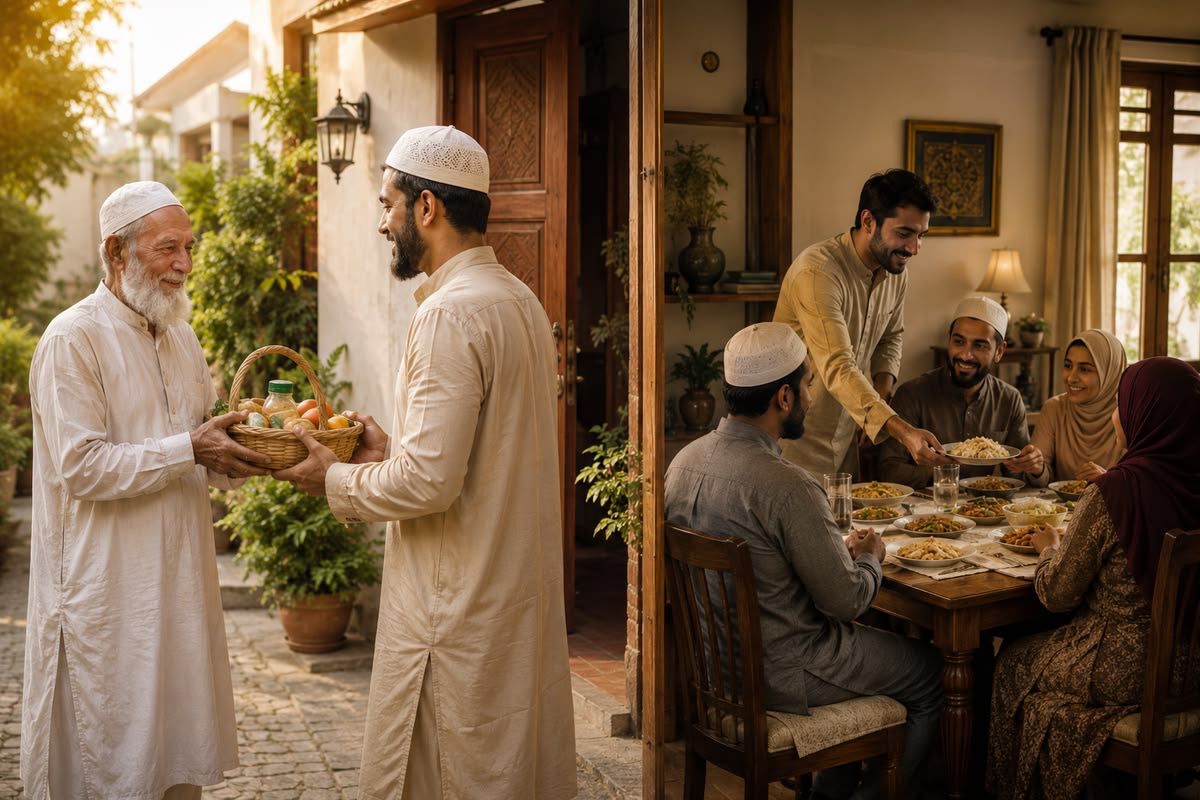
In a world where many people can live next door to someone for years without knowing their name, Islam teaches something very different.
Your neighbour is not simply the person whose house is beside yours.
Your neighbour has rights.
They have a right to safety. A right to good treatment. A right to consideration. A right not to be harmed by you. And, when they are in need, they may have a right to your kindness and assistance.
This is one of the beautiful things about Islam: it does not limit good character to the mosque.
Islam follows you home.
It follows you into your workplace, your street, your apartment building, your compound and your community. It teaches that how you treat the people around you is part of your relationship with Allah.
And among the people Islam repeatedly draws our attention to are our neighbours.
ALLAH MENTIONS THE NEIGHBOUR IN THE QUR’AN
Allah says:
“And worship Allah and associate nothing with Him, and to parents do good, and to relatives, orphans, the needy, the near neighbour, the neighbour farther away…”
(Qur’an 4:36)
Look at the position of the neighbour in this verse.
Allah commands worship of Him, then mentions a number of people toward whom Muslims are expected to show goodness. Among them are parents, relatives, orphans, the needy and neighbours.
This tells us something important.
Being a good Muslim is not only about what happens between you and Allah. Your faith should also influence how you treat the people Allah has placed around you.
You cannot claim to care about righteousness while deliberately making life miserable for everyone living around you.
Your Islam should be visible in your character.
THE PROPHET ﷺ EMPHASISED THE RIGHTS OF THE NEIGHBOUR
The Prophet Muhammad ﷺ placed enormous emphasis on good treatment of neighbours.
Abu Hurayrah رضي الله عنه reported that the Messenger of Allah ﷺ said:
“Jibril kept recommending me to treat my neighbours well until I thought that he would make them my heirs.”
(Sahih al-Bukhari and Sahih Muslim)
Think about that.
Jibril عليه السلام repeatedly brought the instruction to the Prophet ﷺ concerning neighbours until the Prophet ﷺ thought that perhaps neighbours would even be given inheritance rights.
This shows how seriously Islam treats the subject.
The neighbour is not a minor social issue.
It is part of Islamic character.
YOU CAN WORSHIP ALL NIGHT AND STILL HARM YOUR NEIGHBOUR
This is where the subject becomes uncomfortable.
A person may pray regularly.
They may fast.
They may give charity.
They may attend the mosque.
They may speak constantly about Islam.
But if they deliberately harm the people living around them, something is seriously wrong with their understanding of Islamic character.
The Prophet ﷺ warned strongly about harming one’s neighbour.
He said:
“By Allah, he does not believe! By Allah, he does not believe! By Allah, he does not believe.”
The Companions asked who he was referring to, and he ﷺ said:
“The one whose neighbour is not safe from his evil.”
(Sahih al-Bukhari)
This does not mean that every mistake automatically takes a person outside Islam. Rather, it is a severe warning showing how dangerous it is for a Muslim to harm their neighbour.
A neighbour should be able to feel safe around you.
They should not constantly fear your behaviour.
They should not have to tolerate deliberate abuse, intimidation, insults or unnecessary disturbance from you.
WHAT DOES IT MEAN TO HARM A NEIGHBOUR?
Harming a neighbour does not always mean physically attacking them.
Sometimes harm comes in much more ordinary forms.
Playing extremely loud music late at night.
Blocking someone’s entrance.
Throwing rubbish where it affects others.
Allowing water or waste to flow into another person’s property.
Parking carelessly and repeatedly preventing someone from accessing their home.
Creating unnecessary noise.
Gossiping about neighbours.
Spreading rumours about their family.
Watching their movements unnecessarily.
Invading their privacy.
Insulting them during disagreements.
Allowing children to repeatedly disturb others without addressing the issue.
Keeping animals in a way that causes unnecessary harm or disturbance.
These things may appear small to the person doing them.
But the person experiencing them may be dealing with the consequences every day.
Islam teaches us to consider the effect of our actions on others.
YOUR NEIGHBOUR DOES NOT HAVE TO BE MUSLIM
One of the important lessons here is that Islamic good character is not restricted to Muslims.
The Qur’an commands goodness toward neighbours without making good treatment dependent upon whether the neighbour shares your faith.
A Muslim may live beside Christians, traditional religious communities, people of other faiths, or people who have no religion.
They are still human beings with rights.
You can disagree with someone’s beliefs while treating them with justice and kindness.
That is part of Islamic character.
The Prophet ﷺ demonstrated this principle through his dealings with people of different backgrounds and faiths.
Islam does not teach Muslims to become bad neighbours simply because someone does not share their religion.
BE THE NEIGHBOUR PEOPLE ARE HAPPY TO HAVE
Imagine moving into a new neighbourhood.
What kind of person would you want living beside you?
Someone who greets you respectfully?
Someone who checks on you when you are sick?
Someone who keeps the environment peaceful?
Someone who returns something you accidentally dropped?
Someone who does not interfere unnecessarily in your private life?
Someone who is willing to help when there is genuine need?
That is the kind of neighbour Islam encourages you to become.
And sometimes you do not need to do anything extraordinary.
A simple greeting can matter.
Sharing food can matter.
Checking on someone can matter.
Helping an elderly neighbour carry something can matter.
Offering assistance when someone is struggling can matter.
Being considerate with noise can matter.
Islamic character often appears through small actions that other people remember for years.
THE PROPHET ﷺ TAUGHT MUSLIMS TO SHARE FOOD
The Prophet ﷺ also encouraged consideration toward neighbours in matters as simple as food.
Abu Dharr رضي الله عنه reported that the Prophet ﷺ said:
“O Abu Dharr, when you cook a broth, add more water to it and take care of your neighbours.”
(Sahih Muslim)
There is something beautiful about this instruction.
The Prophet ﷺ did not tell Muslims that you must prepare expensive meals for everyone around you.
He taught generosity according to your ability.
If you have enough, share.
If you are cooking something, remember the people around you.
If you have been blessed with food while someone nearby may be struggling, do not allow your heart to become so occupied with yourself that you forget them.
DO NOT LET YOUR NEIGHBOUR DISCOVER YOUR BLESSING WHILE THEY ARE IN NEED
This is particularly relevant in a world where people display their lives constantly.
Someone may be struggling financially while seeing their neighbours regularly receive deliveries, host large gatherings and purchase expensive things.
Islam teaches us to develop sensitivity.
This does not mean you must hide every blessing Allah has given you.
It means you should not become so obsessed with displaying what you have that you become blind to the circumstances of those around you.
Sometimes the most beautiful form of generosity is quiet.
You help without humiliating.
You give without reminding.
You support without making the person feel inferior.
That is the dignity Islam encourages.
YOUR NEIGHBOUR’S PRIVACY MATTERS
Modern life has made privacy increasingly difficult.
People know when their neighbours leave.
They know who visits.
They notice what arrives at someone’s house.
They hear conversations.
They see family disagreements.
And sometimes people turn this information into entertainment.
They discuss it with others.
They send messages.
They gossip.
They speculate.
But Islam teaches Muslims to protect people’s dignity.
The Qur’an warns believers against spying and backbiting.
Allah says:
“And do not spy or backbite each other.”
(Qur’an 49:12)
Your neighbour’s private life is not community entertainment.
If you happen to notice something that does not concern you, learn to leave it alone.
Not everything you know needs to become something you tell someone else.
WHEN NEIGHBOURS DISAGREE
Of course, neighbours will sometimes have disagreements.
Someone will park badly.
Someone will make noise.
A boundary may be disputed.
Children may have a disagreement.
Someone may feel that another person has behaved disrespectfully.
Islam does not demand that you pretend problems do not exist.
Instead, it teaches us to handle problems with justice and self-control.
Speak directly when appropriate.
Avoid unnecessary humiliation.
Do not immediately involve the entire neighbourhood.
Do not turn one disagreement into a lifelong feud.
Do not allow Shaytan to transform a small issue into hatred between families.
And if you have made a mistake, apologise.
There is nothing un-Islamic about saying:
“I was wrong.”
In fact, sometimes that sentence can save years of conflict.
THE NEIGHBOUR YOU DO NOT LIKE STILL HAS RIGHTS
This may be one of the hardest lessons.
It is easy to be kind to someone you like.
Islamic character becomes more meaningful when you are dealing with someone who irritates you.
You may dislike their personality.
You may disagree with them.
You may have had an unpleasant experience with them.
But dislike does not give you permission to become unjust.
Allah says:
“Do not let the hatred of a people cause you to be unjust. Be just; that is nearer to righteousness.”
(Qur’an 5:8)
The principle extends beyond neighbours, but it provides a powerful lesson for neighbourhood relationships.
You can dislike someone’s behaviour without becoming an unjust person yourself.
YOUR NEIGHBOUR MAY BE TESTING YOUR CHARACTER
Sometimes Allah places difficult people around us.
Not every difficult person is there because Allah wants to punish us.
Sometimes difficult relationships reveal what is inside us.
How patient are you?
How quickly do you become angry?
Can you control your tongue?
Can you forgive?
Can you communicate?
Can you remain fair when you are frustrated?
Can you choose peace when your ego wants revenge?
These are spiritual questions.
A difficult neighbour can therefore become an unexpected test of character.
THE COMMUNITY BEGINS AT YOUR DOOR
We often talk about improving the Muslim community.
We want stronger mosques.
Better schools.
More charity.
More unity.
More brotherhood.
All of these things matter.
But communities are made up of individuals.
And those individuals live somewhere.
They have neighbours.
If Muslims become people who are trustworthy, considerate, generous and safe to live beside, they are already strengthening the community.
You do not have to be famous to make an impact.
You can change the atmosphere of your street simply by becoming a better neighbour.
BEFORE YOU ASK WHAT YOUR NEIGHBOUR IS DOING, ASK WHAT KIND OF NEIGHBOUR YOU ARE
It is easy to complain about other people.
Their noise.
Their behaviour.
Their children.
Their visitors.
Their parking.
Their lifestyle.
Their habits.
But before constantly examining someone else’s behaviour, examine your own.
Am I considerate?
Do I disturb people?
Do I gossip?
Do I help?
Do I greet people?
Do people feel safe around me?
Would my neighbour describe me as someone who brings peace or problems?
These questions can reveal more about our character than we realise.
A SIMPLE CHALLENGE FOR EVERY MUSLIM
This week, do something for a neighbour.
It does not have to be expensive.
Check on someone.
Share food.
Offer help.
Greet them properly.
Help an elderly neighbour.
Resolve an old misunderstanding.
Stop doing something that unnecessarily disturbs them.
If there has been tension, take the first step toward peace where appropriate.
And if you have a neighbour who is struggling, do not assume someone else will help.
Maybe Allah placed that person beside you because He wants you to be part of the solution.
CONCLUSION
Islam takes neighbours seriously because Islam takes human relationships seriously.
Your worship is not disconnected from your character.
Your salah should influence your behaviour.
Your fasting should influence your patience.
Your Qur’an should influence your speech.
Your belief in Allah should influence how you treat the people around you.
The person living next door to you may never enter your mosque.
They may never read your Islamic posts.
They may never hear you give a reminder.
But they will experience your character.
And sometimes, the strongest representation of Islam is not what we say.
It is how safe, respected and valued people feel when they are around us.
So ask yourself today:
If my neighbour had to describe me in one sentence, what would they say?
May Allah make us people who bring peace wherever we live, protect the rights of those around us, and represent Islam through beautiful character.
Ameen.
3SIXTYISLAM
At 3SixtyIslam, we believe Islam is not only a religion we practise in the mosque it is a way of life that shapes how we worship, work, travel, relate to others and build our communities.
Follow 3SixtyIslam for more Islamic articles, reminders, stories, practical guidance and beneficial knowledge for everyday Muslim life.
