


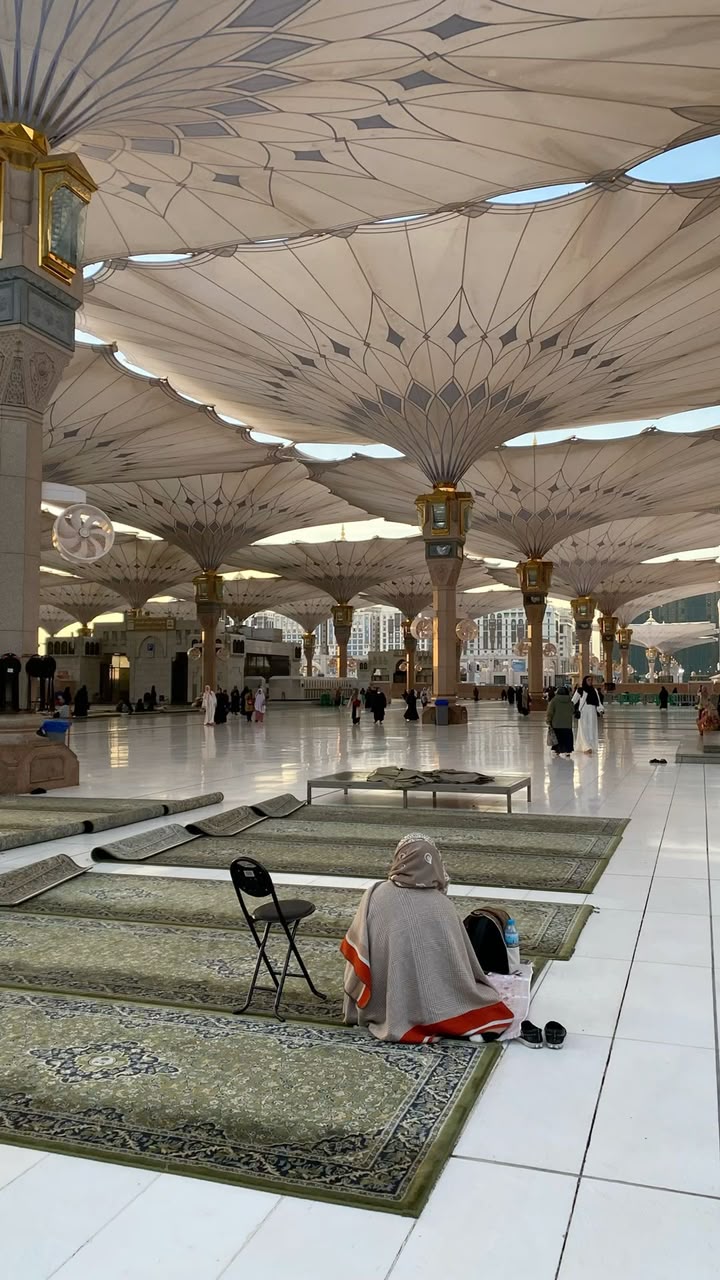
For many Muslims, Friday begins when the time for Jumu’ah prayer approaches. People finish work, close their businesses, leave their homes and head towards the mosque shortly before the prayer begins.
But the Sunnah gives us a very different picture of how Friday should be approached.
The Prophet Muhammad ﷺ encouraged Muslims to go to the mosque early for Jumu’ah, and the reward described for those who arrive early is remarkable.
In fact, the earlier a person arrives, the greater the reward recorded for that person’s effort.
This is one of those teachings that many Muslims hear but may not fully appreciate.
THE ANGELS ARE AT THE DOORS OF THE MOSQUE
Abu Hurairah رضي الله عنه reported that the Messenger of Allah ﷺ said that when Friday comes, angels stand at the doors of the mosque and record the people according to the order in which they arrive.
The Prophet ﷺ then gave examples of the different levels of reward.
The person who comes first is compared to someone who offers a camel in sacrifice. The next is compared to someone who offers a cow, followed by a ram, a chicken and then an egg.
The hadith is recorded in both Sahih al-Bukhari and Sahih Muslim.
This is not simply a lesson about punctuality.
It shows that Allah rewards the effort a person makes to get to Jumu’ah early.
THE EARLIER YOU COME, THE GREATER THE REWARD
The comparison in the hadith is powerful because the Prophet ﷺ deliberately used different levels of sacrifice to illustrate the difference.
The earliest person receives the greatest comparison: a camel.
The next receives the comparison of a cow.
Then comes the ram, followed by the chicken and finally the egg.
The point is not that a person is literally sacrificing these animals by arriving at the mosque. Rather, the Prophet ﷺ was explaining the enormous difference between the rewards associated with arriving at different times.
This means that there is a spiritual value in making the effort to arrive early.
Someone who regularly walks into the mosque just before the prayer begins should not assume that they have received exactly the same opportunity as the person who deliberately made time to arrive much earlier.
The Sunnah encourages us to make Jumu’ah part of our schedule rather than trying to squeeze Jumu’ah into whatever time remains after everything else.
THE ANGELS RECORD THE ORDER OF ARRIVAL
There is another detail in the hadith that deserves attention.
The angels are described as recording the people according to their order of arrival.
This means that the effort to arrive early is known and recorded.
You may arrive at the mosque before most people and nobody may notice.
Nobody may congratulate you.
Nobody may even know that you rearranged your schedule, left work earlier or travelled a longer distance to make it there.
But Allah knows.
The hadith reminds us that acts of worship are not measured by human recognition.
A person may sit quietly in the mosque for some time before Jumu’ah and appear to be doing very little from the perspective of other people. Yet their early arrival itself is part of the virtue described in the Sunnah.
WHEN THE IMAM COMES, SOMETHING CHANGES
The hadith also tells us that the angels remain at the doors recording those who arrive.
But when the Imam comes and sits for the khutbah, the angels close their records and turn their attention to listening to the reminder.
This gives us another important lesson.
There is a period before the khutbah during which arriving early has a special virtue.
Once the Imam begins the khutbah, the focus changes.
Now the Muslim should listen attentively to the sermon.
This is why arriving early should not be understood as simply getting to the mosque five minutes before the prayer starts.
The Sunnah encourages Muslims to make use of the time before the khutbah.
WHAT SHOULD YOU DO AFTER ARRIVING EARLY?
Arriving early is not merely about finding a comfortable place and waiting.
It can become valuable worship time.
A Muslim can use the time to pray voluntary prayers, read Qur’an, make dhikr, send Salawat upon the Prophet ﷺ and make dua.
The exact practices a person chooses should be based on what is established and permissible, rather than assuming that every action commonly associated with Friday has a special prescribed reward.
The important point is that arriving early gives you time to prepare your heart before the khutbah and Jumu’ah prayer.
Instead of rushing into the mosque while the Imam is already speaking, you can arrive calmly, settle down and prepare yourself for worship.
WHAT DOES “THE FIRST HOUR” MEAN?
One thing that sometimes causes confusion is the phrase “first hour” mentioned in some translations of the hadith.
This does not necessarily mean the first 60 minutes after midnight or the first 60 minutes after Fajr.
The hadith describes successive periods of time before the Imam comes for the khutbah, with those arriving earlier receiving the greater reward.
Scholars have discussed how these periods should be understood, including differences concerning how the daytime period is divided.
The important practical lesson is straightforward: the earlier you arrive before the Imam begins the khutbah, the greater the virtue described in the hadith.
We therefore should not become overly focused on calculating the exact minute that corresponds to “the first hour” while missing the broader message of the Sunnah.
THIS IS WHY FRIDAY SHOULD BE PLANNED
One reason many Muslims arrive late for Jumu’ah is that Friday is treated like an ordinary day.
Work continues.
Traffic continues.
Business continues.
Appointments continue.
Then, when the time for Jumu’ah approaches, the person suddenly remembers that they need to get to the mosque.
Islam teaches us to approach Friday differently.
If you know when Jumu’ah begins at your local mosque, plan around it.
Finish what needs to be finished earlier.
Give yourself enough time for the journey.
Account for traffic.
Perform your preparation without rushing.
Then arrive at the mosque with enough time to worship before the khutbah.
This is a much better way to approach Jumu’ah than making it a race against the clock every Friday.
ARRIVING EARLY IS ALSO ABOUT RESPECTING THE KHUTBAH
Another important benefit of arriving early is that you are less likely to disturb other worshippers.
Someone who arrives after the khutbah has started may need to walk across rows, search for a place and potentially distract people who are listening.
By arriving early, you can settle down before the sermon begins.
Once the Imam starts the khutbah, your responsibility is to listen attentively.
The hadith itself describes the angels turning their attention to the remembrance when the Imam begins. (sunnah.com)
That should make us think about how seriously we approach the khutbah.
The khutbah is not background noise.
It is part of the Jumu’ah experience.
DON’T WAIT UNTIL THE LAST MINUTE
There is a habit that many Muslims should seriously reconsider.
Arriving at the mosque exactly when the prayer is about to begin may mean that you have fulfilled the obligation of attending Jumu’ah, but you may have missed the special opportunity of arriving early.
The hadith gives us a reason to do better.
Instead of asking, “What is the latest time I can leave home and still make Jumu’ah?”
Ask:
“How early can I reasonably get there so I can benefit from the virtue of early arrival?”
That change in mindset can completely change the way we experience Friday.
IT IS NOT ABOUT COMPETING WITH OTHER MUSLIMS
The encouragement to arrive early should not turn into competition, pride or looking down on people who arrive later.
Some people have legitimate circumstances that affect when they can reach the mosque.
A worker may have a demanding schedule.
A person may be caring for children or an elderly relative.
Someone may have difficulty with transportation.
Another person may live far from the mosque.
Islam takes circumstances into account.
The purpose of the hadith is to encourage those who are able to arrive early to take advantage of the opportunity.
It is not an invitation to judge everyone who walks through the mosque door after you.
THE BIGGER LESSON
There is a deeper lesson behind this Sunnah.
Allah rewards preparation.
The person who decides in advance that Jumu’ah matters enough to rearrange their schedule is already approaching worship differently from the person who treats it as something to fit in at the last minute.
This applies beyond Friday.
Many things in our religious lives improve when we stop waiting until the last moment.
Prayer improves when we plan around it.
Qur’an improves when we create time for it.
Dua improves when we deliberately make time to speak to Allah.
And Jumu’ah becomes more meaningful when we prepare for it before the khutbah even begins.
MAKE EARLY ARRIVAL YOUR FRIDAY HABIT
This Friday, try something simple.
Don’t aim to arrive just before the Imam begins the khutbah.
Aim to arrive earlier.
Give yourself enough time to enter the mosque without rushing. Sit down calmly. Worship. Reflect. Make dua. Read Qur’an. Send Salawat upon the Prophet ﷺ and prepare your mind for the khutbah.
You may not see the angels recording your arrival.
You may not know exactly how your reward is being written.
But the Prophet ﷺ has already told us that the order of arrival matters.
The person who makes the extra effort to arrive early is not simply sitting in a mosque for longer.
They are responding to a Sunnah.
And sometimes, the difference between an ordinary Jumu’ah and a deeply rewarding Jumu’ah is simply how early we decided to show up.
THIS FRIDAY, DON’T JUST ATTEND JUMU’AH — PREPARE FOR IT
Jumu’ah should not be something we rush into.
It should be something we prepare for.
The Prophet ﷺ gave us a clear incentive: those who arrive earlier receive a greater virtue, with the earliest compared to one who offers a camel in sacrifice.
So, if you are able to do it, make a change this Friday.
Leave earlier.
Arrive earlier.
Worship before the khutbah.
Listen attentively when the Imam begins.
And make Jumu’ah a part of your week that you deliberately prepare for, rather than something you simply manage to catch.
3SIXTYISLAM
For reliable Islamic knowledge, practical Muslim lifestyle content, and trusted Hajj and Umrah guidance, follow 3SixtyIslam. Our goal is to provide useful Islamic knowledge that Muslims can learn from, apply in their daily lives and return to whenever they need reliable guidance.
