


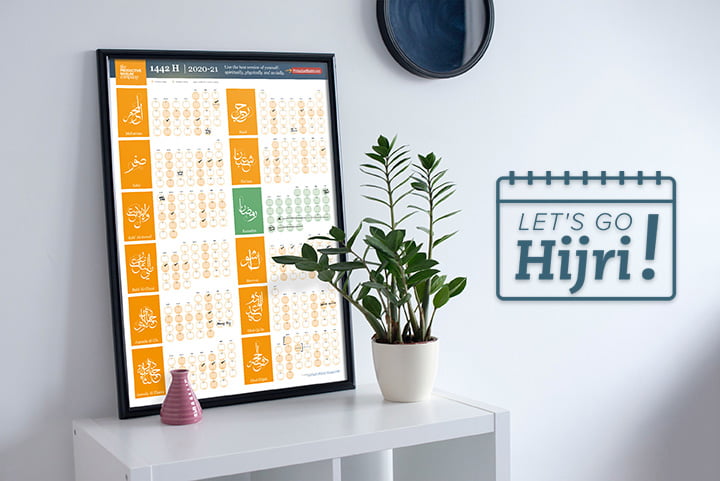
Every year, Muslims welcome months such as Muharram, Ramadan, Dhul-Hijjah and Rabi’ al-Awwal. Unlike the Gregorian calendar, which begins in January and ends in December, the Islamic calendar follows a completely different system.
But have you ever wondered who introduced the Hijri calendar and why the Muslim world adopted it?
The answer takes us back to the time of the second Caliph, Umar ibn Al-Khattab (RA).
THE PROBLEM OF UNDATED LETTERS
During the rapidly expanding Islamic state, official letters and government documents were regularly exchanged between Madinah and different provinces.
One day, a governor received an official letter that contained instructions but no date. This created confusion because it was impossible to know exactly when the letter had been written.
The issue was brought to Caliph Umar ibn Al-Khattab (RA), who realised that the Muslim community needed a standard calendar for administration, record-keeping and communication.
HOW DID THEY CHOOSE THE STARTING POINT?
Umar (RA) gathered the senior companions of the Prophet ﷺ to discuss the matter.
Several important events were suggested as the beginning of the Islamic calendar.
Some proposed the year the Prophet ﷺ was born.
Others suggested the year he received the first revelation.
Another suggestion was to begin from the year of his passing.
After careful discussion, the companions agreed that the most suitable event was the Hijrah—the migration of the Prophet ﷺ and his companions from Makkah to Madinah.
This event marked the establishment of the first Muslim society and changed the course of Islamic history.
For that reason, the calendar became known as the Hijri Calendar.
WHY WAS MUHARRAM CHOSEN AS THE FIRST MONTH?
An interesting fact is that the Hijrah itself did not take place in Muharram.
It occurred later in the year.
However, the companions chose Muharram as the first month because it was already recognised as the beginning of the new year among the Arabs, and it followed the period in which many Muslims made the pledge that eventually led to the Hijrah.
This decision provided a practical and organised way to structure the calendar.
A LUNAR CALENDAR
Unlike the Gregorian calendar, which is based on the movement of the sun, the Hijri calendar follows the phases of the moon.
Each month begins with the sighting of the new crescent.
Because a lunar year is about eleven days shorter than a solar year, Islamic months move through different seasons over time.
This is why Ramadan and Hajj do not occur in the same season every year.
Over several decades, they gradually pass through summer, winter, spring and autumn.
WHY IS THE HIJRI CALENDAR IMPORTANT?
The Hijri calendar is not simply a historical record.
Many acts of worship depend on it.
Muslims use it to determine:
- The beginning and end of Ramadan.
- The days of Hajj.
- Eid al-Fitr.
- Eid al-Adha.
- The Day of Arafah.
- The Day of Ashura.
- The payment of Zakah in many cases.
- Other important dates in the Islamic year.
Without the Hijri calendar, it would not be possible to organise many of these acts of worship correctly.
WHAT CAN MUSLIMS LEARN FROM THIS?
The establishment of the Hijri calendar shows the foresight and organisational ability of the early Muslim community.
Rather than choosing an event that focused on an individual’s birth or death, they chose the Hijrah because it represented the beginning of a new chapter for Islam—a chapter built on faith, sacrifice and community.
Today, while Muslims use the Gregorian calendar for business, education and international affairs, the Hijri calendar remains an essential part of Islamic life.
It reminds us that our history is not measured only by years, but by the events that shaped the Muslim Ummah.
More than fourteen centuries after its introduction, the Hijri calendar continues to unite Muslims around the world, marking the occasions that define our worship and connect us with the legacy of the Prophet Muhammad ﷺ and his noble companions.
