


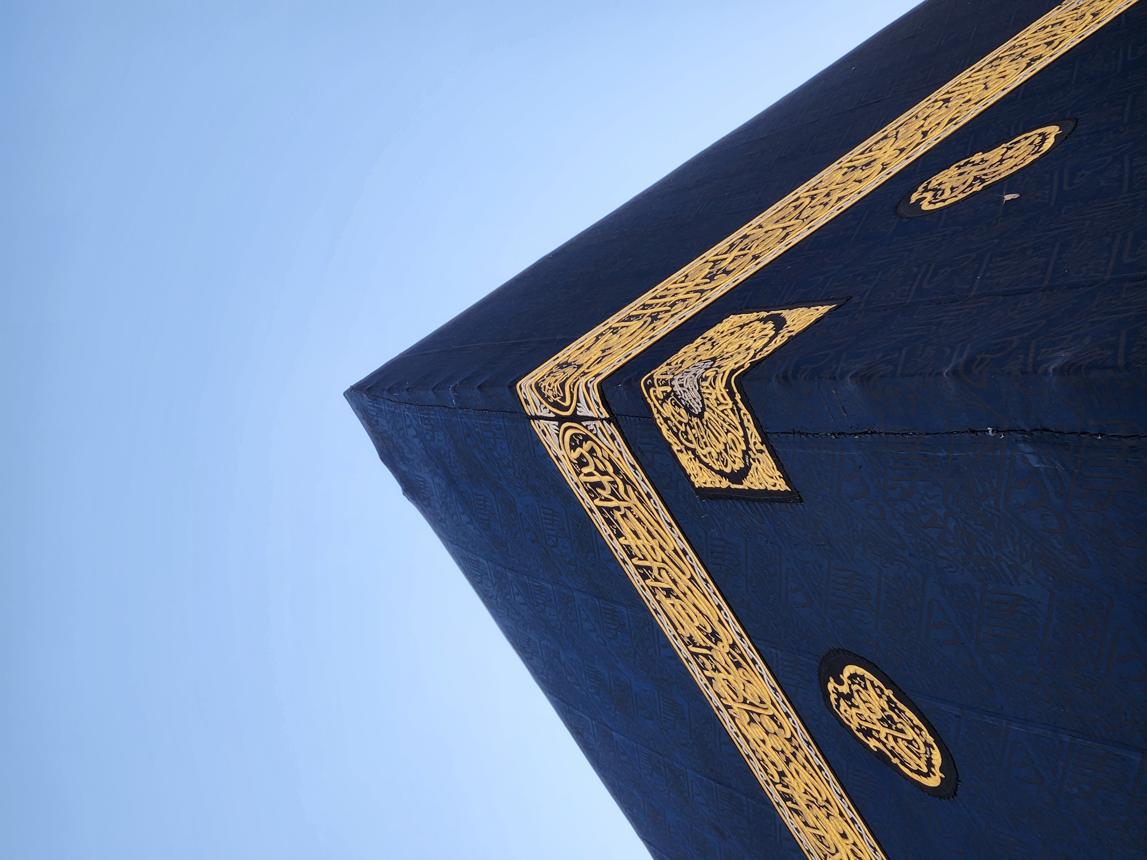
Millions of Muslims visit the Ka’bah every year during Hajj and Umrah. As they perform Tawaf around the Sacred House, one feature immediately stands out: the door of the Ka’bah is not at ground level. Instead, it is positioned about two metres above the ground, making it impossible to enter without a staircase.
This has led many Muslims to ask an interesting question: Why was the door of the Ka’bah built so high?
The answer lies in the long history of the Ka’bah and the decisions made by the Quraysh before the advent of Islam.
THE KA’BAH WAS NOT ALWAYS LIKE THIS
According to authentic Islamic sources, the Ka’bah has been rebuilt several times throughout history. Prophet Ibrahim (Abraham) عليه السلام and his son, Prophet Isma’il (Ishmael) عليه السلام, rebuilt it by Allah’s command after its original foundations had been established.
Centuries later, the Quraysh decided to rebuild the Ka’bah after it had been damaged by floods. This reconstruction took place about five years before the Prophet Muhammad ﷺ received revelation.
The Quraysh agreed that only wealth earned through lawful means should be used for the rebuilding. Because they did not have enough funds, they were unable to rebuild the Ka’bah exactly on the original foundations laid by Prophet Ibrahim عليه السلام.
As a result, they reduced the size of the building and made several structural changes.
WHY WAS THE DOOR RAISED?
One of the most significant changes made by the Quraysh was raising the entrance above ground level.
Their reason was practical rather than religious.
By placing the door high above the ground, they could decide who was allowed to enter the Ka’bah. Anyone wishing to go inside had to be given permission and provided with a ladder or staircase.
This gave the leaders of the Quraysh complete control over access to the Sacred House.
If they wished to honour someone, they allowed them in. If they wished to prevent someone from entering, they simply refused to provide access.
In this way, the raised door became a symbol of control rather than a requirement of Islamic worship.
WHAT DID THE PROPHET ﷺ SAY?
After the conquest of Makkah, the Prophet Muhammad ﷺ explained to his wife, Aishah (RA), that if the Quraysh had not been so close to their pre-Islamic beliefs, he would have rebuilt the Ka’bah on the original foundations of Prophet Ibrahim عليه السلام.
He also said he would have made two doors one for entering and one for exiting—and both doors would have been at ground level.
This authentic narration is recorded in both Sahih al-Bukhari and Sahih Muslim.
The Prophet ﷺ chose not to make these changes because he wanted to avoid causing confusion among the newly converted Muslims of Makkah.
His decision demonstrates an important principle of Islamic leadership: even when a change is correct, wisdom must be exercised in deciding the right time to implement it.
WHY HAS IT REMAINED THE SAME?
Years after the Prophet ﷺ passed away, Abdullah ibn al-Zubayr (RA) rebuilt the Ka’bah according to the Prophet’s description. He restored it to the original foundations of Prophet Ibrahim عليه السلام and built two doors at ground level.
However, after his rule ended, the Ka’bah was rebuilt once again by the Umayyad governor al-Hajjaj ibn Yusuf, who returned it to the design established by the Quraysh.
Since then, the structure has remained largely unchanged.
For this reason, the Ka’bah we see today still has a single elevated door.
DOES THE HEIGHT OF THE DOOR HAVE ANY RELIGIOUS SIGNIFICANCE?
Many people assume that the raised door has a special spiritual meaning, but there is no authentic evidence from the Qur’an or Sunnah to support this.
Its height is the result of historical construction decisions, not a prescribed act of worship.
The significance of the Ka’bah lies not in the position of its door, but in the fact that it is the first House established for the worship of Allah and the direction towards which Muslims around the world pray every day.
LESSONS FROM THIS HISTORY
The history of the Ka’bah’s door teaches us several important lessons.
First, understanding Islamic history helps us appreciate many of the features we observe in Makkah today.
Second, the Prophet ﷺ demonstrated remarkable wisdom by balancing what was ideal with what was beneficial for the Muslim community at that time.
Finally, the story reminds us that while buildings and structures may change over the centuries, the purpose of the Ka’bah has remained constant: it is the focal point of Muslim worship and a symbol of the unity of the Ummah.
The next time you see the Ka’bah or perform Tawaf around it, you will know that its elevated door is not a mystery. It is a historical feature that has remained for centuries, carrying with it an important chapter in the history of Islam.
