


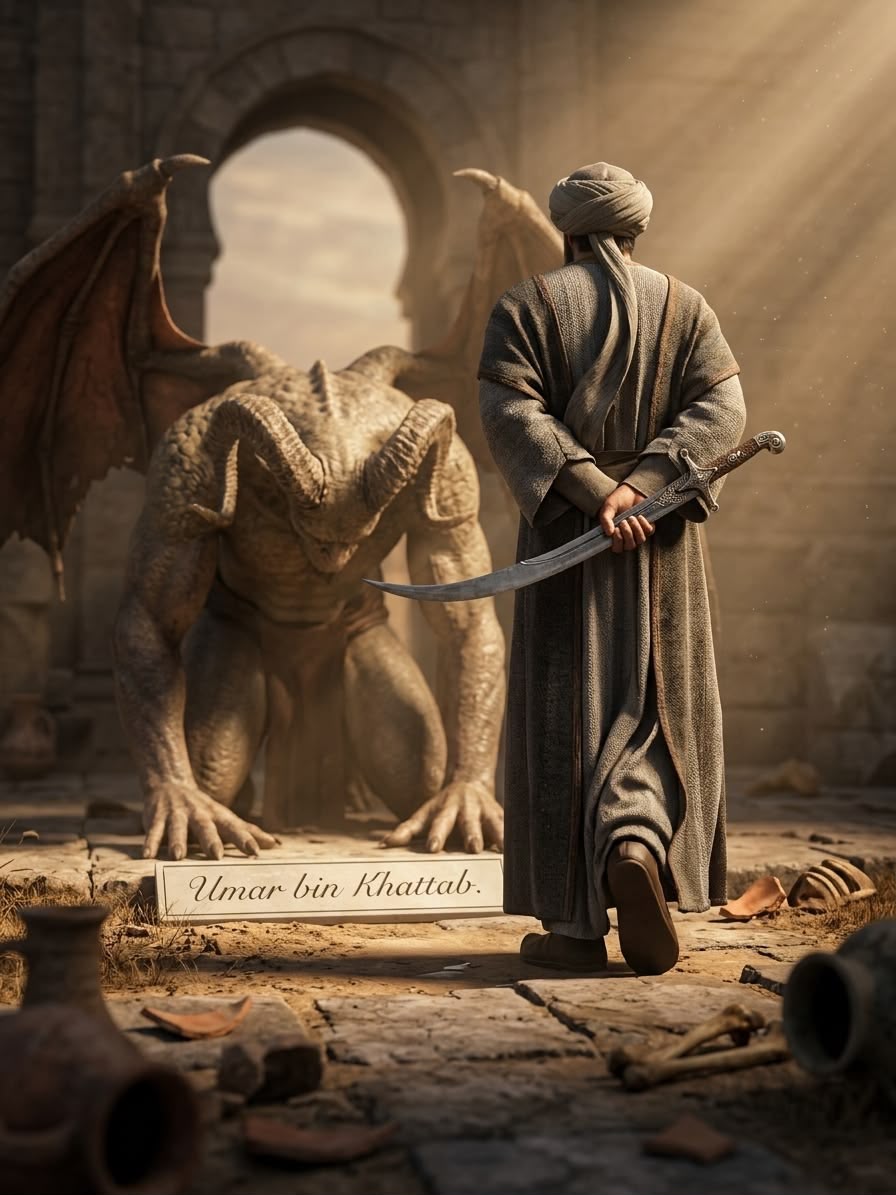
He once walked the streets of Makkah determined to put an end to the message of Islam. He was strong, fearless and fiercely opposed to Prophet Muhammad (peace and blessings be upon him). But one unexpected encounter changed the direction of his life forever. The man who once wanted to destroy Islam became one of its greatest defenders, a leader remembered for his justice, courage and extraordinary humility. This is the remarkable story of Umar ibn Al-Khattab (may Allah be pleased with him).
Imagine being so strongly opposed to something that you are willing to risk everything to stop it.
You believe its message threatens the society you know, and you are determined to put an end to it.
But then something happens.
You hear words that reach your heart in a way you never expected.
You begin questioning everything you previously believed.
The anger you once carried starts turning into something else.
And eventually, you become one of the strongest supporters of the very cause you once opposed.
This was the extraordinary transformation of Umar ibn Al-Khattab.
Before accepting Islam, Umar was among its fiercest opponents in Makkah.
Yet Allah guided his heart, and he became one of the closest companions of Prophet Muhammad (peace and blessings be upon him).
His conversion strengthened the early Muslim community, his leadership transformed the Muslim world, and his commitment to justice became an example for generations.
His story teaches us that no person should ever be considered beyond guidance.
It reminds us that hearts can change, that sincere faith can transform character and that the person we are today does not have to determine who we become tomorrow.
So, who was Umar ibn Al-Khattab? Why did he oppose Islam? What happened that changed his heart? And how did he become the second caliph of the Muslim community?
Let’s explore his remarkable journey.
1. WHO WAS UMAR IBN AL-KHATTAB?
Umar ibn Al-Khattab was born in Makkah into the Quraysh tribe, specifically the Banu Adi clan.
He grew up in a society where tribal identity, family reputation and social standing were extremely important.
Umar became known for his strength, confidence, determination and strong personality.
He was also capable of reading and writing, skills that were not widespread in Arabian society at the time.
Before Islam, he was involved in the affairs of Makkah and became known as a determined opponent of the new religion being preached by Prophet Muhammad.
He believed that Islam threatened the traditions and social structure of Quraysh.
His opposition was serious, and the early Muslims feared the influence he possessed.
However, Umar had qualities that would later become important in his leadership.
He was decisive, courageous and unwilling to compromise when he believed something was right.
After accepting Islam, those same qualities became powerful tools in the service of Allah.
His story demonstrates that even characteristics used in the wrong direction can be redirected towards goodness through guidance.
2. WHY UMAR OPPOSED ISLAM
When Prophet Muhammad began calling people towards Islam, the message challenged many of the established beliefs of Makkah.
The Prophet taught that there was only one God worthy of worship.
He rejected idol worship and called people towards justice, accountability and righteousness.
This message threatened the influence of powerful leaders who benefited from the existing religious and social system.
Umar was among those who strongly opposed the new religion.
He was concerned about the divisions developing within Quraysh and believed that Islam was challenging the traditions of his people.
The early Muslims experienced hostility and persecution.
Some were insulted, threatened and physically abused.
Umar himself became part of the opposition against the believers.
Yet Allah had already decreed that his life would take a completely different direction.
The man who once opposed the Prophet would eventually become one of his most devoted companions.
3. THE DAY UMAR SET OUT TO KILL THE PROPHET
One of the most famous accounts in the traditional Seerah describes the day Umar left his home carrying a sword.
He was determined to confront Prophet Muhammad and put an end to his message.
On his way, he encountered a man who informed him that his own sister Fatimah bint Al-Khattab and her husband Sa’id ibn Zayd had accepted Islam.
This news enraged him.
He changed direction and went to confront them.
Imagine the tension inside that household.
Umar was known for his strength and anger, and his sister and brother-in-law were secretly learning the teachings of Islam.
When he arrived, they were reportedly reciting passages from the Qur’an.
They attempted to conceal what they were reading.
But Umar discovered what was happening.
The encounter became heated, and his sister was struck.
When he saw that she had been injured, his anger began to give way to concern.
He asked to see what they had been reading.
His sister initially refused because he was not in a state of ritual purity.
After washing himself, he was given the written passages.
He began reading verses from Surah Ta-Ha.
What happened next would change his life.
Note: This account is widely related in Seerah literature, although its individual details are not established with the same level of authenticity as reports in Sahih al-Bukhari and Sahih Muslim.
4. THE WORDS OF THE QUR’AN THAT CHANGED HIS HEART
As Umar read the verses, something began to happen inside him.
The words were unlike anything he had encountered before.
They spoke about Allah, His greatness and the purpose of human existence.
The passage included the words:
“Indeed, I am Allah. There is no deity except Me, so worship Me and establish prayer for My remembrance.”
(Qur’an 20:14)
These words carried a powerful message.
Umar had spent his life surrounded by the religious traditions of Makkah.
Now he was encountering a message that challenged everything he had previously believed.
He asked where Muhammad could be found.
He wanted to meet the Prophet.
The man who had set out to harm the Messenger of Allah was now approaching him with a different intention.
His heart had begun to change.
This is one of the most powerful lessons from Umar’s story.
Never underestimate the power of the Qur’an.
A person may hear its words many times, but Allah can open their heart to guidance at a moment they least expect.
5. UMAR ACCEPTS ISLAM
After learning where the Prophet was, Umar made his way to the place where the early Muslims were gathered.
The companions were understandably concerned when they learned that he was approaching with a sword.
They knew how strongly he had opposed Islam.
However, the Prophet allowed him to enter.
Umar stood before the Messenger of Allah.
The moment was significant.
He had arrived as an opponent, but he was now ready to accept the message.
He declared his belief in Allah and His Messenger.
He embraced Islam.
The companions were overjoyed.
The conversion of Umar was an extraordinary moment for the early Muslim community.
The man whose strength and influence had once been used against Islam was now ready to defend it.
His conversion reminds us that guidance belongs to Allah.
A person’s past does not necessarily determine their future.
No matter how far someone may have travelled away from the truth, the door of repentance and guidance remains open while they are alive.
6. WHY UMAR’S CONVERSION WAS SO IMPORTANT
The early Muslims had faced years of hostility in Makkah.
They were a small community, and many believers were vulnerable to persecution.
The conversion of Umar brought an important change.
He was known for his courage and strong personality.
His acceptance of Islam strengthened the confidence of the believers.
Abdullah ibn Mas’ud (may Allah be pleased with him) is reported to have described Umar’s acceptance of Islam as a source of strength for the Muslims.
There is also an authentic narration in which the Prophet made a supplication asking Allah to strengthen Islam through one of two men, Abu Jahl or Umar ibn Al-Khattab.
Allah guided Umar.
His conversion became a turning point in the early Muslim community.
It demonstrated that Allah could transform even someone who had once been among Islam’s strongest opponents into one of its greatest supporters.
7. UMAR’S COURAGE AFTER ACCEPTING ISLAM
After becoming Muslim, Umar did not hide his faith out of fear of public opinion.
Traditional Seerah accounts describe how he openly declared his Islam and became determined to practise his religion without shame.
He wanted the Muslims to be able to worship Allah openly.
Unlike some of the early believers who had to conceal their faith because of persecution, Umar possessed a level of personal influence that made it more difficult for others to intimidate him.
His courage became an important source of strength for the Muslim community.
However, his story also reminds us that courage must be guided by wisdom.
Islam does not encourage unnecessary confrontation or reckless behaviour.
True bravery involves standing firmly for what is right while maintaining justice and good character.
Umar would later demonstrate this through his leadership and commitment to the teachings of the Prophet.
8. UMAR BECAME ONE OF THE CLOSEST COMPANIONS OF THE PROPHET
Following his conversion, Umar developed a close relationship with Prophet Muhammad (peace and blessings be upon him).
He became one of his trusted companions and participated in major events throughout the development of Islam.
He was present during the migration to Madinah and participated in important battles and events.
His daughter Hafsah (may Allah be pleased with her) later married the Prophet, further connecting Umar to the Prophet’s household.
Umar was known for his strong personality and his willingness to speak honestly.
He would sometimes express opinions that were later supported by Qur’anic revelation.
Several narrations discuss occasions when Umar’s views coincided with revelations, including matters concerning the station of Ibrahim and the observance of Hijab.
These accounts demonstrate his insight and the important role he played within the early Muslim community.
However, Umar never placed his own opinions above the guidance of Allah and His Messenger.
He understood that Islam was built upon revelation, not personal authority.
9. THE PROPHET’S PRAISE FOR UMAR
Umar’s virtues were recognised by Prophet Muhammad.
In an authentic narration, the Prophet said:
“Among the nations before you there were people who were inspired, and if there is anyone among my Ummah, it is Umar.”
(Sahih al-Bukhari and Sahih Muslim)
This narration highlights the remarkable insight and sound judgement associated with Umar.
There are also authentic reports describing how Satan would take another path when encountering Umar.
These narrations reflect the strength of his faith and character.
The Prophet also gave Umar glad tidings of Paradise in narrations concerning the ten companions promised Paradise.
Umar’s status was not based on his power or influence.
It was rooted in his faith, devotion and service to Islam.
10. UMAR BECOMES THE SECOND CALIPH
After the death of Prophet Muhammad, Abu Bakr As-Siddiq became the first caliph of the Muslim community.
During his leadership, the Muslim world faced serious challenges, including the Ridda wars and the preservation of the unity of the community.
Before his death, Abu Bakr nominated Umar as his successor after consulting leading companions.
Umar became the second caliph in 634 CE.
His leadership marked an important period in Islamic history.
During his caliphate, the Muslim state expanded significantly, and major administrative institutions were developed.
He oversaw the organisation of public finances, established systems for managing government responsibilities and strengthened the administration of the growing Muslim territories.
He also introduced the Hijri calendar as an official dating system for the Muslim community.
His leadership was not simply about territorial expansion.
It was also about establishing systems of accountability and public responsibility.
11. UMAR’S COMMITMENT TO JUSTICE
Perhaps the quality most frequently associated with Umar is his commitment to justice.
He believed that leadership was a responsibility before Allah, not an opportunity to enjoy personal privilege.
He understood that a ruler would be accountable for how people were treated under his authority.
During his caliphate, he paid close attention to the conduct of governors and officials.
He was concerned about corruption, abuse of power and the mistreatment of ordinary people.
He established administrative measures to oversee public responsibilities and encouraged accountability.
His example teaches us that leadership is not simply about giving instructions.
It is about serving people, protecting their rights and ensuring that authority is used responsibly.
A Muslim leader should never believe that their position makes them superior to the people they serve.
12. THE FAMOUS STORY OF UMAR AND THE HUNGRY FAMILY
One of the most popular stories associated with Umar describes him walking through Madinah at night to observe the condition of the people.
He reportedly heard children crying and discovered a woman preparing a pot over a fire.
When he asked what was happening, she explained that her children were hungry.
The pot contained water and stones, which she was boiling to make the children believe that food was being prepared while she waited for them to fall asleep.
Umar was deeply affected.
He returned to the public storehouse, collected food supplies and carried them back himself.
He reportedly refused to allow another person to carry the burden for him, explaining that he would be the one accountable before Allah.
This story is widely told in Islamic historical literature and reflects the qualities associated with Umar’s leadership, although its precise chain of narration should be distinguished from authenticated Hadith reports.
The lesson is powerful.
A leader should care about the suffering of ordinary people.
It is not enough to occupy a position of authority while remaining unaware of the difficulties experienced by those under your responsibility.
13. UMAR’S HUMILITY DESPITE HIS POWER
Despite governing a rapidly expanding Muslim state, Umar remained known for his humility.
He did not consider leadership an opportunity to live above everyone else.
He understood that wealth, authority and influence were temporary responsibilities.
His life reminds us that the more responsibility a person receives, the more seriously they should consider their accountability before Allah.
True leadership is not measured by the number of people who obey you.
It is measured by how fairly and responsibly you treat them.
Umar demonstrated that a person can hold enormous authority while still recognising that they are a servant of Allah.
14. THE YEAR OF FAMINE AND UMAR’S COMPASSION
During Umar’s caliphate, Arabia experienced a severe period of drought and famine, commonly known as the Year of Ashes.
Food became scarce, and many people suffered.
Umar took the situation seriously.
Historical accounts describe how he reduced his own consumption and made efforts to ensure that available food supplies were distributed to those in need.
He also worked to organise assistance from other regions.
This period demonstrated his concern for the welfare of the Muslim population.
He understood that a leader cannot ignore the suffering of people simply because the problem is difficult to solve.
His example reminds us of the importance of compassion, responsibility and practical assistance during times of crisis.
15. THE TRAGIC DEATH OF UMAR IBN AL-KHATTAB
Umar’s life came to a tragic end in 644 CE.
During the Fajr prayer in Madinah, he was attacked by Abu Lu’lu’ah, also known as Fayruz, and sustained fatal injuries.
The attack took place while Umar was leading the prayer.
He later died from his wounds.
Before his death, he appointed a council of six senior companions to choose the next caliph.
The council eventually selected Uthman ibn Affan.
Umar was buried beside Prophet Muhammad and Abu Bakr in the chamber of Aisha (may Allah be pleased with her).
His death marked the end of an extraordinary period in Islamic leadership.
He had entered Islam as one of its fiercest opponents and left this world as one of its most influential leaders.
16. WHAT UMAR’S STORY TEACHES MUSLIMS TODAY
Umar’s life contains lessons that remain relevant for every Muslim.
1. Never lose hope in someone’s guidance.
The man who once opposed Islam became one of its greatest defenders. Never assume that someone is beyond Allah’s guidance.
2. The Qur’an has the power to transform hearts.
The traditional account of Umar’s conversion reminds us of the importance of reflecting upon Allah’s words.
3. Courage should be used for good.
Umar’s strength and determination became valuable when directed towards defending the truth.
4. Leadership is a responsibility, not a privilege.
His caliphate teaches us that those in authority must care about the people they serve.
5. Justice must apply to everyone.
A leader should not allow wealth, status or personal relationships to influence the fair treatment of people.
6. Remain humble regardless of your position.
Even with enormous authority, Umar understood that he was accountable to Allah.
7. Do not allow your past to define your future.
Your mistakes do not have to become your permanent identity. Sincere repentance and guidance can transform a life.
17. THE IMPORTANCE OF UMAR’S LEGACY FOR THE MUSLIM UMMAH
Today, Muslims around the world face challenges involving leadership, injustice, corruption and social responsibility.
Umar’s story offers important lessons about what responsible leadership should look like.
It reminds us that authority is a trust.
A person who manages a business, leads a family, oversees a community or governs a country has responsibilities towards those affected by their decisions.
Leadership should never become an excuse for arrogance.
It should encourage accountability, fairness and service.
Umar also reminds us that people can change.
Sometimes, we judge others according to their previous mistakes without considering what they might become through guidance.
His transformation teaches us to leave room for repentance and never despair of Allah’s mercy.
The Muslim Ummah needs people who are courageous enough to stand for justice, humble enough to recognise their mistakes and sincere enough to place Allah above personal interests.
These are qualities that made Umar’s legacy so remarkable.
CONCLUSION: THE MAN WHO ONCE OPPOSED ISLAM BECAME ONE OF ITS GREATEST LEADERS
Umar ibn Al-Khattab’s life is one of the most extraordinary transformations in Islamic history.
He began as a determined opponent of Prophet Muhammad and the message of Islam.
But Allah guided his heart.
He accepted Islam, became one of the closest companions of the Prophet and played an important role in strengthening the early Muslim community.
After the death of Abu Bakr, he became the second caliph and led the Muslim world through a period of significant growth and development.
He became remembered for his courage, justice, humility and commitment to public responsibility.
His story teaches us that no one should lose hope in the power of guidance.
The person who appears furthest from the truth today may become someone who serves it tomorrow.
It also reminds us that true greatness is not about how much power we possess, but how we use the responsibilities Allah gives us.
Umar once walked towards the Prophet with a sword intending to stop Islam. Allah transformed his heart, and he became one of the greatest defenders of the faith. What might Allah transform in our own lives if we sincerely ask Him for guidance?
May Allah be pleased with Umar ibn Al-Khattab, reward him for his service to Islam and grant him the highest ranks of Jannatul Firdaus.
May Allah guide our hearts, grant us courage to stand for justice, protect us from arrogance and make us leaders who serve others with sincerity.
Ameen.
