


Islam is a complete way of life that guides Muslims in their relationship with Allah, their responsibilities towards others, and their preparation for the Hereafter.
At the heart of Islamic practice are the Five Pillars of Islam. These pillars form the foundation of a Muslim’s religious life and teach us how to put our faith into action.
Every Muslim should understand these pillars, why they are important, and how to fulfil them correctly. They are not merely religious duties to complete; they are acts of worship that strengthen our relationship with Allah and shape our daily lives.
Whether you are a new Muslim or someone who has practised Islam for many years, revisiting these foundations can help you improve your worship and deepen your understanding of the religion.
WHAT ARE THE FIVE PILLARS OF ISLAM?
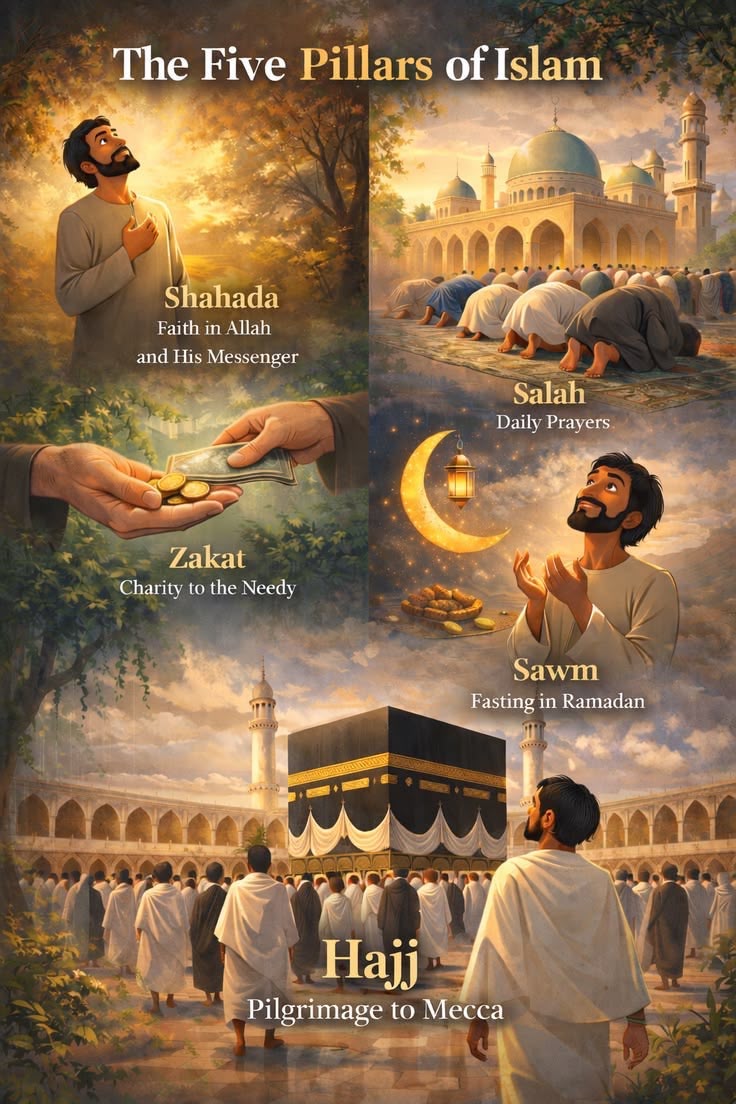
The Five Pillars of Islam are:
- Shahadah — The declaration of faith.
- Salah — The five daily prayers.
- Zakah — The obligatory charity.
- Sawm — Fasting during Ramadan.
- Hajj — The pilgrimage to Makkah.
These pillars are established in the teachings of Prophet Muhammad (peace and blessings be upon him).
In a famous narration recorded in Sahih al-Bukhari and Sahih Muslim, the Prophet ﷺ explained that Islam is built upon five: testifying that none has the right to be worshipped except Allah and that Muhammad is the Messenger of Allah, establishing prayer, paying Zakah, performing Hajj, and fasting during Ramadan.
Let us examine each pillar and understand what it means for a Muslim.
1. SHAHADAH — THE DECLARATION OF FAITH
The first pillar of Islam is the Shahadah, the testimony that there is no deity worthy of worship except Allah and that Muhammad is the Messenger of Allah.
In Arabic, it is:
أَشْهَدُ أَنْ لَا إِلَٰهَ إِلَّا اللَّهُ وَأَشْهَدُ أَنَّ مُحَمَّدًا رَسُولُ اللَّهِ
Transliteration: Ashhadu an la ilaha illallah, wa ashhadu anna Muhammadan rasulullah.
Meaning: I bear witness that there is no deity worthy of worship except Allah, and I bear witness that Muhammad is the Messenger of Allah.
The Shahadah is more than a sentence a person memorises. It expresses the foundation of Islamic belief.
The first part affirms Tawheed: Allah alone deserves worship, and no partner should be associated with Him.
The second part affirms that Muhammad ﷺ is Allah’s Messenger. Muslims believe his message, follow his authentic Sunnah, and accept the guidance he conveyed.
A sincere understanding of the Shahadah should influence our worship, intentions, decisions, and behaviour.
It reminds us that our ultimate devotion belongs to Allah, not to wealth, status, popularity, or other created things.
2. SALAH — THE FIVE DAILY PRAYERS
The second pillar of Islam is Salah, the obligatory prayer performed five times each day.
The five daily prayers are:
- Fajr: Performed at dawn, before sunrise.
- Dhuhr: Performed after the sun passes its highest point.
- Asr: Performed in the afternoon.
- Maghrib: Performed after sunset.
- Isha: Performed at night.
The precise prayer times vary according to location and the time of year.
Salah is one of the most important acts of worship in Islam. It gives Muslims regular opportunities to remember Allah, seek His guidance, ask for forgiveness, and renew their commitment to living according to His commands.
Allah says:
“Indeed, prayer prohibits immorality and wrongdoing.”
— Surah Al-Ankabut 29:45
This verse reminds us that prayer should influence our conduct. It should encourage us to become more truthful, patient, humble, and mindful of Allah.
Every Muslim should learn how to perform Salah correctly, including purification, the conditions of prayer, its essential actions, and the recitations involved.
Prayer should not be treated as an obligation to rush through. Muslims should strive to pray on time, understand what they recite, and develop concentration and humility in their worship.
3. ZAKAH — THE OBLIGATORY CHARITY
The third pillar of Islam is Zakah, an obligatory form of giving that purifies wealth and fulfils the rights of eligible recipients.
Zakah is not simply voluntary generosity. It is a duty that becomes obligatory when a Muslim meets the relevant conditions.
For many forms of qualifying wealth, Zakah is commonly calculated at 2.5% when the applicable conditions are met, including the relevant threshold and, where required, the passage of a lunar year. The rules differ according to the type of wealth, so Muslims should learn the calculation that applies to their circumstances.
Allah says:
“And establish prayer and give Zakah.”
— Surah Al-Baqarah 2:43
The repeated pairing of prayer and Zakah in the Qur’an highlights the importance of both worship and fulfilling people’s rights.
Zakah supports eligible recipients, including categories specified in Surah At-Tawbah 9:60. It helps address hardship and reminds Muslims that wealth comes with responsibilities.
Every Muslim who owns wealth should learn whether Zakah is obligatory upon them, which assets are included, how to calculate what is due, and who may receive it.
It is also important to distinguish Zakah from Sadaqah. Sadaqah is voluntary charity, while Zakah is an obligation subject to specific rules.
4. SAWM — FASTING DURING RAMADAN
The fourth pillar of Islam is fasting during the month of Ramadan.
Fasting involves abstaining from food, drink, and other things that invalidate the fast from dawn until sunset, with the intention of worshipping Allah.
However, fasting is not only about staying hungry and thirsty. It is also an opportunity to develop self-discipline, patience, gratitude, and awareness of Allah.
Allah says:
“O you who have believed, decreed upon you is fasting as it was decreed upon those before you that you may become righteous.”
— Surah Al-Baqarah 2:183
This verse explains one of the central purposes of fasting: developing taqwa, or consciousness of Allah.
During Ramadan, Muslims strive to increase their Qur’an recitation, perform additional prayers, give charity, make du’a, and avoid sinful behaviour.
A Muslim should also understand the rulings concerning fasting. Certain circumstances, such as illness or travel, may permit a person to break the fast, with the applicable requirements depending on the situation. Menstruation and postnatal bleeding also affect fasting obligations.
Those who are exempt should learn whether they need to make up missed fasts or fulfil another obligation according to their circumstances.
Ramadan is a valuable opportunity to strengthen our faith and develop habits that continue after the month ends.
5. HAJJ — THE PILGRIMAGE TO MAKKAH
The fifth pillar of Islam is Hajj, the pilgrimage to Makkah performed during its prescribed days.
Hajj is obligatory once in a Muslim’s lifetime for those who meet its conditions, including the required physical and financial ability.
Allah says:
“And [due] to Allah from the people is a pilgrimage to the House—for whoever is able to find thereto a way.”
— Surah Ali ‘Imran 3:97
Hajj brings Muslims from different countries, cultures, and backgrounds together in worship of Allah.
During the pilgrimage, Muslims perform prescribed rites, including entering Ihram, standing at Arafah, and completing the other required rites according to the teachings of the Prophet Muhammad ﷺ.
Hajj reminds Muslims of the equality of humanity before Allah. Wealth, nationality, social position, and appearance do not determine a person’s worth before Him.
The pilgrimage also teaches patience, sacrifice, humility, and obedience.
Because Hajj involves specific rites and conditions, anyone preparing to perform it should study its requirements carefully and seek guidance from reliable scholars or qualified Hajj instructors.
WHAT IS THE DIFFERENCE BETWEEN ISLAM AND IMAN?
Although the terms Islam and Iman are closely connected, they highlight different aspects of the religion.
Islam refers to submission to Allah and is commonly explained through the Five Pillars, which establish the foundations of Islamic practice.
Iman refers to faith and is explained through the Six Pillars of belief: belief in Allah, His angels, His revealed books, His Messengers, the Last Day, and divine decree.
The famous Hadith of Jibril explains these concepts alongside Ihsan, which means worshipping Allah with a deep awareness of Him.
These concepts work together. A Muslim should strive to maintain sound belief, fulfil religious obligations, and develop sincerity and excellence in worship.
COMMON MISTAKES MUSLIMS SHOULD AVOID
Understanding the Five Pillars also means avoiding common misunderstandings about them.
1. Treating the Shahadah as words without meaning
The declaration of faith carries profound implications. Muslims should understand what it means and strive to live according to its teachings.
2. Neglecting Salah
Prayer is an obligation that should not be treated casually. Muslims should learn its rulings, strive to perform it on time, and seek help when struggling to maintain consistency.
3. Confusing Zakah with voluntary charity
Giving money to a good cause does not automatically fulfil every Zakah obligation. Zakah has specific eligibility and distribution rules that must be understood.
4. Assuming fasting is only about food and drink
A fasting Muslim should also strive to guard their speech, behaviour, and intentions against sin.
5. Delaying Hajj without learning the obligation
Muslims who meet the conditions for Hajj should learn when it becomes obligatory and plan responsibly to fulfil it. Questions about personal circumstances should be discussed with a qualified scholar.
HOW CAN WE PUT THE FIVE PILLARS INTO PRACTICE?
Every Muslim can take practical steps to strengthen their observance of Islam.
- Renew your understanding of the Shahadah and what it means to worship Allah alone.
- Organise your daily routine around the five obligatory prayers.
- Learn how to calculate and distribute Zakah correctly if it is due upon you.
- Prepare for Ramadan by improving your worship and learning the rulings of fasting.
- Learn the conditions and rites of Hajj and plan for the pilgrimage if it becomes obligatory upon you.
- Seek knowledge from reliable Islamic sources and qualified teachers.
- Ask Allah for sincerity, guidance, and consistency in fulfilling your obligations.
The goal is not merely to know the names of the Five Pillars but to understand their meanings and fulfil them according to Islamic guidance.
CONCLUSION
The Five Pillars of Islam form the foundation of a Muslim’s religious practice. They teach us to declare our faith sincerely, maintain our prayers, fulfil our financial obligations, fast during Ramadan, and perform Hajj when we are able.
Each pillar carries important spiritual lessons and helps us develop a stronger relationship with Allah.
Islam is not simply about knowing what is required; it is about striving to fulfil those obligations with sincerity, knowledge, and humility.
Let us continue learning the foundations of our religion, correcting our shortcomings, and improving our worship one step at a time.
May Allah help us establish our prayers, fulfil our obligations, purify our wealth, benefit from Ramadan, grant us the opportunity to perform Hajj, and keep us steadfast upon Islam until our final breath. Amin.
