


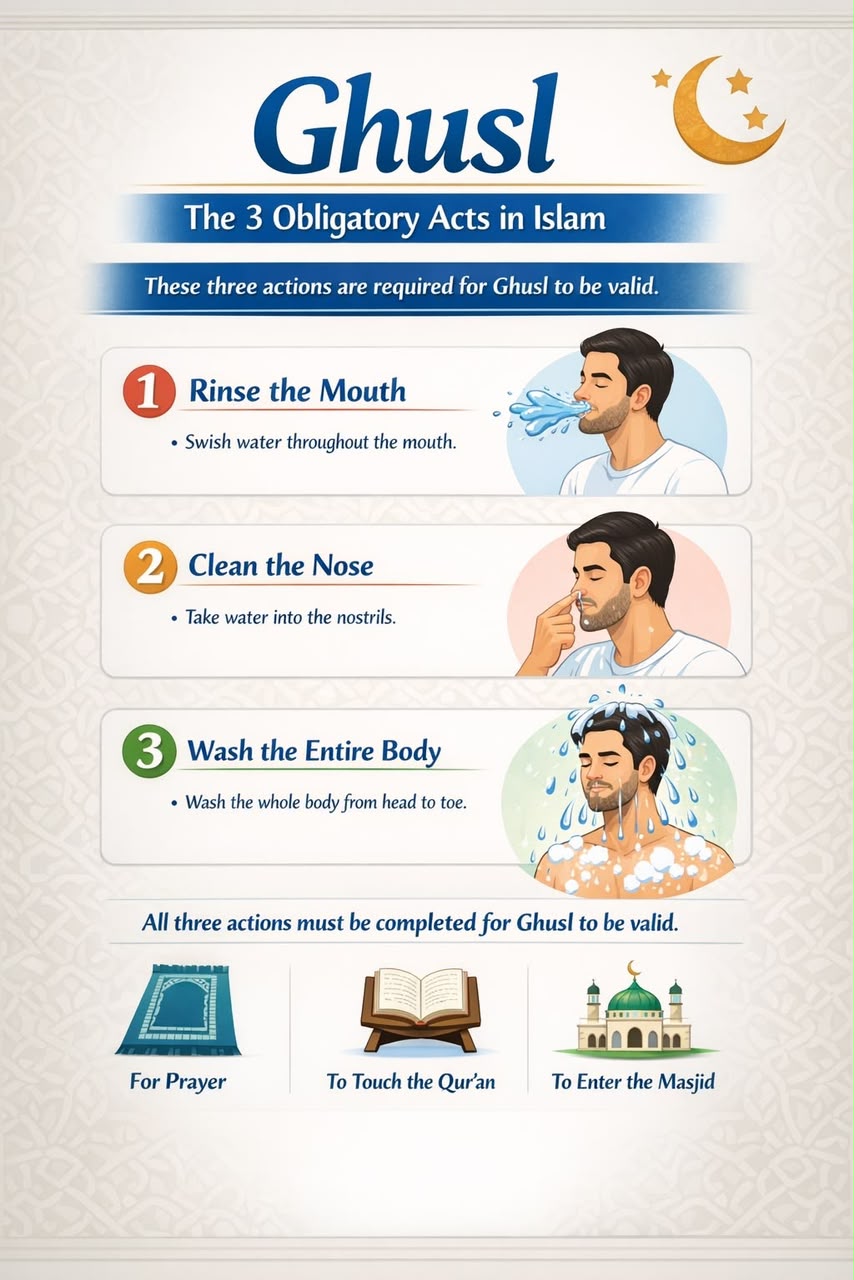
Ghusl is one of the important areas of Taharah that every Muslim should understand. While Wudu provides minor ritual purification, Ghusl is the major ritual bath required in circumstances where a person enters a state of major ritual impurity.
These matters can sometimes feel sensitive to discuss, but they are essential Islamic knowledge. A Muslim should be able to understand the rulings of purification without embarrassment because they affect Salah and other acts of worship.
Allah says:
“And if you are in a state of janabah, then purify yourselves.”
Qur’an 5:6
One of the main circumstances requiring Ghusl is Janabah. This occurs following sexual intercourse or ejaculation, whether during sleep or while awake.
A person in a state of Janabah must perform Ghusl before performing Salah and other acts for which major ritual purification is required.
For example, if a person experiences a wet dream and discovers evidence of sexual discharge after waking, Ghusl becomes necessary. However, simply dreaming about something without finding evidence of discharge does not by itself require Ghusl.
This distinction is important because Islam is based on actual rulings, not unnecessary assumptions.
Ghusl is also required after menstruation ends and after postnatal bleeding ends. A woman waits until the bleeding has actually ended and then performs Ghusl before returning to the acts of worship that require ritual purity.
These matters are part of Islamic Fiqh and should be learned properly rather than treated as subjects that cannot be discussed.
So how is Ghusl performed?
There are details that scholars discuss regarding the obligatory elements and the complete Sunnah method. In general, the person intends purification, removes any physical impurity, performs Wudu and then ensures that water reaches the entire body, including the hair and the areas where water might otherwise fail to reach.
The essential point is that the whole body must be properly washed according to the relevant ruling.
A Muslim should not assume that simply standing under a shower automatically fulfils every requirement of Ghusl. At the same time, Ghusl does not require an elaborate ritual that takes an unnecessarily long time.
Islam encourages thoroughness without excess.
The Prophet ﷺ demonstrated a practical and efficient method of performing Ghusl. His example shows that major purification can be completed without wasting large quantities of water.
This is particularly important because some people become excessive when performing Ghusl, repeating the washing of the same areas again and again because they fear that they may have missed something.
The same principle we discussed with Wudu applies here: certainty should not be abandoned because of mere doubt.
A person should make a reasonable effort to ensure that water reaches the required areas and then consider the purification complete.
There is also an important distinction between cleanliness and ritual purification.
A person can take a normal shower because they are sweaty, dirty or preparing for the day. That does not necessarily mean they have performed Ghusl for ritual purification.
Likewise, Ghusl itself is not simply about removing physical dirt. It is an act connected to Islamic ritual purity.
Understanding this distinction helps Muslims avoid confusion.
Another important matter is water.
Islam requires purification with water when water is available and its use is possible. But Allah’s law also recognises genuine hardship. If a person cannot use water because it is unavailable or because using it would cause legitimate harm, the rules of Tayammum provide a concession under the appropriate conditions.
Islam therefore combines purity with mercy.
Ghusl also teaches Muslims something about modesty.
Islam does not treat matters of the human body as shameful subjects simply because they are private. What Islam requires is haya, modesty and appropriate boundaries. Necessary knowledge can and should be taught respectfully.
This is especially important when teaching young Muslims.
If children and teenagers are never taught the basic rulings of purification because adults are uncomfortable discussing them, they may eventually learn from unreliable sources or develop incorrect beliefs about their religion.
Parents, teachers and Islamic educators have an important responsibility to provide accurate knowledge in an appropriate manner.
There are also different details within the Fiqh of Ghusl, including matters concerning hair, braids, menstruation, sexual discharge and other circumstances. Some of these have differences among the recognised schools of Islamic jurisprudence.
Therefore, Muslims should avoid turning every difference in detail into an accusation that someone else does not understand Islam.
The most important thing is to learn the ruling you follow from a reliable source and practise it correctly.
Ghusl may be a private act, but it is an important part of public worship because it determines whether a Muslim can perform certain acts of worship in a state of major ritual purity.
Knowing when Ghusl is required removes unnecessary confusion.
Knowing how to perform it removes unnecessary anxiety.
And understanding its purpose reminds the Muslim that Islam pays attention not only to what we believe and say, but also to how we prepare ourselves to stand before Allah.
Purification is part of worship. Learning it properly is part of learning your religion.
