


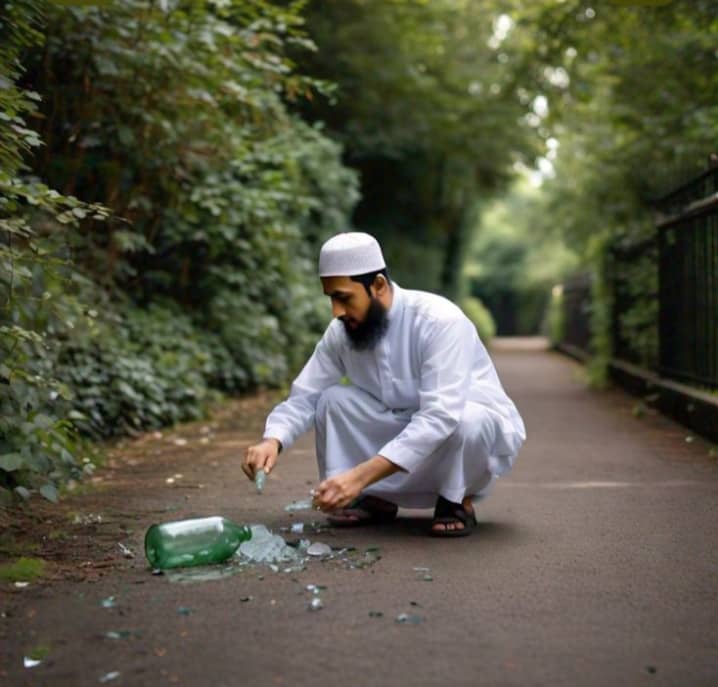
HOW A SMALL ACT OF KINDNESS CAN BECOME A GREAT DEED IN ISLAM
Have you ever walked along a road and noticed a broken bottle lying in the path? Have you ever seen a nail, a sharp object, a fallen branch, or rubbish scattered across a walkway where someone could easily trip or get injured?
Perhaps you noticed the danger, walked past it, and continued with your day. You may have thought that removing it was not your responsibility or that such a small action could not make much difference.
But what if that simple act of removing the object could prevent someone from getting hurt? What if a child avoided an injury, a cyclist escaped an accident, or an elderly person walked safely because someone took a moment to clear the path?
In Islam, such an action is not insignificant.
The religion of Islam teaches us that goodness is not measured only by the size of our wealth, the visibility of our achievements, or the number of people who praise us. Sometimes, a deed that appears small in the eyes of people carries great value because it protects another person from harm.
Removing something harmful from the road is an act of charity in Islam, a practical expression of faith, and a beautiful example of caring for the well-being of others.
This teaching reminds us that our responsibility towards people extends beyond our homes, families, and immediate circles. It includes the strangers who walk the same streets, use the same pathways, and share the same public spaces with us.
Let us reflect on what Islam teaches about this simple but powerful act of goodness.
1. REMOVING HARM FROM THE ROAD IS AN ACT OF CHARITY
One of the beautiful teachings of the Prophet Muhammad ﷺ is that charity is not limited to giving money.
The Prophet ﷺ said:
“Removing a harmful thing from the road is charity.” — Sahih al-Bukhari and Sahih Muslim.
This hadith offers an important lesson about how Islam defines goodness.
Many people associate charity primarily with financial donations. They think of giving money to the poor, supporting an orphan, feeding someone who is hungry, or contributing to a charitable cause.
These are all valuable forms of generosity. However, the teachings of the Prophet ﷺ show that opportunities for charity exist in our everyday lives, even when we have little or no money to give.
Removing a dangerous object from a road may take only a few seconds. It may not attract attention, earn praise, or be noticed by anyone else.
Yet it can protect people from injury and make their journey safer.
Imagine finding a broken bottle on a pavement. You recognise that a child or an unsuspecting pedestrian could step on it. You safely remove the glass and place it in an appropriate container.
You have helped protect another person from harm.
Perhaps nobody saw you do it. Perhaps nobody will ever know that you were responsible.
But the absence of recognition does not make a good deed worthless.
This is one of the beautiful lessons of Islam: you do not need wealth to be charitable, and you do not need an audience to do something good.
Sometimes, the most meaningful acts of kindness are the ones performed quietly, sincerely, and without expecting anything in return.
2. ISLAM TEACHES US NOT TO CAUSE HARM TO OTHERS
Removing harm from the road is closely connected to a broader Islamic principle: protecting people from unnecessary injury and hardship.
The Prophet ﷺ taught the principle:
“There should be neither harm nor reciprocating harm.” — Sunan Ibn Majah, hadith 2340, commonly cited in Islamic legal discussions.
This principle is widely used by Muslim scholars when discussing the prevention of harm and the protection of people’s rights.
A road is a shared space. People use it to travel to work, attend school, visit family, buy food, seek medical care, and carry out countless everyday activities.
When someone leaves dangerous objects in these spaces, dumps rubbish carelessly, or ignores an obvious hazard they could safely address, other people may suffer the consequences.
A sharp piece of metal could puncture a tyre. Broken glass could injure a pedestrian. An obstruction could cause a cyclist to fall. A slippery substance on a walkway could cause someone to lose their balance.
Not every dangerous situation is caused intentionally, of course. Some hazards arise from storms, accidents, damaged infrastructure, or other circumstances beyond an individual’s control.
Nevertheless, when we encounter a danger, we should consider whether there is a reasonable and safe way to reduce the risk.
We should not think only about our own journey while ignoring the safety of everyone who comes after us.
Islam encourages us to develop a sense of responsibility that extends beyond ourselves.
A considerate Muslim does not deliberately create hazards for others and, where reasonably possible, helps prevent avoidable harm.
3. A SMALL ACTION CAN PREVENT A GREAT INJURY
One reason removing harmful objects is so important is that we may never know who would otherwise have been injured.
Consider an elderly person walking along a pavement. Their balance may not be as strong as it once was. A small obstruction could cause them to fall.
Consider a child running towards a playground. They may not notice a sharp object on the ground.
Consider a cyclist travelling along a road. A piece of debris could cause a sudden loss of control.
Now imagine that someone notices the danger and removes it before any of these people arrive.
The action may take less than a minute, but its potential benefit may be significant.
This teaches us an important lesson about the relationship between intention, effort, and consequences.
We often underestimate simple acts because we cannot see their full impact. We may assume that something is too small to matter unless it produces an immediate, visible result.
But preventing harm is valuable even when the injury never occurs and nobody knows what might have happened.
You may never meet the person whose safety you helped protect. You may never hear their story or receive their gratitude.
That does not mean your action was meaningless.
In fact, one of the most beautiful aspects of this kind of kindness is that the person benefiting from it may never even realise that you were there.
They simply continue their journey safely.
Sometimes, goodness is not about changing someone’s entire life. It is about preventing one moment of unnecessary suffering.
4. GOOD DEEDS DO NOT HAVE TO BE EXPENSIVE OR COMPLICATED
Many people want to do good but believe they lack the resources to make a meaningful contribution.
They may wish to support charitable projects but have limited finances. They may want to help people in need but feel that they have little influence. They may believe that only large donations or extraordinary achievements can make a real difference.
The teaching about removing harm from the road challenges that assumption.
You do not need a large income to pick up litter safely. You do not need a leadership position to report a dangerous obstruction. You do not need public recognition to help make a shared space safer.
You can begin with what is within your ability.
If you notice a small, harmless piece of litter on a walkway, you may be able to dispose of it appropriately.
If you see a fallen branch blocking a pedestrian path and it is safe to move, you may be able to clear it.
If you discover a deep pothole, exposed electrical wire, or dangerous debris that you cannot safely handle, you can warn others from a safe distance and report the hazard to the relevant authority.
The principle is not that every person must personally solve every public problem. It is that we should not dismiss opportunities to do good simply because they seem ordinary.
Islam gives us many ways to contribute to the well-being of others.
Some involve money. Some involve time. Some involve knowledge. Others involve a moment of attention and a willingness to act responsibly.
What matters is that we recognise the opportunity and respond within our ability.
5. SINCERITY MATTERS EVEN WHEN NOBODY IS WATCHING
Imagine two people removing dangerous objects from a road.
One person does it because they want others to praise them. The other does it because they genuinely want to protect people and seek the pleasure of Allah.
Both actions may benefit the public, but the intention behind a deed is important in Islam.
The Prophet ﷺ said:
“Actions are but by intentions.” — Sahih al-Bukhari and Sahih Muslim.
This hadith teaches us that intentions are central to the spiritual value of our actions.
When you remove something harmful from a road, you can intend to protect people, fulfil an opportunity for charity, and do something pleasing to Allah.
You do not need to announce your deed or tell everyone what you have done.
There is nothing inherently wrong with encouraging others through a good example, but a deed should not depend on public recognition to feel worthwhile.
Some of the most sincere acts of worship and kindness happen privately.
A person may quietly clear a walkway before anyone arrives. Another may report a dangerous hazard without expecting a reward from the community. Someone else may spend time cleaning a shared space simply because they want others to use it safely.
These actions remind us that our relationship with Allah is not limited to the moments when people see us.
Allah knows our intentions, our efforts, and the good we seek to accomplish.
When we develop sincerity, ordinary responsibilities can become opportunities for spiritual growth.
6. DO NOT UNDERESTIMATE THE VALUE OF SMALL DEEDS
A common mistake is to believe that a good deed must be impressive to be valuable.
We may think that giving a large donation is meaningful, while picking up a piece of litter is insignificant. We may celebrate public acts of generosity while overlooking quiet acts of consideration.
But Islam teaches us to recognise the value of goodness in its different forms.
The Prophet ﷺ taught that even a smile is charity, as reported in Jami’ at-Tirmidhi.
This illustrates how charity can extend into everyday behaviour.
A kind word, assistance to someone struggling, the removal of an obstruction, or a sincere effort to prevent an injury can all be meaningful expressions of goodness.
The lesson is not that every small act has the same reward or that we can determine precisely how Allah will reward a particular deed. That knowledge belongs to Allah.
Rather, we should avoid dismissing a good action simply because it appears small.
A person who consistently looks for opportunities to benefit others may contribute to the well-being of an entire community through ordinary acts of kindness.
Imagine a neighbourhood where residents regularly clear safe walkways, dispose of rubbish properly, report hazards, and look out for vulnerable people.
Over time, these small actions can help create a cleaner, safer, and more considerate environment.
The impact of one person’s action may be limited, but a community that shares this attitude can accomplish a great deal.
Never assume that you must wait until you have more money, more influence, or more time before you can begin doing good.
Start with what you can do today.
7. CARING FOR PUBLIC SPACES IS PART OF CARING FOR PEOPLE
Roads and walkways are more than physical spaces. They are places where people’s daily lives unfold.
A child walks to school. A worker travels to earn a living. A parent takes a baby outside. A patient makes their way to a clinic. An elderly person visits a neighbour.
All these people depend, in different ways, on spaces that can be used safely.
When we care for these spaces, we help care for the people who depend on them.
This is why removing harmful objects should not be viewed as an isolated act. It can form part of a wider attitude of responsibility towards our communities.
We should avoid throwing rubbish into drains, leaving dangerous materials on pavements, blocking entrances unnecessarily, or damaging facilities that others use.
We should also be willing to report hazards that require professional attention.
For example, an exposed electrical cable should not be handled casually. A large fallen tree may require trained workers and proper equipment. A serious road obstruction may need the attention of local authorities.
Acting responsibly means understanding the difference between a hazard we can safely remove and one that requires professional help.
Our goal is to reduce harm, not to put ourselves or others in greater danger.
A good deed should be performed with wisdom as well as good intentions.
8. TEACH CHILDREN THAT HELPING OTHERS IS PART OF FAITH
Children often learn values through the examples they see in everyday life.
If they repeatedly see adults ignore public spaces, throw rubbish carelessly, or treat shared property as someone else’s problem, they may begin to believe that these behaviours are normal.
But when they see adults protecting others, cleaning up responsibly, and taking small steps to prevent harm, they learn a different lesson.
They learn that being a good Muslim involves more than personal acts of worship. It also involves consideration for the people around them.
Parents and teachers can explain the hadith about removing harm from the road and help children understand its practical meaning.
They can encourage children to dispose of rubbish properly, avoid leaving dangerous objects where others might encounter them, and tell a responsible adult when they notice a hazard.
Children should not be encouraged to handle broken glass, sharp metal, exposed wires, or other dangerous materials themselves. They can learn to recognise risks and seek appropriate help.
The purpose is to develop responsibility without exposing them to unnecessary danger.
Over time, children can learn that kindness is not something reserved for special occasions.
It is a habit built through ordinary decisions: being considerate, avoiding harm, and recognising that other people’s safety matters.
When these values are taught early, they can help shape more responsible individuals and communities.
9. WHAT IF YOU CANNOT REMOVE THE HARM YOURSELF?
Not every harmful object can be removed safely.
You may encounter a heavy obstruction, hazardous chemical, broken electrical equipment, or debris in the middle of a busy road. Attempting to remove it could expose you to traffic, injury, or other serious risks.
Islam does not require you to behave recklessly in the name of doing good.
If you cannot safely remove the danger, there are other ways to help.
- Warn nearby people when it is safe and appropriate to do so.
- Contact the relevant road maintenance team or local authority.
- Report exposed wires, dangerous spills, or serious obstructions to the appropriate emergency or utility service.
- Keep yourself and others away from the hazard when possible.
- Avoid creating an additional danger by standing in traffic or attempting work beyond your abilities.
For instance, if a large object is blocking a busy road, your priority should be to alert the appropriate authorities rather than risk being struck by a vehicle while trying to move it.
If broken glass is scattered across a heavily used path, you may be able to notify a maintenance worker or responsible adult instead of picking it up with your bare hands.
The Islamic principle of preventing harm should be applied with good judgement.
You can fulfil your responsibility by taking a sensible step towards reducing the danger, even if you cannot eliminate it personally.
Sometimes, the most responsible action is to seek help.
10. THE LESSON OF REMOVING HARM FROM THE ROAD: THINK BEYOND YOURSELF
At the heart of this teaching is a shift in perspective.
Many of us move through life concentrating on our own responsibilities, ambitions, and difficulties. We are thinking about where we need to go, what we need to accomplish, and how we can manage our own affairs.
There is nothing wrong with attending to our responsibilities. But faith should also encourage us to notice the needs of others.
When walking along a road, do we see only the path we need to follow, or do we also consider the people who will use it after us?
When we notice a dangerous object, do we assume someone else will deal with it, or do we consider whether there is something useful we can safely do?
When we see a problem affecting the community, do we automatically distance ourselves from it, or do we look for a reasonable way to contribute?
Removing harm from the road reminds us that we are part of a wider human community.
Our actions affect other people, sometimes in ways we never fully understand.
A careless act may expose a stranger to danger. A thoughtful act may protect someone we have never met.
Islam encourages us to become people who are conscious of these effects.
We should not live only to avoid harming ourselves. We should also seek opportunities to reduce harm to others.
That is one way faith becomes visible in our everyday lives.
CONCLUSION: NEVER UNDERESTIMATE A GOOD DEED DONE FOR THE SAKE OF ALLAH
The teaching of removing harm from the road is a beautiful reminder that Islam values practical kindness.
It teaches us that charity is not restricted to money, that protecting others matters, and that even an ordinary action can become an opportunity to do good.
A broken bottle removed from a walkway may prevent an injury. A dangerous obstruction reported to the authorities may help protect many road users. A piece of rubbish disposed of properly may contribute to a cleaner public space.
These actions may appear small, but they reflect important qualities: consideration, responsibility, mercy, and awareness of other people’s rights.
We do not need to wait for a special occasion to practise these values.
The next time you encounter something harmful on a road or walkway, pause and consider whether there is a safe and reasonable way to help.
If you can remove it safely, do so responsibly. If you cannot, warn others when appropriate and seek assistance from the people who can address the danger.
Do not dismiss the opportunity simply because the task seems ordinary.
And do not assume that a deed is worthless because nobody notices it.
Allah knows the good we do, including the actions that pass without public recognition.
Perhaps the object you remove today will prevent an injury tomorrow. Perhaps the danger you report will protect someone you will never meet. And perhaps the small act you almost ignored will become a deed of great value through Allah’s mercy.
May Allah make us people who bring benefit to others, prevent harm wherever we reasonably can, and recognise opportunities for goodness in our everyday lives.
May He grant us sincere intentions, wisdom in our actions, and hearts that care about the safety and well-being of others.
May He accept our small and great deeds, forgive our shortcomings, and make us a source of goodness for our families and communities.
Ameen.
