


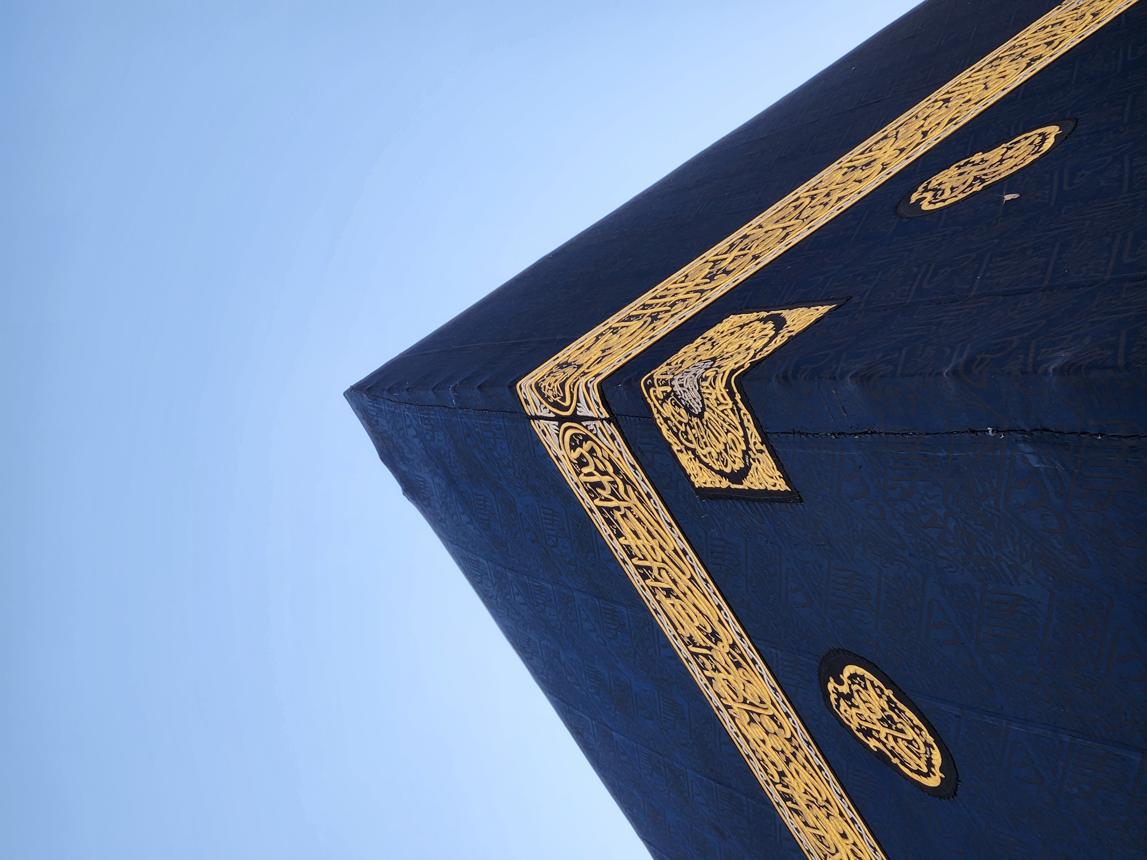
The Ka’bah is one of the most sacred places in Islam. Located in the centre of Masjid al-Haram in Makkah, Saudi Arabia, it is the direction towards which Muslims around the world turn when performing their five daily prayers.
Every year, millions of Muslims travel to Makkah to perform Hajj and Umrah, and visiting the Ka’bah becomes one of the most meaningful experiences of their lives.
However, the Ka’bah is more than a sacred building. Its history is connected to Prophet Ibrahim عليه السلام, his son Prophet Ismail عليه السلام, and the establishment of the worship of Allah alone.
Every Muslim should understand the history of the Ka’bah, why Muslims face it during Salah, what happens during Hajj and Umrah, and the lessons its significance teaches us about faith, unity, and devotion to Allah.
WHAT IS THE KA’BAH?
The Ka’bah is a sacred, cube-shaped structure situated within Masjid al-Haram in Makkah.
It is also known as Baytullah, meaning the House of Allah. This expression reflects its honoured status as a place of worship dedicated to Allah; it does not mean that Allah lives inside the building or is confined to a particular location.
Muslims face the Ka’bah when performing Salah, wherever they are in the world. This direction is known as the Qiblah.
The Ka’bah is also the central point around which pilgrims perform Tawaf during Hajj and Umrah.
Although Muslims deeply revere the Ka’bah, they do not worship the building, its stones, or the Black Stone. Worship belongs to Allah alone.
This distinction is essential to understanding the place of the Ka’bah in Islam.
WHO BUILT THE KA’BAH?
The Qur’an connects the foundations of the Ka’bah with Prophet Ibrahim عليه السلام and his son Prophet Ismail عليه السلام.
Allah says:
“And [mention] when Abraham was raising the foundations of the House and [with him] Ishmael.”
— Surah Al-Baqarah 2:127
This verse describes Ibrahim عليه السلام and Ismail عليه السلام raising the foundations of the House while supplicating to Allah.
Their work was not undertaken for fame, wealth, or worldly recognition. It was an act of obedience and devotion to Allah.
They also prayed that Allah would accept their efforts, teaching Muslims that even acts of worship should be accompanied by humility and a desire for acceptance.
The Qur’an further records Ibrahim’s supplication asking Allah to make Makkah a place of security and provide its people with sustenance.
The Ka’bah therefore represents a legacy of worship, obedience, and the call to worship Allah alone.
THE STORY OF PROPHET IBRAHIM AND THE KA’BAH
Prophet Ibrahim عليه السلام occupies an important place in Islamic history because of his unwavering commitment to Tawheed, the worship of Allah alone.
Allah instructed Ibrahim and Ismail عليهما السلام to establish and purify His House for those who would worship Him.
Allah says:
“And [mention] when We designated for Abraham the site of the House, [saying], ‘Do not associate anything with Me and purify My House for those who perform Tawaf and those who stand [in prayer] and those who bow and prostrate.'”
— Surah Al-Hajj 22:26
This verse highlights the purpose of the Ka’bah: worshipping Allah alone and providing a place for acts of devotion.
According to Islamic tradition, the Ka’bah became a focal point for pilgrimage and worship. Muslims continue to visit it today, following the rites associated with Prophet Ibrahim عليه السلام and the teachings of Prophet Muhammad ﷺ.
The story reminds us that the value of a sacred place lies in its connection to obedience to Allah, not in worldly status or material wealth.
WHY DO MUSLIMS FACE THE KA’BAH WHEN PRAYING?
One of the most recognisable practices in Islam is facing the Ka’bah during Salah.
This direction is called the Qiblah, and Allah commanded Muslims to turn towards the Sacred Mosque in Makkah.
Allah says:
“So turn your face toward al-Masjid al-Haram. And wherever you [believers] may be, turn your faces toward it [in prayer].”
— Surah Al-Baqarah 2:144
Before this command, the Prophet Muhammad ﷺ and the Muslims had prayed towards Jerusalem. Allah subsequently commanded the change of direction to the Ka’bah.
Facing one direction helps unite Muslims in worship, regardless of their nationality, language, ethnicity, or social background.
Whether a Muslim is praying in Nigeria, Indonesia, Britain, Egypt, or anywhere else in the world, the Qiblah connects their prayer to the same sacred direction.
However, Muslims must understand that facing the Ka’bah does not mean worshipping it. The Ka’bah is the direction of prayer, while Allah alone is the One being worshipped.
WHAT IS INSIDE THE KA’BAH?
Many people wonder what lies inside the Ka’bah because its exterior is familiar to Muslims worldwide.
The interior is a relatively simple space containing structural features and furnishings. It is not a place where Muslims perform the five daily congregational prayers, nor is entry into it a requirement for Hajj or Umrah.
The Ka’bah’s religious significance does not depend on what is inside the building.
Its importance comes from its honoured status in Islam as the Sacred House towards which Muslims pray and around which pilgrims perform Tawaf.
Muslims do not need to enter the Ka’bah to worship Allah, receive His mercy, or have their supplications accepted.
Allah hears the supplication of His servants wherever they call upon Him.
WHAT IS THE BLACK STONE?
The Black Stone, known in Arabic as Al-Hajar Al-Aswad, is set into one corner of the Ka’bah.
It holds a special place in Islamic tradition because Prophet Muhammad ﷺ touched and kissed it during Tawaf when circumstances permitted.
During Hajj and Umrah, pilgrims may approach the Black Stone to kiss it or touch it if they can do so safely and without harming or pushing others. If they cannot reach it, they may gesture towards it according to the established practice.
The Black Stone is not worshipped, and touching or kissing it is not an act of worship directed towards the stone itself.
Umar ibn al-Khattab رضي الله عنه is reported to have said to the Black Stone that he knew it was a stone that could neither harm nor benefit, and that he would not have kissed it had he not seen the Prophet ﷺ do so.
This narration is recorded in Sahih al-Bukhari.
It teaches Muslims an important principle: we follow the Prophet’s authentic teachings while directing our worship to Allah alone.
WHAT IS THE KISWAH?
The Kiswah is the covering placed around the Ka’bah.
It is traditionally made of black cloth decorated with embroidered Qur’anic inscriptions and Islamic calligraphy.
The covering is an important part of the Ka’bah’s appearance and is associated with a long history of care for the Sacred House.
However, Muslims should distinguish between respecting the Ka’bah and believing that its covering possesses independent supernatural powers.
The Kiswah is a covering, not an object of worship.
The reverence Muslims show towards the Ka’bah should ultimately remind them of Allah’s greatness and their responsibility to worship Him alone.
WHAT IS TAWAF AROUND THE KA’BAH?
Tawaf is the act of circling the Ka’bah seven times in worship of Allah.
It is an essential rite of Umrah and forms part of Hajj, with specific details depending on the type and stage of pilgrimage.
Pilgrims move around the Ka’bah in an anticlockwise direction, following the established practice.
Tawaf is not simply a physical walk. It is an act of worship that expresses obedience, humility, and devotion to Allah.
During Tawaf, pilgrims may remember Allah, praise Him, recite supplications, and ask Him for forgiveness and guidance.
There is no single mandatory personal du’a that must be recited during every circuit. Muslims may use authentic supplications or make lawful personal supplications.
The important thing is to perform Tawaf according to its prescribed requirements and maintain respect for fellow pilgrims.
THE CONNECTION BETWEEN THE KA’BAH AND HAJJ
The Ka’bah is central to the rites of Hajj and Umrah.
Muslims travel from different parts of the world to Makkah to fulfil these acts of worship, which bring together believers from many cultures and backgrounds.
During Hajj, pilgrims perform Tawaf and other prescribed rites, including standing at Arafah, depending on the stage of the pilgrimage.
The rites of Hajj are connected to the legacy of Prophet Ibrahim عليه السلام and the teachings of Prophet Muhammad ﷺ.
The pilgrimage reminds Muslims that worldly distinctions such as wealth, nationality, language, and social status do not make a person inherently superior before Allah.
What matters is faith, sincerity, and righteousness.
The Ka’bah therefore stands at the heart of an act of worship that teaches obedience, patience, unity, and humility.
CAN MUSLIMS MAKE DU’A AT THE KA’BAH?
Yes. Muslims can make du’a when visiting the Ka’bah and at other times and places.
Many pilgrims use their time in Masjid al-Haram to seek Allah’s forgiveness, ask for guidance, pray for their families, and make supplications concerning this life and the Hereafter.
However, Muslims should remember that Allah can hear and answer their supplications anywhere. The Ka’bah is not a requirement for making du’a, and a person does not need to touch its walls to call upon Allah.
Nor should anyone believe that a particular personal request is automatically guaranteed simply because it is made beside the Ka’bah.
Supplication should be made with sincerity, humility, hope, and trust in Allah’s wisdom.
Muslims should also avoid pushing, harming others, or violating people’s rights in an attempt to reach a particular part of the Ka’bah.
Good character remains important even in the holiest places.
COMMON MISCONCEPTIONS ABOUT THE KA’BAH
1. MUSLIMS WORSHIP THE KA’BAH
This is incorrect. Muslims worship Allah alone and face the Ka’bah because Allah commanded them to do so.
2. ALLAH LIVES INSIDE THE KA’BAH
This is also incorrect. Calling it the House of Allah is an expression of honour. Allah is not confined to a building or dependent upon creation.
3. EVERY MUSLIM MUST ENTER THE KA’BAH
Entering the Ka’bah is not an obligation for Hajj, Umrah, or ordinary Islamic worship.
4. TOUCHING THE KA’BAH IS REQUIRED FOR DU’A
There is no general requirement to touch the Ka’bah when making supplication. Muslims can call upon Allah without touching it.
5. EVERY PRACTICE PERFORMED AROUND THE KA’BAH IS AUTOMATICALLY CORRECT
Muslims should distinguish authentic Sunnah from cultural practices and unsupported claims. Religious acts should be based on reliable Islamic evidence.
6. THE KA’BAH HAS ALWAYS LOOKED EXACTLY AS IT DOES TODAY
The Ka’bah has undergone repairs and rebuilding at different points in history. Its present appearance reflects its history and subsequent maintenance.
Understanding this helps Muslims appreciate its historical significance without assuming that every physical feature has remained unchanged since the time of Ibrahim عليه السلام.
IMPORTANT LESSONS EVERY MUSLIM SHOULD LEARN FROM THE KA’BAH
The Ka’bah offers several important lessons for our daily lives.
1. WORSHIP ALLAH ALONE. The Ka’bah’s central purpose is connected to Tawheed and devotion to Allah.
2. FOLLOW THE PROPHET ﷺ. The rites associated with the Ka’bah teach Muslims the importance of following authentic prophetic guidance.
3. REMAIN HUMBLE. Standing alongside Muslims from different backgrounds reminds us that worldly status does not determine our worth before Allah.
4. PROTECT THE UNITY OF THE MUSLIM COMMUNITY. Muslims share a Qiblah and a common foundation of faith despite differences in culture and language.
5. BE PATIENT AND SINCERE. Hajj and Umrah require patience, discipline, and consideration for others.
6. REMEMBER THE HEREAFTER. Visiting sacred places should inspire us to improve our worship and prepare for the meeting with Allah.
7. RESPECT OTHERS. No desire to touch the Black Stone or approach the Ka’bah justifies harming fellow Muslims.
HOW CAN A MUSLIM PREPARE FOR A VISIT TO THE KA’BAH?
If Allah grants you the opportunity to visit Makkah, prepare by learning the rules of Hajj or Umrah before travelling.
Study the required rites, the conditions of Ihram, the correct method of Tawaf, and the relevant supplications.
Learn what actions are obligatory, which are recommended, and what mistakes should be avoided.
Also prepare spiritually by repenting sincerely, fulfilling people’s rights, and strengthening your commitment to Salah and other acts of worship.
During your visit, show patience, avoid arguments, respect other pilgrims, and remember that the purpose of the journey is worshipping Allah rather than simply taking photographs or collecting memories.
If you have not yet visited Makkah, you can still learn about the Ka’bah, improve your worship, and ask Allah to grant you the opportunity to perform Hajj or Umrah when you are able.
CONCLUSION
The Ka’bah is one of the most important sacred places in Islam. Its history connects Muslims to Prophet Ibrahim عليه السلام, Prophet Ismail عليه السلام, and the establishment of worship dedicated to Allah alone.
It is the Qiblah towards which Muslims pray and the centre around which pilgrims perform Tawaf during Hajj and Umrah.
However, the greatest lesson of the Ka’bah is not simply its appearance or location. It is the reminder that Muslims should worship Allah alone, follow His guidance, remain humble, and strengthen their unity through faith.
Whether we have visited Makkah or hope to visit one day, we should allow the significance of the Ka’bah to inspire us to improve our relationship with Allah.
May Allah grant us the opportunity to visit His Sacred House, accept our Hajj and Umrah, forgive our sins, strengthen our faith, and allow us to remain steadfast upon Tawheed until our final breath. Amin.
