


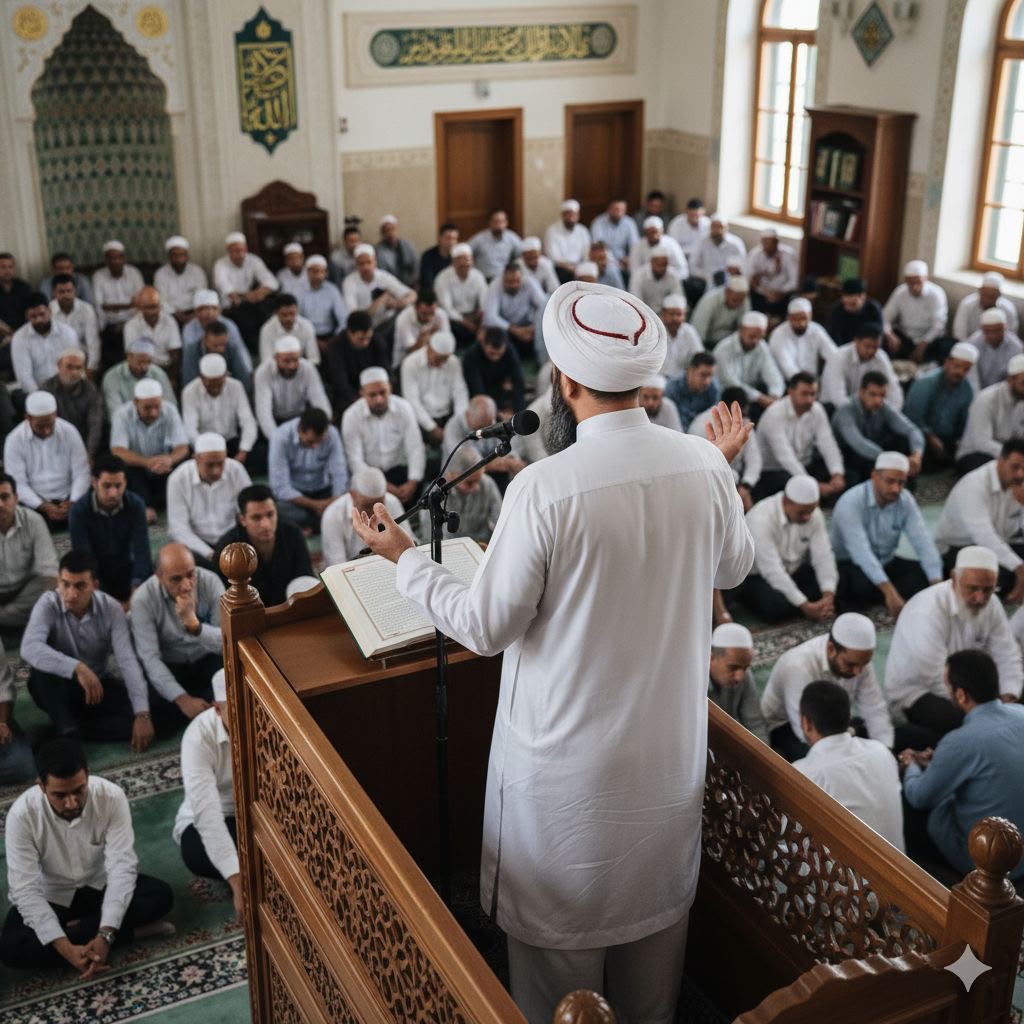
Every Friday, Muslims gather in mosques for Jumuʿah. The rows are filled, the imam climbs the minbar, the congregation becomes quiet, and the khutbah begins.
For some people, this is simply the part that comes before the prayer. They sit, listen for a while, perhaps check the time repeatedly, and wait for the two rakʿahs to begin.
But the Jumuʿah khutbah is much more than something to sit through before Salah.
It is a central part of the Friday gathering and an opportunity for the believer to be reminded of Allah, corrected in areas where he may have become careless, encouraged towards righteousness and reminded of his responsibilities as a Muslim.
The Qur’an gives a clear instruction concerning Jumuʿah:
“O you who believe! When the call is proclaimed for the prayer on Friday, then hasten to the remembrance of Allah and leave off business. That is better for you, if you only knew.”
(Qur’an 62:9)
The Friday prayer is therefore connected directly to the remembrance of Allah. The khutbah forms part of that experience of remembrance and instruction.
LISTENING IS PART OF THE WORSHIP
The Prophet Muhammad ﷺ taught Muslims to remain silent and listen when the imam is delivering the khutbah.
Abu Hurayrah رضي الله عنه narrated that the Messenger of Allah ﷺ said:
“When you say to your companion, ‘Listen,’ on Friday while the imam is delivering the khutbah, you have engaged in idle speech.”
This hadith, recorded in Sahih al-Bukhari and Sahih Muslim, shows how seriously Islam treats the khutbah.
Notice what the Prophet ﷺ mentioned.
He did not only prohibit long conversations. Even telling another person to be quiet during the khutbah was described as idle speech.
The purpose is to protect the khutbah from becoming an ordinary gathering where people talk, joke, respond to messages or hold side conversations while the imam is addressing the congregation.
The believer is being asked to stop and listen.
But listening is more than keeping your mouth closed.
YOUR BODY MAY BE IN THE MOSQUE, BUT WHERE IS YOUR MIND?
A person can remain completely silent during the khutbah and still fail to truly listen.
His body is in the mosque, but his mind is somewhere else.
He may be thinking about work.
He may be replaying an argument from earlier in the week.
He may be wondering what he will eat after Jumuʿah.
He may be scrolling through his phone.
He may be watching the clock.
He may hear the imam’s words without allowing them to reach his heart.
This is why the attitude we bring into the khutbah matters.
Before the imam begins, the Muslim should remind himself that these few minutes are not ordinary minutes. This is an opportunity to hear a reminder about Allah.
Perhaps the khutbah will address a weakness you have been struggling with.
Perhaps one sentence will make you rethink a decision.
Perhaps a reminder about repentance will cause you to return to Allah.
Perhaps something you hear will help you become a better husband, wife, parent, child, neighbour or member of the Muslim community.
You do not know which reminder Allah may use to benefit you.
THE KHUTBAH IS A REMINDER, NOT ENTERTAINMENT
There is another important point.
The khutbah is not designed to entertain the congregation.
A speaker does not need to make people laugh every few minutes for the khutbah to be valuable. The purpose is not to compete with social media, comedy or public speaking.
The khutbah should bring people back to Allah.
Sometimes the message may be uncomfortable.
It may remind us about sins we have become comfortable with.
It may challenge the way we treat our families.
It may remind us about the rights of our neighbours.
It may speak about dishonesty, arrogance, backbiting, injustice, neglect of Salah or attachment to worldly possessions.
A sincere believer does not automatically reject a reminder simply because it makes him uncomfortable.
Allah says:
“And remind, for indeed the reminder benefits the believers.”
(Qur’an 51:55)
The believer listens with the intention of benefiting.
THE KHUTBAH SHOULD MAKE US THINK ABOUT OUR LIVES
One of the most important questions a Muslim can ask after Jumuʿah is not, “Was the khutbah interesting?”
A better question is:
“What am I going to do differently because of what I heard?”
If the imam speaks about repentance, will you take your repentance seriously?
If he speaks about Salah, will you become more careful with your prayers?
If he speaks about the tongue, will you become more conscious of gossip and backbiting?
If he speaks about parents, will you improve the way you treat yours?
If he speaks about honesty, will you examine your dealings?
If he speaks about the temporary nature of this world, will you reconsider what has been consuming your heart?
The value of a reminder is not only in what we hear. It is also in what we do with what we hear.
A khutbah may last twenty or thirty minutes, but its effect can continue for the rest of the week if the listener carries its message into daily life.
WHY THE PHONE CAN WAIT
Modern distractions have made attentive listening more difficult.
A notification appears.
Someone sends a message.
A social media update arrives.
A person opens the phone for one reason and suddenly spends several minutes doing something completely unrelated.
During Jumuʿah, the believer should recognise that some moments deserve his complete attention.
The phone can wait.
The message can wait.
The social media update can wait.
The khutbah is taking place now.
This does not mean that every person holding a phone during the khutbah is automatically doing something sinful; circumstances differ, and a phone may sometimes be needed for a legitimate reason. But unnecessary phone use during the khutbah defeats the purpose of gathering for remembrance and listening.
When you enter the mosque for Jumuʿah, give yourself permission to disconnect from the noise outside.
For those few minutes, let the world wait.
LISTENING ALSO REQUIRES HUMILITY
There is another dimension to listening that is often overlooked.
To genuinely listen, you must accept that you still have things to learn.
A person may have been Muslim for decades and still need reminders about basic matters.
He may know that lying is wrong but still need a reminder about honesty.
He may know that Salah is important but still need encouragement to protect his prayers.
He may know that Allah forgives but still need to be reminded to repent.
He may know the rights of parents but still need to examine his behaviour towards them.
Islam does not assume that knowing something once means we will always remember it.
Human beings forget.
We become distracted.
We become weak.
We become careless.
That is why reminders matter.
THE KHUTBAH IS ALSO ABOUT THE COMMUNITY
Jumuʿah is not only about individual spiritual improvement.
It is also a gathering of the Muslim community.
The khutbah can address issues affecting families, neighbours and society. It can remind Muslims about justice, compassion, honesty, responsibility, good character and concern for others.
When Muslims sit together and listen to a reminder, they are being reminded that Islam is not simply a private relationship between an individual and Allah.
Our actions affect other people.
The way we conduct business affects customers.
The way we treat employees affects families.
The way we treat our parents affects our homes.
The way we raise our children affects the next generation.
The way we speak about other Muslims affects the unity of the community.
A meaningful khutbah can therefore take the believer beyond personal worship and make him think about the responsibilities he carries towards others.
DON’T CHOOSE ONLY THE KHUTBAHS YOU LIKE
Another important part of benefiting from the khutbah is learning to receive reminders even when they are not about our favourite subjects.
Some people enjoy khutbahs about spirituality.
Others prefer discussions about family.
Some prefer fiqh.
Others prefer stories from the lives of the Prophets and the companions.
But Islam is broader than our personal preferences.
A reminder about something you already know may still be useful.
A topic you consider ordinary may be exactly what another person desperately needs to hear.
And sometimes Allah benefits you through a message you did not expect.
The believer should therefore approach Jumuʿah with an open heart rather than demanding that every khutbah match his personal interests.
WHAT IF YOU DON’T UNDERSTAND EVERYTHING?
Muslims live in different environments and have different levels of knowledge and language ability. Not everyone will understand every word of every khutbah.
That should not become a reason to stop trying to benefit.
If there are things you do not understand, learn them afterwards where possible. Ask a knowledgeable person. Read about the subject. Continue developing your Islamic knowledge.
The important thing is to take the khutbah seriously and make an effort to understand and apply its message.
Islam encourages believers to seek knowledge, and every Friday provides another opportunity to hear Islamic reminders.
JUMUʿAH SHOULD NOT END AT THE MOSQUE DOOR
The real test of a khutbah is what happens after the prayer.
If you heard a reminder about patience but returned home and immediately became harsh with your family, what did the reminder change?
If you heard about controlling the tongue but spent the afternoon gossiping, what did you take from the khutbah?
If you heard about repentance but continued deliberately returning to the same sin without even trying to change, what did you learn?
The purpose of a reminder is transformation.
It may be gradual. It may take time. A person may struggle repeatedly before overcoming a weakness.
But there should be some effort.
Jumuʿah gives us a weekly opportunity to pause and ask ourselves where we are heading.
Perhaps this week you need to work on your Salah.
Perhaps you need to repair a relationship.
Perhaps you need to apologise.
Perhaps you need to stop a particular sin.
Perhaps you need to become more grateful.
Perhaps you simply need to return to Allah after allowing yourself to become spiritually distant.
Whatever the reminder may be, do not allow it to disappear as soon as you walk out of the mosque.
MAKE YOURSELF A LISTENER WHO BENEFITS
Every Friday, thousands of Muslims sit through the khutbah.
But the goal should not simply be to be physically present.
Be present with your heart.
Listen carefully.
Put distractions aside.
Think about the message.
Ask yourself how it applies to your life.
And when you leave the mosque, carry at least one lesson with you.
You do not need to remember every sentence.
You do not need to memorise the entire khutbah.
Sometimes one sincere reminder is enough to change the direction of a person’s day, his behaviour, or even his relationship with Allah.
Friday gives us this opportunity every week.
The imam speaks.
The believer listens.
The heart reflects.
And then life continues.
The question is what the believer carries from the mosque into that life.
May Allah make us people who listen to reminders with sincere hearts, benefit from what we hear and put beneficial knowledge into practice. May He make our Jumuʿah a means of strengthening our iman and bringing us closer to Him.
Ameen.
3SixtyIslam — your trusted partner for Hajj and Umrah travel. For reliable packages, proper guidance and full support throughout your sacred journey, DM @3SixtyIslam.
