


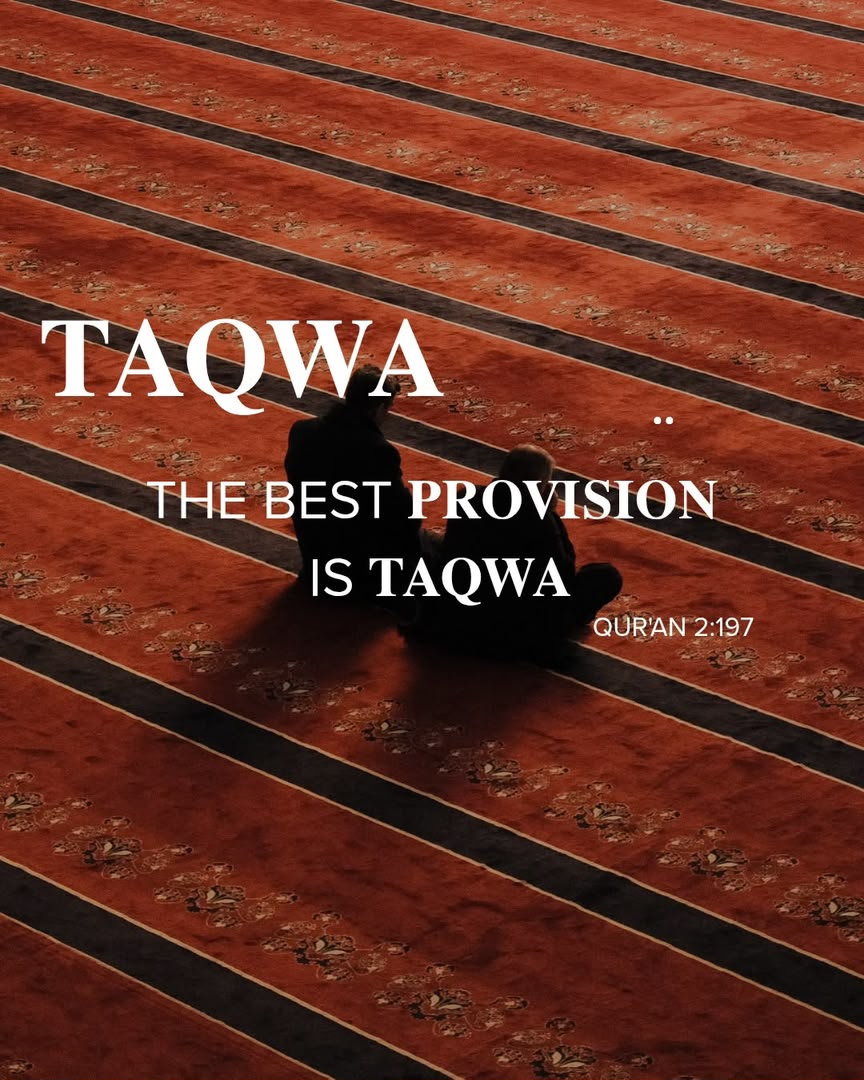
Taqwa is one of those Islamic words that Muslims hear frequently, especially in khutbahs, lectures and reminders, but it is also a word that is sometimes misunderstood. It is often translated simply as “fear of Allah,” and while fear of Allah is certainly part of taqwa, the meaning goes much deeper. Taqwa is a state of awareness in which a Muslim becomes conscious of Allah, careful about disobeying Him, eager to obey Him and mindful of the consequences of their choices.
A person with taqwa does not live only according to what other people can see. Their relationship with Allah influences their private decisions, their behaviour when nobody is watching, the words they choose, the money they earn, the people they deal with and the sins they walk away from. Taqwa creates an internal sense of accountability. It reminds a Muslim that even when the world does not see an action, Allah sees it.
The Qur’an gives taqwa an extremely important position in the life of a believer. Allah says, “O you who believe, fear Allah as He should be feared and do not die except as Muslims.” (Qur’an 3:102). This is not a command directed only at scholars, imams or people who are considered highly religious. It is addressed to the believers.
Taqwa therefore belongs to every Muslim.
WHAT DOES TAQWA ACTUALLY MEAN?
The Arabic word taqwa comes from a root connected with protection and guarding oneself. In an Islamic sense, it carries the meaning of protecting oneself from Allah’s displeasure by obeying Him and avoiding what He has prohibited.
This helps us understand why translating taqwa simply as fear does not tell the whole story.
Fear can cause someone to run away from something, but taqwa also draws a person towards Allah. It involves love, hope, reverence, obedience, awareness and caution. A Muslim fears Allah’s punishment, hopes for His mercy, loves Him, honours His commands and tries to stay away from whatever could damage their relationship with Him.
Taqwa changes the question a person asks before making a decision. Instead of asking only, “Can I get away with this?” the believer begins to ask, “Is this pleasing to Allah?”
That difference is enormous.
Imagine someone finds money that does not belong to them. Nobody is around. There are no cameras and nobody knows what happened. A person without that awareness might think, “I can keep it because nobody will find out.” But a person who has taqwa remembers something more important: Allah knows.
That same awareness applies to countless situations in everyday life.
It applies when a person is tempted to lie because the truth may be inconvenient. It applies when someone has an opportunity to cheat in business. It applies when a person is angry and wants to insult someone. It applies when someone receives a private message that should not be shared. It applies when a person is alone with access to something sinful.
Taqwa reminds the believer that being unseen by people does not mean being unseen by Allah.
THE REAL TEST OF TAQWA IS OFTEN PRIVATE
It is relatively easy to appear righteous when people are watching. We naturally become more conscious of our behaviour when we know that others are observing us. The more difficult test comes when there is no audience.
Who are we when nobody is watching?
That question is important because Islam is not built around appearances. Allah knows what is visible and what is hidden. He knows the actions that receive praise and the actions that nobody ever hears about.
Allah says, “Indeed, Allah is aware of what you do.” (Qur’an 59:18).
A Muslim may successfully hide something from family members, friends, colleagues or the wider community, but nothing can be hidden from Allah. This awareness is one of the foundations of taqwa.
It is what makes someone close their phone when they come across something they know they should not be watching. It is what makes a business owner refuse dishonest profit even when nobody would discover the deception. It is what makes someone apologise after hurting another person instead of allowing pride to control them.
These may seem like small decisions, but they reveal something significant about the heart.
Taqwa means remembering Allah in the moments when personal desire is competing with obedience.
TAQWA DOES NOT MEAN YOU WILL NEVER SIN
One of the mistakes people make when thinking about taqwa is imagining that a person with taqwa must be completely free from sin.
That is not realistic.
Human beings make mistakes. Muslims struggle. People become weak, fall into temptation and sometimes disobey Allah. The existence of a sin does not automatically mean that a person has no taqwa. What matters is how the believer responds after falling.
Does the person justify the sin?
Do they become comfortable with it?
Do they stop caring?
Or does their heart recognise that they have moved away from what Allah wants and push them towards repentance?
Allah describes the people of taqwa in a powerful way:
“Indeed, those who are mindful of Allah—when an impulse touches them from Satan, they remember Allah, then instantly they see clearly.” (Qur’an 7:201).
Notice that the verse does not describe people who are never tempted. It describes people who, when temptation comes, remember Allah and regain clarity.
This is an important lesson for Muslims who feel discouraged by their own struggles. Taqwa is not about pretending to be perfect. It is about keeping your heart connected to Allah and refusing to become comfortable with disobedience.
When a Muslim falls, they get back up.
When they sin, they repent.
When they become distracted, they return.
When they become weak, they seek strength from Allah.
That return is part of the journey.
TAQWA CHANGES HOW WE TREAT PEOPLE
Sometimes Muslims think about taqwa only in terms of personal worship: Salah, fasting, Qur’an and dhikr. These are undoubtedly important, but taqwa also appears in our dealings with other people.
How we treat people is part of our religion.
A person cannot deliberately cheat customers, abuse employees, mistreat family members, spread people’s secrets, take advantage of vulnerable people and then assume that personal acts of worship make these matters irrelevant.
Taqwa should influence our character.
It should affect how we speak to our parents, how we treat our spouses, how we deal with colleagues, how we conduct business and how we behave towards people who cannot offer us anything in return.
The Prophet Muhammad ﷺ taught that righteousness is deeply connected to the heart and character of a believer. Islam does not ask us to build a relationship with Allah while ignoring the rights of the people around us.
This is why taqwa should be visible not only inside the mosque but also inside the home, the office, the marketplace and the street.
TAQWA AND THE WAY WE EARN OUR MONEY
One of the clearest places taqwa becomes practical is in our finances.
It is easy to speak about trusting Allah when everything is going well. It becomes more difficult when a person is struggling financially and is presented with an opportunity to make money through something doubtful or clearly prohibited.
Taqwa tells the Muslim that provision does not need to come through disobedience.
A person may refuse to participate in fraud even when money is urgently needed. A business owner may choose honesty even when competitors appear to be making more money through deception. An employee may refuse to falsify records even when doing so would benefit them.
These choices can be difficult, but they demonstrate that Allah’s pleasure is more important than temporary gain.
The Qur’an says, “Whoever is mindful of Allah, He will make a way out for them and provide for them from where they do not expect.” (Qur’an 65:2–3).
This does not mean a Muslim will never experience financial difficulty. Rather, it teaches the believer to place their trust in Allah and remain within what is lawful even when circumstances are difficult.
TAQWA IS ALSO ABOUT WHAT HAPPENS INSIDE THE HEART
Taqwa is not only about outward actions. It also requires a person to examine what is happening inside.
Jealousy, arrogance, hatred, envy, resentment and pride can slowly affect the heart if they are not confronted. A Muslim may perform outward acts of worship while allowing unhealthy attitudes to grow within them.
Developing taqwa therefore requires self-examination.
Why am I doing this?
Why am I angry?
Why do I want this person’s blessing to disappear?
Why do I need people to praise me?
Why am I performing this act of worship?
Why am I finding it difficult to forgive?
These questions can be uncomfortable, but they can also help a Muslim recognise problems before they become deeply rooted.
A heart that is conscious of Allah does not simply look at other people’s mistakes. It also examines itself.
HOW CAN A MUSLIM DEVELOP TAQWA?
Taqwa does not appear overnight. It grows through consistent acts of worship and conscious effort.
A Muslim develops taqwa by learning about Allah, reflecting on His names and attributes, maintaining the five daily prayers, reading and reflecting upon the Qur’an, remembering Allah frequently, making sincere repentance and being careful about what they allow into their hearts and lives.
The people around us also matter. Our friends, the content we consume, the conversations we participate in and the environments we spend time in can either strengthen our awareness of Allah or gradually weaken it.
A person cannot constantly surround themselves with things that pull them away from Allah and expect their heart to remain unaffected.
This is why taqwa requires choices.
Sometimes it means leaving a conversation.
Sometimes it means refusing an opportunity.
Sometimes it means changing a friendship.
Sometimes it means putting the phone away.
Sometimes it means admitting that something you have become comfortable with is not good for your faith.
These decisions may not always be easy, but taqwa teaches the Muslim to value their relationship with Allah above temporary comfort.
THE FRUIT OF TAQWA
The Qur’an repeatedly mentions the blessings connected to taqwa. Allah says, “And whoever is mindful of Allah, He will make a way out for them and provide for them from where they do not expect.” (Qur’an 65:2–3).
Allah also says, “Indeed, the most noble of you in the sight of Allah is the most righteous of you.” (Qur’an 49:13).
This changes the way Muslims should understand success.
People may measure success through wealth, education, popularity, appearance, influence or social status. Islam gives us another measure: our relationship with Allah and the quality of our obedience to Him.
A person may not be famous but may have immense taqwa.
They may not have great wealth but may be extremely sincere.
They may not receive public recognition for their good deeds, yet Allah knows every private act of worship, every temptation they resisted and every sacrifice they made for His sake.
That is why taqwa is so valuable.
IT STARTS WITH ONE QUESTION
Developing taqwa does not require waiting for a particular stage of life. It begins with the next decision.
Before speaking, ask whether your words please Allah. Before earning, ask whether your income is halal. Before posting something online, ask whether it is beneficial and permissible. Before responding in anger, remember that Allah sees you. Before committing a private sin, remember that you are never truly alone.
And when you make a mistake, do not allow shame to convince you that there is no way back. Turn to Allah.
Taqwa is ultimately about living with an awareness that Allah is greater than our desires, greater than people’s opinions and greater than the temporary attractions of this world.
It is the consciousness that follows a Muslim into private moments and public moments, into ease and difficulty, into success and disappointment.
The goal is not to become a person who never struggles. The goal is to become a person whose heart continues to return to Allah.
And perhaps one of the most important questions we can ask ourselves at the beginning of this journey is simple: if nobody could see what I was doing, would I still choose what pleases Allah?
The answer to that question can tell us a great deal about our taqwa.
