


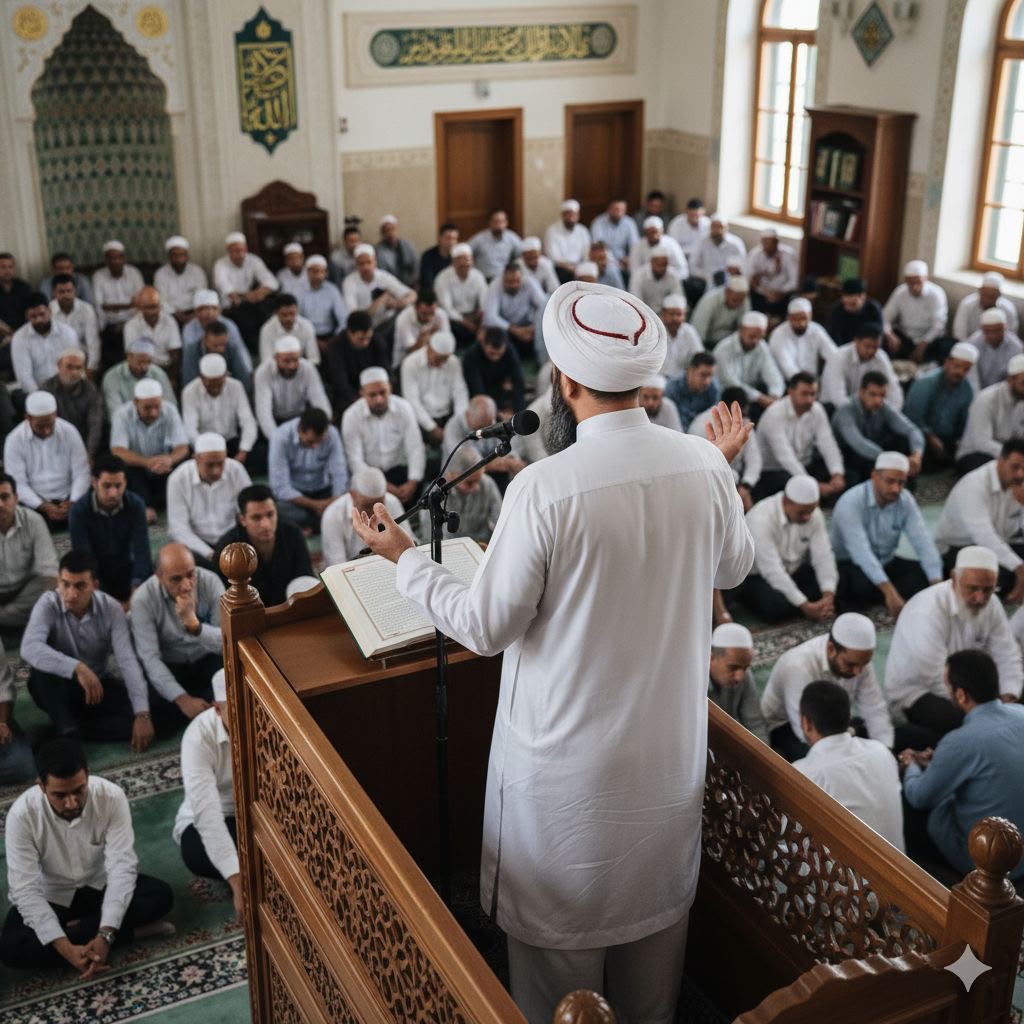
Most Muslims know that there is a khutbah before the Jumu’ah prayer. But many people do not realise just how seriously Islam treats the instruction to listen when the imam is delivering it.
The khutbah is not simply a speech that happens before the prayer. It is part of the Jumu’ah gathering, and the congregation has been given a specific responsibility: listen.
EVEN TELLING SOMEONE TO BE QUIET CAN BECOME A PROBLEM
The Prophet ﷺ said:
“If you say to your companion, ‘Listen,’ on Friday while the imam is delivering the khutbah, you have engaged in idle talk.”
This hadith is recorded in Sahih al-Bukhari and Sahih Muslim.
Think about that.
Someone is talking during the khutbah, and you turn to them and say, “Please be quiet.”
Your intention may be good.
You are trying to stop the disturbance.
Yet the Prophet ﷺ described even this instruction as laghw — idle or unnecessary speech — when the imam is delivering the khutbah.
That shows how important silence and attention are during the khutbah.
WHY IS THE KHUTBAH TREATED DIFFERENTLY?
The khutbah is not simply another lecture.
The Friday gathering has a specific structure. Muslims gather, the imam delivers the khutbah, and the congregation listens before the prayer.
Allah says:
“When the call to prayer is made on Friday, then proceed to the remembrance of Allah and leave trade.”
Qur’an 62:9
The verse establishes that Jumu’ah requires the believer to temporarily step away from ordinary activities and give attention to the remembrance of Allah.
That includes putting aside conversations and distractions.
THIS ALSO MEANS PUTTING THE PHONE AWAY
This is where an old Islamic teaching becomes particularly relevant today.
A person may sit quietly during the khutbah but spend the entire time checking messages.
They are physically present but mentally somewhere else.
The phone vibrates.
They check it.
Another notification appears.
They respond.
They scroll.
They read something unrelated to the khutbah.
Technically, they may not be talking, but they are still allowing distractions to take away from the purpose of the gathering.
Jumu’ah is an opportunity to deliberately disconnect from those distractions.
For a short period, the phone can wait.
WHAT IF THE KHUTBAH IS NOT INTERESTING?
This is another important point.
Sometimes the khutbah may not be delivered in the style we personally prefer.
Perhaps the speaker is too slow.
Perhaps the subject does not interest us.
Perhaps we have heard similar advice before.
That does not give us permission to start conversations or create distractions.
Listening attentively is part of the etiquette of Jumu’ah.
There is a difference between finding a khutbah less engaging than you expected and deciding that you no longer need to listen.
WHAT ABOUT RESPONDING TO SALAM?
This is an area where Muslims should avoid giving simplistic answers because there are different circumstances and detailed rulings concerning speech during the khutbah.
The general principle, however, is to avoid unnecessary conversation and to listen attentively.
If something requires action for safety or genuine necessity, that is obviously different from casual conversation.
The goal is not to turn the khutbah into an exercise where people are afraid to move or respond to an emergency.
The goal is to preserve the seriousness and attention of the gathering.
THE KHUTBAH IS ALSO A TEST OF SELF-CONTROL
There is a deeper lesson here.
We live in a time when people are accustomed to constant stimulation.
If something does not immediately capture our attention, we reach for our phones.
If we disagree with something, we want to respond immediately.
If someone is talking for too long, we become restless.
Jumu’ah gives us an opportunity to practise something increasingly difficult:
sitting down and listening.
No scrolling.
No side conversations.
No unnecessary interruptions.
No checking every notification.
Just listening.
That discipline itself is valuable.
DO NOT ARRIVE AND THEN DISTURB EVERYONE
This connects with another important Jumu’ah etiquette.
If you arrive while the khutbah is already underway, enter calmly and avoid disturbing people.
Do not squeeze through rows unnecessarily.
Do not greet people with loud conversation.
Do not create a distraction because you arrived late.
Find an appropriate place and listen.
This is one reason arriving early is so beneficial. You avoid many of these problems altogether.
WHAT IF YOU HAVE SOMETHING IMPORTANT TO SAY?
Islam is not asking people to ignore genuine emergencies or necessary matters.
If someone’s safety is at risk, action may be necessary.
If a child is in danger, you cannot simply sit silently because the khutbah is taking place.
If there is an urgent situation, the circumstances are different.
But ordinary conversation can wait.
That is the key distinction.
JUMU’AH REQUIRES YOUR ATTENTION
One of the easiest ways to change your Friday experience is to stop treating the khutbah as background noise.
Before the imam begins, put your phone away.
Clear your mind.
Listen to the message.
Think about how it applies to your life.
If you disagree with something or do not find the topic interesting, remain respectful and attentive.
You may discover that the reminder you initially thought you did not need was exactly the reminder you needed.
Jumu’ah is not simply about being physically present in the mosque.
It is about being present enough to listen.
