


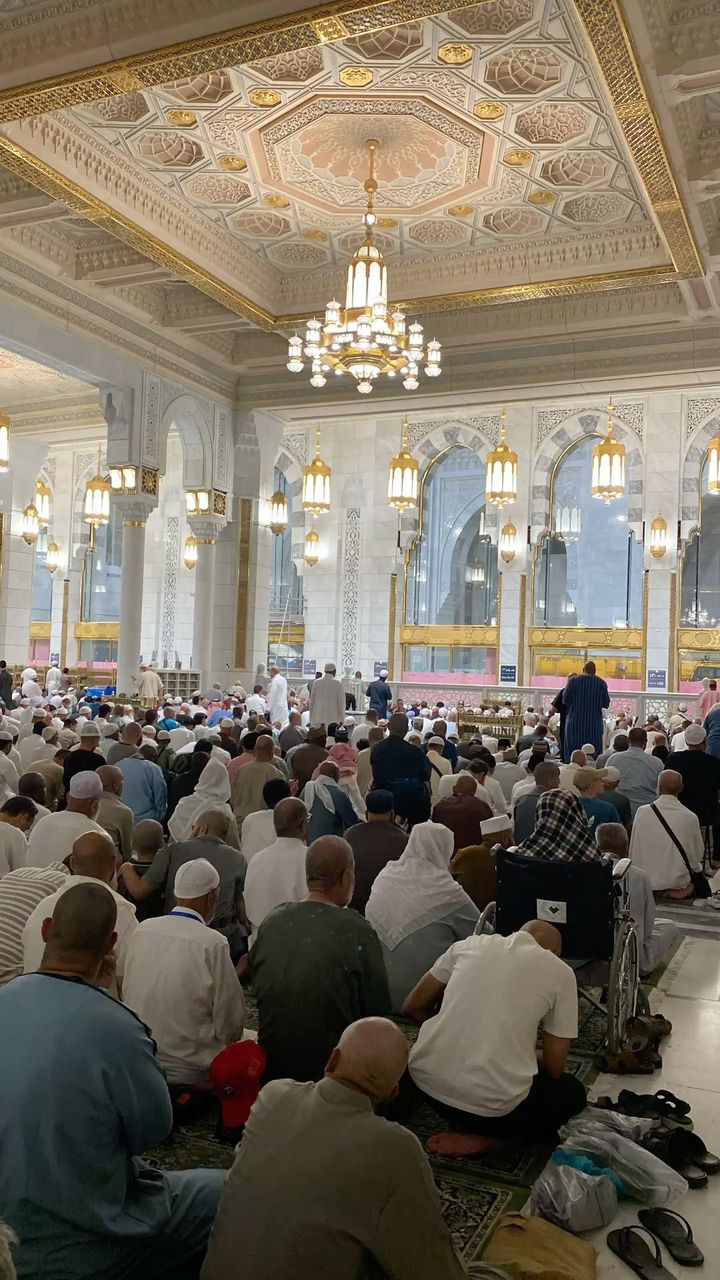
There is a small Jumu’ah etiquette that many Muslims have heard about but may not fully understand: when the mosque is crowded, you should not climb over or step across people in order to reach a preferred place.
It can seem like a minor issue, especially when someone arrives late and sees an empty space further towards the front.
But the Prophet ﷺ addressed this behaviour directly.
THE PROPHET ﷺ CORRECTED A MAN WHO WAS STEPPING OVER PEOPLE
During a Friday khutbah, a man came late and began stepping over the people to move towards the front.
The Prophet ﷺ saw him and said:
“Sit down, for you have caused harm.”
This narration is reported in Sunan Abi Dawud and Ibn Majah, and scholars have discussed its chain and supporting narrations.
The important principle is clear: your desire to get a better position in the mosque should not come at the expense of disturbing other worshippers.
WHY IS THIS SUCH A BIG DEAL?
Imagine someone has arrived early, found a place, settled down and is listening to the khutbah.
Then another person arrives late and starts stepping over their shoulders, walking in front of them or squeezing between people to reach a space further ahead.
The latecomer may think:
“I am only trying to sit closer to the imam.”
But the people already seated experience something very different.
They are distracted.
They may have to move.
They may lose concentration during the khutbah.
Someone could even be injured.
Islamic etiquette therefore considers not only what you want to achieve but also how your actions affect other Muslims.
ARRIVING EARLY SOLVES THE PROBLEM
This is one reason the Sunnah of arriving early for Jumu’ah is so beautiful.
The earlier you arrive, the more choices you have.
You can find a comfortable place without disturbing anyone.
You can sit quietly.
You can worship before the khutbah.
And you avoid creating inconvenience for people who have already arrived.
On the other hand, arriving at the last minute can put you in a difficult position.
The mosque may be full.
People may already be seated.
You may have to sit wherever you find space.
That is part of the consequence of arriving late.
BUT WHAT IF THERE IS A GAP?
This is where common sense and Islamic etiquette matter.
If there is a genuine open space that you can reach without disturbing people, there is no reason to remain at the back simply because you arrived after others.
The problem is not moving forward itself.
The problem is causing harm or unnecessary disturbance while doing so.
If people are sitting tightly together and you have to climb over them to reach a particular spot, it is better to avoid doing so.
THE FRONT ROW SHOULD NOT BECOME A COMPETITION
There is great virtue in being close to the imam and in the first rows of the prayer.
But the desire to obtain that reward should not cause a Muslim to violate another person’s rights.
This reflects a broader principle in Islam:
A good intention does not make every method acceptable.
You may genuinely want the reward of the first row.
But that does not give you permission to inconvenience people who are already seated.
The Sunnah teaches us to seek virtue while maintaining good manners.
THERE IS ANOTHER PROBLEM: WALKING IN FRONT OF SOMEONE WHO IS PRAYING
This should also be distinguished from stepping over people.
There are separate rulings concerning walking directly in front of someone who is praying, particularly between the person praying and their sutrah.
Many people are unaware of how seriously the Prophet ﷺ warned against passing directly in front of someone who is praying.
This is another reason to be considerate when moving around a crowded mosque.
The mosque is a shared space, and every worshipper has responsibilities towards the people around them.
WHAT SHOULD YOU DO IF YOU ARRIVE LATE?
If the mosque is crowded, look for a genuine space.
If you cannot find one near the front without disturbing people, sit where you can.
Do not turn your late arrival into someone else’s inconvenience.
And perhaps the next Friday, adjust your schedule so that you arrive earlier.
That small change can completely improve your Jumu’ah experience.
JUMU’AH IS ALSO ABOUT HOW WE TREAT PEOPLE
This is perhaps the deeper lesson.
Jumu’ah is not only about performing two rak’ahs.
It is also an opportunity to practise Islamic character.
Patience.
Consideration.
Respect.
Humility.
Self-control.
A person may want the front row, but they also have to consider the Muslim already sitting there.
A person may want a particular spot, but they cannot treat everyone else as obstacles standing in their way.
The mosque belongs to the community, not to the person who arrived last and wants the best position.
So when you attend Jumu’ah, remember that worship is not only about where you stand before Allah.
It is also about how you behave towards the people standing beside you.
And sometimes, choosing not to disturb another Muslim may itself be part of the character that Allah loves.
