


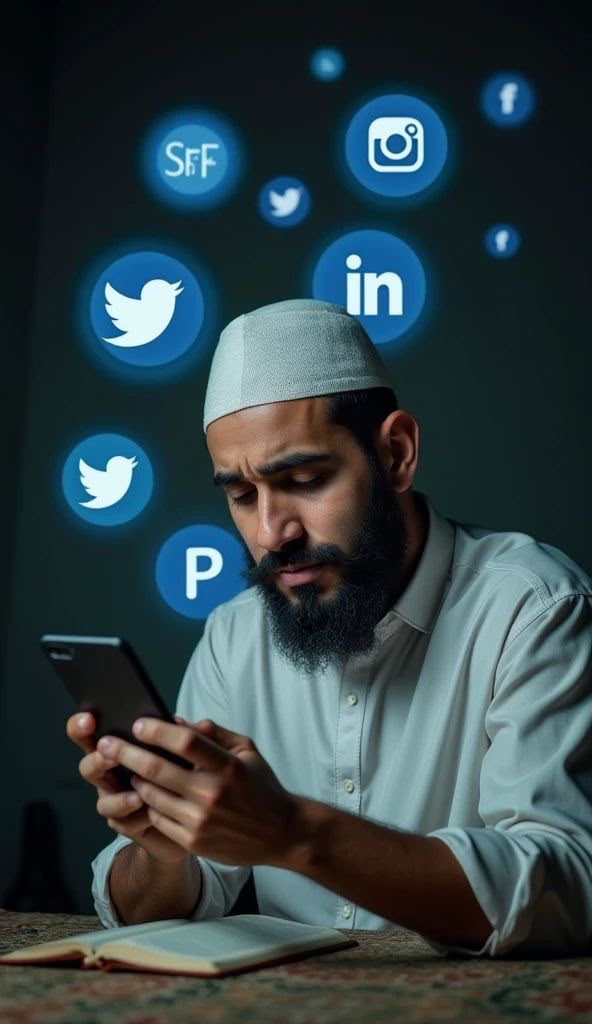
Most people know that they spend too much time on their phones.
We complain about it. We joke about it. We even make promises to ourselves that we will reduce our screen time.
But there is a deeper question we rarely ask:
What exactly is the phone taking from us?
It may be taking our time, but the loss can go much further than that.
It can take our attention, our concentration, our conversations, our sleep, our productivity and, if we are not careful, even some of the quality of our relationship with Allah.
The phone itself is not the problem. It is one of the most useful tools available to us today. We use it to work, study, communicate, learn, run businesses, access the Qur’an, listen to lectures, keep up with family and stay informed.
The problem begins when a useful tool quietly becomes the thing controlling our attention.
THE FIRST THING YOU REACH FOR
Think about the first few minutes after you wake up.
Before you have properly gathered your thoughts, you reach for your phone.
You check WhatsApp.
Then Instagram.
Then X.
Then YouTube.
Then perhaps your email.
You have not even properly started your day, but you have already consumed dozens of messages, opinions, advertisements, videos and other people’s activities.
And without realising it, you have allowed everyone else to enter your mind before you have had a moment to organise yourself.
For a Muslim, this deserves serious reflection.
What if the first thing your mind received every morning was not another person’s lifestyle, argument or advertisement, but a moment of remembrance, gratitude and intention?
WE ARE LOSING THE ABILITY TO BE FULLY PRESENT
One of the biggest problems with excessive phone use is not simply the number of hours spent online.
It is the inability to remain present when the phone is not in use.
You are having a conversation, but your phone is beside you.
You are eating with your family, but you are checking notifications.
You are working, but every few minutes you look at your screen.
You are in the masjid, and your attention is pulled toward a notification.
You are reading Qur’an, but part of your mind is wondering whether someone has replied to your message.
The body may be in one place while the mind is somewhere else.
And that affects the quality of our relationships, our work and even our worship.
NOT EVERY NOTIFICATION DESERVES YOUR ATTENTION
A notification creates a small sense of urgency.
Someone liked something.
Someone sent a message.
A new video has been posted.
There is breaking news.
Someone has replied to a comment.
Your phone vibrates.
You immediately check.
But ask yourself:
Is everything that demands my attention actually worthy of it?
The answer is no.
One of the most important skills a Muslim can develop in the digital age is the ability to decide what deserves attention.
Your attention is valuable.
Once you give it away, you cannot recover that particular moment.
YOUR PHONE CAN CHANGE HOW YOU SPEND YOUR FREE TIME
There was a time when having nothing to do meant sitting quietly.
You might think.
You might speak with someone.
You might read.
You might take a walk.
You might simply rest.
Today, the moment boredom appears, the phone comes out.
Waiting for transport?
Phone.
Waiting for food?
Phone.
Sitting alone?
Phone.
Waiting for someone?
Phone.
Taking a break?
Phone.
Before long, we have trained ourselves to avoid silence.
But silence is not always empty.
Sometimes silence gives you the opportunity to think.
Sometimes it allows you to notice how you are actually feeling.
Sometimes it gives you space to remember Allah.
Sometimes you simply need to be away from constant information.
THE DANGER OF CONSTANT COMPARISON
Social media makes comparison extremely easy.
You see someone’s new car.
Someone’s wedding.
Someone’s business.
Someone’s holiday.
Someone’s graduation.
Someone’s new house.
Someone’s successful career.
Someone’s seemingly perfect family.
And then you look at your own life.
Suddenly, what you were grateful for yesterday does not seem sufficient today.
This is one of the hidden costs of constantly consuming carefully selected versions of other people’s lives.
You are comparing your ordinary moments with someone else’s highlights.
You do not see their private struggles.
You do not see their financial pressures.
You do not see their family problems.
You do not see their difficult days.
You see what they chose to show.
And if you are not careful, the phone can make you dissatisfied with blessings you once considered valuable.
YOUR HEART ALSO NEEDS A DIGITAL DIET
We understand the importance of eating healthy food.
We think about what enters our bodies.
But we should also think about what constantly enters our minds and hearts.
What are you watching every day?
What conversations are you following?
What kind of arguments are you consuming?
What kind of language are you repeatedly exposed to?
What are you laughing at?
What are you becoming desensitised to?
What kind of content occupies your mind before you sleep?
The things we repeatedly consume can influence what we think about, what we desire and what eventually feels normal to us.
This does not mean that every piece of entertainment is automatically harmful.
It means that Muslims should become more intentional about what they consume.
WHEN THE PHONE STARTS AFFECTING SALAH
This is where the issue becomes particularly serious.
If your phone causes you to delay salah, rush your salah or become distracted during salah, something needs to change.
Imagine being deeply involved in a conversation with someone important and suddenly receiving a call from another person.
You might politely say, “I will call you back.”
But sometimes we do the opposite with Allah.
We allow notifications, conversations, videos and entertainment to occupy our attention while our relationship with Allah receives whatever remains.
The phone should never become more important than our obligations to Allah.
Technology should serve our worship, not compete with it.
YOU DO NOT HAVE TO DELETE EVERYTHING
Some people respond to concerns about phone addiction by saying:
“I will just delete all my social media.”
For some people, that may be the right decision.
But for many others, the better solution is learning discipline.
Set boundaries.
Turn off unnecessary notifications.
Keep your phone away during salah.
Do not take it to bed unnecessarily.
Create periods during the day when you are completely offline.
Stop checking your phone simply because you are bored.
Unfollow accounts that consistently damage your peace, values or faith.
Follow accounts that teach you something useful.
Use technology intentionally instead of automatically.
The goal is not to hate technology.
The goal is to control your relationship with it.
TRY A SIMPLE TEST THIS WEEK
For one week, pay attention to how often you pick up your phone without having a specific reason.
You may be surprised.
Before unlocking it, ask yourself:
“Why am I picking this up?”
If you have a genuine reason, do what you need to do and put it away.
If the honest answer is “I am bored,” “I am avoiding something,” or “I just wanted to check,” consider putting it down.
This simple habit can reveal how much of our phone use is intentional and how much is automatic.
PROTECT YOUR SLEEP
Many Muslims underestimate what late-night phone use does to their lives.
You intend to watch one video.
Then another appears.
You check one message.
Then you start scrolling.
You tell yourself you will stop in five minutes.
An hour passes.
The next morning, Fajr becomes harder.
You wake up tired.
Your concentration suffers.
Your mood changes.
Your productivity decreases.
And then you wonder why you feel exhausted all day.
Sometimes the solution is not complicated.
Go to sleep.
Your phone can wait.
YOUR FAMILY DESERVES YOUR ATTENTION TOO
Imagine speaking to someone you love while they repeatedly look at their phone.
Eventually, you stop feeling heard.
The same thing can happen within families.
Parents can become distracted around their children.
Spouses can become distracted around each other.
Friends can sit together without actually interacting.
Everyone is physically present, but mentally somewhere else.
Put the phone away sometimes.
Look at people when they speak.
Listen properly.
Have conversations without checking your screen every few minutes.
You may discover that some relationships do not need more communication.
They simply need more attention.
USE YOUR PHONE TO BECOME BETTER, NOT JUST BUSIER
There is another side to this conversation.
The same device that can waste hours can also help you grow.
You can read Qur’an.
Learn Arabic.
Listen to beneficial lectures.
Study.
Take courses.
Read books.
Follow reliable Islamic scholars and institutions.
Manage your business.
Stay connected with family.
Find useful information.
Learn a new skill.
The question is not simply:
“How much time do I spend on my phone?”
Ask:
“What is my phone helping me become?”
That is a much more important question.
THE MUSLIM’S ATTENTION IS AN AMANAH
Time is an amanah.
So is attention.
Every day, we receive a limited amount of both.
We cannot store today’s hours and use them tomorrow.
We cannot recover yesterday’s attention.
That is why we should be careful about what constantly demands our focus.
A Muslim should not allow algorithms to decide what occupies the mind.
We should not allow notifications to determine our priorities.
We should not allow strangers on the internet to determine our emotional state.
And we certainly should not allow our phones to gradually weaken the things that matter most.
START SMALL
You do not need to completely transform your digital life today.
Start with one change.
Do not check your phone immediately after waking up.
Keep it away during salah.
Stop using it during meals.
Create a phone-free period before sleeping.
Turn off unnecessary notifications.
Remove one distracting application.
Spend thirty minutes reading something beneficial instead of scrolling.
Have one conversation every day without touching your phone.
Small changes can become powerful when maintained consistently.
BEFORE YOU PICK UP YOUR PHONE AGAIN
The next time you reach for your phone without thinking, pause for a moment.
Ask yourself:
What am I looking for?
Do I actually need this?
What am I giving my attention to?
Could these few minutes be better spent?
And most importantly:
Is my phone helping me get closer to the person I want to become?
Because the real issue is not whether you own a smartphone.
The real issue is whether your smartphone owns too much of your attention.
Technology is here to stay.
The digital world will continue to grow.
New applications will appear. New trends will come. New distractions will compete for our attention.
As Muslims, we do not need to run away from the modern world.
We need to learn how to live in it without allowing it to control us.
Use your phone.
Benefit from it.
Learn through it.
Work through it.
Communicate through it.
But remember to put it down.
There are prayers that deserve your full attention.
There are people who deserve to be listened to.
There are responsibilities that deserve your effort.
There are moments that should not be recorded or posted.
And there is a relationship with Allah that deserves more attention than any notification on your screen.
Your phone may be stealing your time.
But if you are not careful, it can also steal your attention, your presence, your peace and some of the moments you will never get back.
Use the technology.
Do not let the technology use you.
3SIXTYISLAM
At 3SixtyIslam, we believe Islamic knowledge should speak to real life.
From faith and spirituality to Muslim lifestyle, Islamic history, beneficial discoveries, current Islamic affairs, Hajj and Umrah guidance, and practical reminders, our goal is to make 3SixtyIslam a trusted destination for Muslims seeking knowledge that is relevant, useful and grounded in Islam.
Follow 3SixtyIslam for more Islamic knowledge and practical reminders.
