


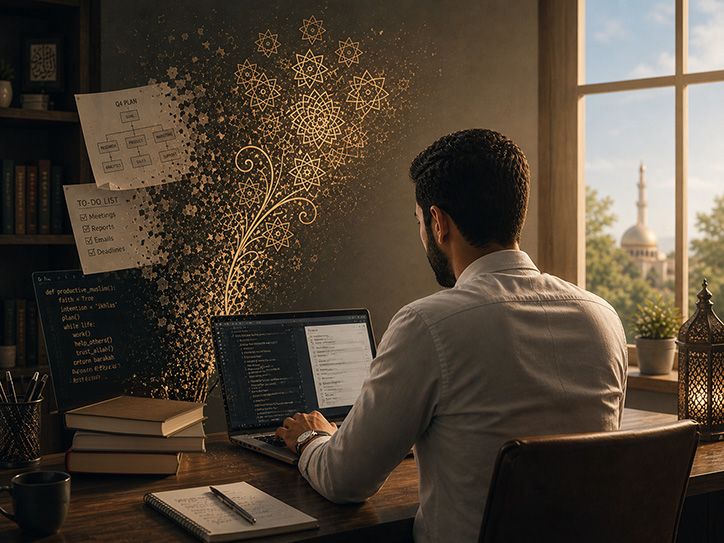
There is a type of exhaustion that sleep does not always fix.
You wake up early, rush through your morning, answer messages, attend meetings, work, study, run errands, deal with family responsibilities, scroll through your phone, and somehow the day is over.
You were busy from morning until night.
But when you look back, you struggle to identify what you actually accomplished.
Your schedule was full, but your heart feels empty. Your phone was busy, your calendar was busy, your work was busy, but something still feels missing.
This is where the concept of barakah becomes important.
Barakah is not simply about having more time, more money or more opportunities. It is about Allah placing goodness, benefit and lasting value in what you have.
A person can have very little time and accomplish something meaningful. Another person can have an entire day available and still feel as though the day disappeared.
The difference is not always how much time they had.
Sometimes, it is what was placed inside that time.
BUSY DOES NOT ALWAYS MEAN PRODUCTIVE
Modern life has taught us to admire busyness.
When someone says, “I have been extremely busy,” we often interpret it as a sign that the person is successful, hardworking or important.
But Islam does not teach us to pursue busyness for its own sake.
The real question is not:
“How busy was I today?”
The better question is:
“What did my time produce?”
You can spend three hours responding to messages and still have accomplished very little.
You can spend two hours scrolling through social media and feel mentally exhausted without having gained anything meaningful.
You can attend countless meetings, make endless plans and constantly move from one task to another while neglecting the things that actually matter.
Being occupied and being productive are not the same thing.
WHEN YOUR PRIORITIES BECOME DISORDERED
One of the reasons people struggle to find barakah in their time is that everything begins to look equally important.
A notification arrives, and you immediately check it.
Someone sends a message, and you stop what you are doing.
A new video appears, and you watch it.
Someone posts something online, and you spend twenty minutes reading the comments.
Meanwhile, salah is delayed.
The Qur’an remains untouched.
Family receives only the leftovers of your attention.
Important work is postponed.
Rest becomes scrolling rather than genuine recovery.
Eventually, the day becomes a collection of interruptions.
This is why a Muslim needs to learn how to distinguish between what is urgent and what is actually important.
Not everything demanding your attention deserves your attention.
BARAKAH BEGINS WITH THE RIGHT PRIORITIES
A Muslim’s day should not be organised around notifications.
It should be organised around purpose.
Salah should have a place in your schedule.
Your responsibilities should have a place.
Your family should have a place.
Your work should have a place.
Your physical and mental rest should have a place.
Your relationship with Allah should have a place.
When these priorities are neglected, simply filling the day with more activities will not solve the problem.
You may need fewer distractions, not more hours.
SOMETIMES THE PROBLEM IS NOT LACK OF TIME
Consider two people who both have 24 hours.
One spends the morning intentionally completing important tasks, protects their salah, limits unnecessary distractions and gives proper attention to their responsibilities.
The other spends the first hour checking social media, constantly switches between tasks, responds to every notification immediately, postpones important work and stays awake late consuming content.
At the end of the day, both can honestly say:
“I had a very busy day.”
But their experiences will be completely different.
This is why Muslims should not only ask Allah for more time.
We should also ask Allah to put barakah in the time we already have.
PROTECT YOUR FIRST HOURS
There is something powerful about how you begin your day.
If the first thing you do is pick up your phone and enter the world of other people’s opinions, problems, advertisements and entertainment, you have allowed the outside world to set the agenda for your mind.
Try something different.
Begin your day with Allah.
Pray Fajr.
Make your morning adhkar.
Read some Qur’an.
Think about what genuinely needs to be accomplished.
Then enter the rest of the day with direction.
You may still have the same 24 hours, but you may experience them differently.
LEARN TO SAY NO
Another reason people lose control of their time is that they are afraid to say no.
No to unnecessary conversations.
No to pointless arguments.
No to every invitation.
No to activities that constantly drain them.
No to spending hours consuming content that adds nothing to their lives.
Saying no does not mean you are arrogant or antisocial.
Sometimes it means you understand that your time is an amanah.
You cannot give everyone unlimited access to something Allah has only given you in limited quantity.
YOUR PHONE DESERVES A PLACE, NOT CONTROL
Technology is useful.
Your phone can help you work, communicate, learn Qur’an, listen to beneficial lectures, manage your business and stay connected with people.
The problem begins when the tool becomes the master.
If you cannot sit for ten minutes without checking your phone, that deserves your attention.
If you wake up to notifications before remembering Allah, that deserves your attention.
If you repeatedly postpone important responsibilities because of social media, that deserves your attention.
If you spend more time consuming other people’s lives than building your own, that deserves your attention.
The solution is not necessarily to throw away your phone.
The solution is to put it back in its proper place.
BARAKAH IS ALSO ABOUT WHAT YOU AVOID
Sometimes we think barakah comes only from doing more.
But sometimes barakah enters our lives when we remove what does not belong there.
Remove unnecessary arguments.
Remove constant comparison.
Remove excessive entertainment.
Remove habits that repeatedly lead you toward sin.
Remove commitments you accepted simply because you could not say no.
Remove the distractions that have been quietly consuming your best hours.
You may discover that you did not need more time after all.
You needed to stop wasting the time you already had.
ASK YOURSELF THESE QUESTIONS TODAY
Before this Monday gets away from you, take a few minutes and ask yourself:
What consumes most of my time?
What deserves more of my attention?
What am I constantly doing that produces little benefit?
Which important responsibility have I been postponing?
How much of my day is spent remembering Allah?
What distraction do I need to reduce?
What is one meaningful thing I can accomplish today?
These questions can reveal more about your life than simply looking at how full your calendar is.
A BUSY LIFE IS NOT NECESSARILY A MEANINGFUL LIFE
Islam does not ask us to become people who are permanently exhausted.
We have responsibilities, ambitions, families, businesses, careers and personal goals. Islam does not require us to abandon these things.
Rather, Islam teaches us to live with purpose.
Work hard.
Pray properly.
Take care of your responsibilities.
Rest when you need to rest.
Spend time with people who matter.
Learn.
Grow.
Remember Allah.
And protect yourself from becoming so busy chasing everything that you lose sight of what actually matters.
Because at the end of the day, the goal is not to be able to say:
“I was busy every minute.”
The goal is to be able to say:
“I used what Allah gave me in a way that mattered.”
May Allah put barakah in our time, our work, our families, our wealth and our efforts. May He help us recognise what deserves our attention and protect us from wasting our lives on things that bring little benefit.
A productive Muslim is not necessarily the person who does the most.
Sometimes, the productive Muslim is the person who knows what matters most and refuses to let everything else take its place.
3SIXTYISLAM
At 3SixtyIslam, we believe Islamic knowledge should help us navigate real life not just teach us what to know, but help us understand how to live better as Muslims.
Follow 3SixtyIslam for practical Islamic reminders, stories, knowledge, Muslim lifestyle content, spiritual reflections, Hajj and Umrah guidance, and important Islamic updates.
