


Introduction
Among the greatest examples of perseverance in the Qur’an is Prophet Nuh (Noah) (AS). His life demonstrates what it means to remain committed to the truth despite persistent rejection, ridicule, and opposition. While many prophets experienced resistance from their people, Nuh (AS) preached for longer than any other prophet mentioned in the Qur’an. His unwavering dedication over centuries serves as a powerful lesson for anyone facing challenges while trying to uphold their faith.
The story of Nuh (AS) appears throughout the Qur’an, particularly in Surah Nuh, Surah Hud, Surah Al-Mu’minun, Surah Al-Qamar, and Surah Nuh, each highlighting different aspects of his mission. Together, these verses present an account of a prophet who fulfilled his responsibility with patience, wisdom, and complete trust in Allah.
His story is not simply about the great flood. It is about faith, perseverance, accountability, and the consequences of persistently rejecting divine guidance.
A Society That Turned Away from Allah
After the time of Prophet Adam (AS), people gradually moved away from pure monotheism. They began venerating righteous individuals who had passed away. Over time, respect turned into excessive reverence, and eventually these figures became objects of worship.
The Qur’an mentions several idols worshipped by the people of Nuh:
“And they said, ‘Do not abandon your gods, nor abandon Wadd, Suwa’, Yaghuth, Ya’uq and Nasr.'”
(Qur’an 71:23)
Islamic scholars explain that these names originally belonged to righteous people. After their deaths, statues were erected to remember them. As generations passed, people forgot the original purpose of these statues and began worshipping them instead.
This marked one of the earliest manifestations of shirk (associating partners with Allah), prompting Allah to send Nuh (AS) to call his people back to the worship of the One True God.
The Mission of Prophet Nuh (AS)
Allah appointed Nuh (AS) as a prophet and instructed him to warn his people before a severe punishment befell them.
He called them with clarity and compassion, saying:
“O my people, worship Allah. You have no deity other than Him. Indeed, I fear for you the punishment of a tremendous Day.”
(Qur’an 7:59)
His message was straightforward and consistent. He did not seek wealth, leadership, or personal recognition. His sole objective was to guide people towards salvation by inviting them to worship Allah alone.
Like every prophet, Nuh (AS) emphasised tawhid, repentance, and obedience to Allah.
Nine Hundred and Fifty Years of Da’wah
One of the most remarkable facts mentioned in the Qur’an is the length of Nuh’s mission.
Allah says:
“Indeed, We sent Nuh to his people, and he remained among them for a thousand years less fifty years.”
(Qur’an 29:14)
This means he spent 950 years calling his people to Allah.
Despite this extraordinary period of preaching, only a small number accepted his message.
His experience teaches that success in da’wah is not measured by numbers but by sincerity and persistence.
A prophet chosen by Allah preached for centuries without seeing mass acceptance. Yet he never abandoned his mission because his responsibility was to convey the message, not to control people’s hearts.
Different Methods of Calling People to Allah
The Qur’an records that Nuh (AS) varied his approach in inviting people to Islam.
He preached publicly.
He spoke privately.
He advised individuals personally.
He reminded them during the day and at night.
He appealed to both their intellect and emotions.
Allah quotes Nuh (AS) as saying:
“Then I invited them openly. Then I announced to them publicly and spoke to them privately.”
(Qur’an 71:8–9)
This demonstrates that effective da’wah requires wisdom, patience, and adapting one’s methods while remaining faithful to the message.
The Arrogance of His People
Rather than reflecting on his message, many people responded with arrogance.
The leaders of society dismissed him because they believed only the poor and socially weak had accepted his teachings.
They accused him of being misguided.
They mocked his warnings.
They refused to abandon the traditions of their ancestors.
Their rejection was driven not by lack of evidence but by pride and attachment to false beliefs.
This pattern appears repeatedly throughout the Qur’an whenever prophets confronted societies that had become comfortable with disbelief.
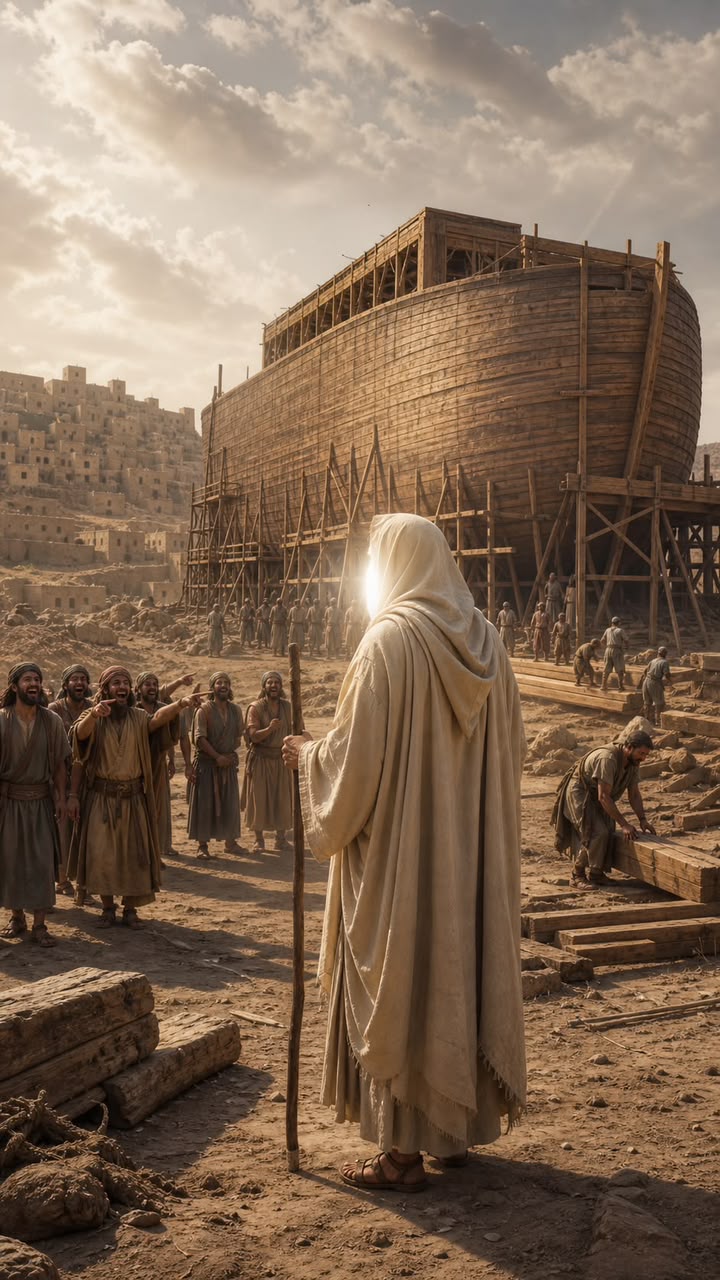
Building the Ark
When it became clear that his people would continue rejecting Allah’s guidance, Allah instructed Nuh (AS) to build an ark.
This command itself became another reason for mockery.
Nuh was constructing a massive ship far from any sea, leading people to ridicule him whenever they passed by.
The Qur’an says:
“And whenever the chiefs of his people passed by him, they mocked him.”
(Qur’an 11:38)
Despite the ridicule, Nuh (AS) continued building exactly as Allah commanded.
His response demonstrates complete trust in Allah even when others fail to understand His wisdom.
The Great Flood
When Allah’s command arrived, rain poured from the sky while water burst forth from the earth.
Nuh (AS) was instructed to board the ark together with the believers and pairs of animals.
The flood overwhelmed the land, destroying those who had persistently rejected Allah’s message.
The Qur’an describes the event as one of divine justice rather than a random natural disaster.
Those who had been warned for centuries could no longer escape the consequences of their choices.
The Story of Nuh’s Son
One of the most emotional moments in the story concerns Nuh’s own son.
Although Nuh (AS) was a prophet, not every member of his family accepted his message.
As the flood began, Nuh called to his son:
“O my son, come aboard with us and do not be with the disbelievers.”
(Qur’an 11:42)
His son replied that he would seek refuge on a mountain.
He believed the mountain could protect him from the rising waters.
Nuh reminded him that no one could escape Allah’s decree.
Moments later, a wave separated them, and his son was among those who drowned.
This painful incident demonstrates that guidance ultimately belongs to Allah. Family relationships alone cannot guarantee salvation. Every individual is responsible for their own faith and actions.
Allah’s Promise Is Always True
After the flood ended, the ark came to rest upon Mount Judi.
Allah instructed Nuh (AS) and the believers to disembark peacefully and begin a new chapter for humanity.
The story concludes with the triumph of faith over disbelief and the fulfilment of Allah’s promise to protect those who remain steadfast.
Although Nuh (AS) faced centuries of rejection, Allah never abandoned him.
His patience was rewarded exactly as Allah had promised.
Lessons from the Story of Prophet Nuh (AS)
The story of Nuh (AS) contains timeless lessons for Muslims.
Calling people to Allah requires patience and sincerity.
Success is measured by faithfulness to one’s responsibilities, not by popularity or numbers.
Arrogance often prevents people from accepting the truth.
Mockery should never discourage believers from doing what is right.
Parents should strive to guide their families while recognising that guidance ultimately belongs to Allah.
Trusting Allah during difficult circumstances is a defining characteristic of true faith.
Every warning from Allah should be taken seriously before it is too late.
Conclusion
The life of Prophet Nuh (AS) stands as one of the greatest examples of perseverance recorded in the Qur’an. For 950 years he remained committed to his mission despite rejection, ridicule, and disappointment. He neither compromised the message nor abandoned his responsibility.
His story reminds Muslims that patience is not passive endurance but steadfast commitment to what is right regardless of the outcome. It also teaches that faith should never be measured by public approval. A person may stand alone upon the truth and still be among the successful in the sight of Allah.
The account of Nuh (AS) continues to inspire believers to remain patient, trust Allah’s wisdom, and fulfil their responsibilities without losing hope.
Key Lessons from the Story
- Tawhid was the central message of Prophet Nuh (AS).
- Patience is essential when calling others to righteousness.
- Numbers do not determine the success of da’wah.
- Arrogance can prevent people from accepting clear guidance.
- Family ties cannot replace personal faith.
- Allah always fulfils His promises to those who remain steadfast.
Coming Next in the Series
THE STORY OF PROPHET HUD (AS): WHEN A NATION CHOSE ARROGANCE
Travel with 3SixtyIslam
When it comes to Hajj and Umrah, experience and trust matter. 3SixtyIslam provides reliable packages, proper guidance, and full support from departure to return. We handle the journey so you can focus on your ibadah. Choose a travel partner that understands the responsibility of serving the guests of Allah.
Follow @3SixtyIslam for trusted Hajj and Umrah guidance, authentic Islamic knowledge, inspiring Muslim news, and practical lessons for everyday Muslim living.
