


The Importance of Kindness, Respect, and Maintaining Good Relationships With Those Who Live Around Us
One of the things that reveals the beauty of a person’s character is how they treat the people around them, especially those who share their everyday environment.
It is easy to appear kind when we are in the mosque, surrounded by friends, or speaking to people we admire. But what about the person who lives next door? What about the neighbour who hears our footsteps, sees us on difficult days, or shares the same compound, street, or apartment building with us?
Do we greet them with kindness? Do we respect their privacy? Do we consider their comfort when making decisions? Do we offer help when they are in need? Or do we make their lives difficult through noise, gossip, arrogance, and unnecessary conflict?
As Muslims, we must understand that our responsibilities do not end with our acts of worship. Our faith should also be reflected in how we treat people, including those who live closest to us.
Being a good neighbour is not simply a matter of good manners; it is an important part of Islamic character and a responsibility that Allah has placed upon us.
Islam teaches us to show kindness, protect the rights of others, avoid causing harm, and build relationships based on mutual respect.
So, what does it truly mean to be a good neighbour according to Islam?
1. UNDERSTAND THE IMPORTANCE OF NEIGHBOURS IN ISLAM
Islam gives neighbours a special place in its teachings.
Allah says in the Qur’an:
“Worship Allah and associate nothing with Him, and to parents do good, and to relatives, orphans, the needy, the near neighbor, the neighbor farther away…” — Qur’an 4:36.
Notice how Allah mentions kindness to neighbours alongside other important responsibilities.
This verse reminds us that our treatment of neighbours is not an insignificant matter. It belongs to a broader Islamic commitment to worship Allah and treat people with goodness.
A neighbour may not be related to you by blood. They may not share your language, culture, financial status, or religious beliefs. You may not even be close friends.
Nevertheless, living near someone creates opportunities for kindness and responsibilities to avoid causing harm.
Your neighbour may be the first person to notice when something is wrong. They may be the person who can offer immediate assistance during an emergency. They may be someone who needs a little consideration to feel safe and comfortable in their own home.
A good Muslim recognises that the people living around them deserve respect and fair treatment.
You do not have to be best friends with every neighbour. You do not have to agree on everything. But you should strive to ensure that your presence brings peace rather than unnecessary hardship.
2. DO NOT HARM YOUR NEIGHBOUR
One of the clearest teachings about neighbourly conduct comes from the Prophet Muhammad ﷺ.
He said:
“By Allah, he does not believe! By Allah, he does not believe! By Allah, he does not believe!” It was said, “Who is that, O Allah’s Messenger?” He said, “That person whose neighbour does not feel safe from his evil.” — Sahih al-Bukhari.
This hadith carries a powerful warning.
A person may pray regularly, fast, give charity, and speak about Islam, yet still seriously neglect the rights of others through harmful behaviour.
What does it mean for a neighbour not to feel safe from you?
It may mean that they fear your threats, worry that you will damage their property, or feel intimidated whenever they encounter you.
It may also involve repeated harassment, deliberate provocation, spreading malicious rumours, or using your position to make their lives difficult.
Being a good neighbour requires us to examine not only the good things we do, but also the harm we may cause.
For example:
- Do you play music or operate equipment so loudly that others cannot rest?
- Do you leave rubbish in places that inconvenience other residents?
- Do you block someone’s entrance or parking space without permission?
- Do you allow visitors to disturb other households late at night?
- Do you threaten or insult neighbours whenever disagreements arise?
- Do you spread private information about people living around you?
These behaviours may seem ordinary to the person committing them, but they can create genuine distress for others.
Islam encourages us to become people whose neighbours feel secure in their presence.
Before doing something that might affect another household, ask yourself: Would I consider this behaviour acceptable if someone did it to me?
That simple question can prevent many unnecessary conflicts.
3. GREET YOUR NEIGHBOURS AND TREAT THEM WITH KINDNESS
Sometimes, being a good neighbour begins with something as simple as a greeting.
A warm salaam, a respectful smile, or a sincere inquiry about someone’s well-being can help create an atmosphere of peace.
Allah says:
“And when you are greeted with a greeting, greet [in return] with one better than it or [at least] return it [in a like manner].” — Qur’an 4:86.
Islam encourages us to respond to greetings with goodness and respect.
You do not need to wait for a neighbour to become your friend before treating them kindly. You can greet them when you meet at the gate, acknowledge them in a shared corridor, or speak politely when you cross paths.
Small gestures can make a difference, particularly for elderly neighbours, people living alone, or those who are new to an area.
You might ask whether they are settling in comfortably. You might help them carry something heavy when it is safe and appropriate. You might offer directions to a visitor who appears lost.
These actions do not require wealth or special status. They require awareness of the people around you.
Of course, kindness should be accompanied by wisdom and appropriate boundaries. Not every neighbour will want a close relationship, and respecting someone’s space is itself a form of consideration.
The goal is not to force friendship. It is to cultivate a respectful and peaceful environment.
4. RESPECT YOUR NEIGHBOURS’ PRIVACY
A person’s home should be a place where they feel safe, comfortable, and protected from unnecessary intrusion.
Islam places great importance on privacy.
Allah says:
“O you who have believed, do not enter houses other than your own houses until you ascertain welcome and greet their inhabitants…” — Qur’an 24:27.
This teaching establishes the importance of seeking permission before entering another person’s home.
The principle extends to our everyday behaviour as neighbours.
Do not enter someone’s compound, room, or home without permission. Do not deliberately look into their windows. Do not listen to private conversations or attempt to discover matters that do not concern you.
Avoid asking intrusive questions about their finances, marriage, family problems, or personal circumstances simply because you live nearby.
If a neighbour receives visitors, experiences a disagreement, or goes through a private difficulty, resist the temptation to turn the situation into a topic of conversation with others.
Living close to someone does not give us ownership of their private life.
Sometimes, we confuse familiarity with permission. We assume that because we have known someone for years, we can enter their home whenever we like or discuss their personal affairs freely.
But respect remains important even in familiar relationships.
A good neighbour understands that kindness does not require intrusion and that genuine concern should never become an excuse for violating another person’s privacy.
5. HELP YOUR NEIGHBOUR WHEN THEY ARE IN NEED
One of the most beautiful ways to demonstrate good neighbourly conduct is to help when someone is struggling.
A neighbour may fall ill, experience financial difficulties, lose a loved one, or face an unexpected emergency. They may need assistance carrying supplies, arranging transport, finding a reliable service, or dealing with a practical problem.
You may not be able to solve everything they are facing, but you may be able to make their situation a little easier.
The Prophet ﷺ said:
“Allah helps the servant as long as the servant helps his brother.” — Sahih Muslim.
This hadith encourages us to recognise the value of helping others.
Imagine that an elderly neighbour is struggling to carry groceries. Perhaps a family nearby has experienced a bereavement. Maybe someone has just moved into the area and needs help understanding how things work.
A small act of assistance can communicate care and humanity.
You might offer food, provide practical help, contribute to an appropriate community collection, or simply ask whether there is anything they need.
However, helping does not mean placing yourself in danger or taking on responsibilities beyond your capacity. Offer assistance wisely, respect the other person’s dignity, and avoid making them feel indebted or humiliated.
You should also remember that not everyone who needs help will ask for it. Sometimes, people feel embarrassed about their circumstances.
Being attentive can help you recognise when a respectful offer of assistance may be appropriate.
And if you are unable to help materially, kindness, a sincere du’a, or connecting someone with a trustworthy source of support can still be valuable.
6. SHARE FOOD AND DO NOT FORGET THOSE AROUND YOU
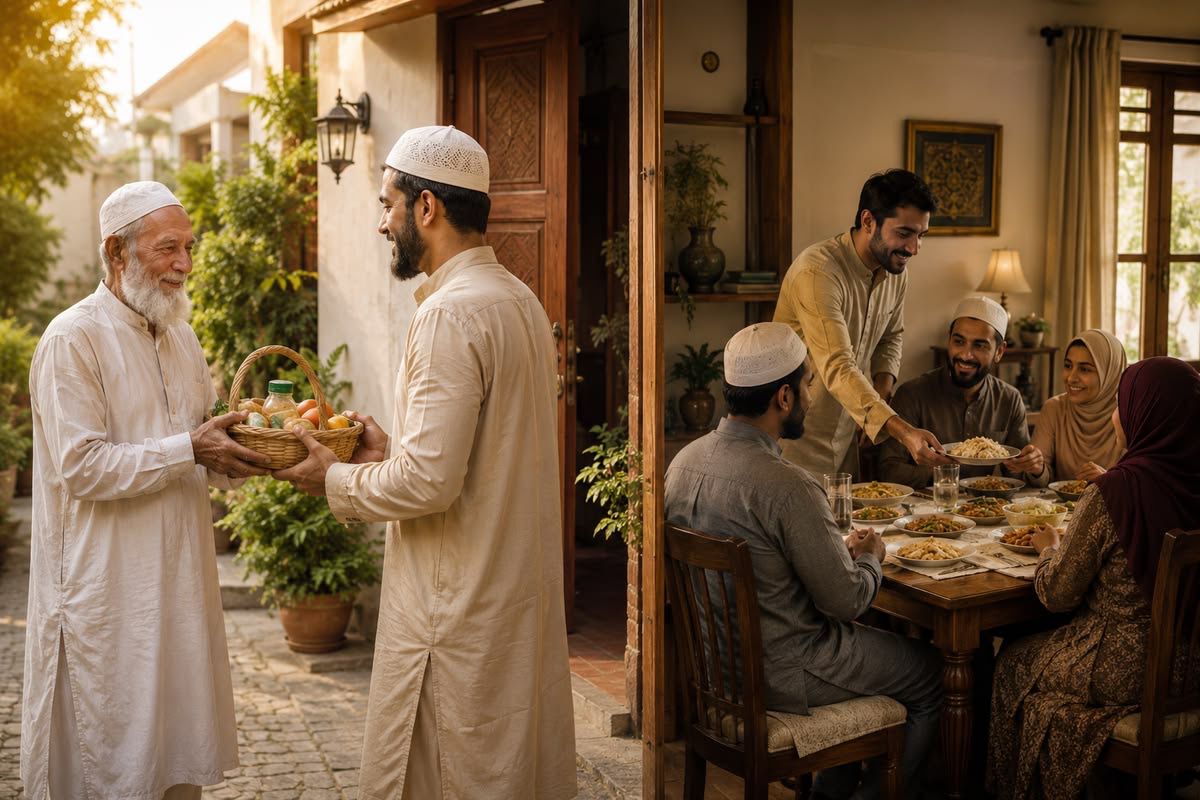
Food has a special place in human relationships. Sharing a meal can create warmth, reduce distance, and help people feel remembered.
The Prophet Muhammad ﷺ advised Abu Dharr:
“O Abu Dharr! When you prepare a broth, add water to it and give some of it to your neighbours.” — Sahih Muslim.
This beautiful teaching encourages generosity and consideration for those living nearby.
Notice that the advice concerns something ordinary: preparing food.
It reminds us that kindness does not always require expensive gifts or grand gestures.
If you prepare a meal and have enough to share, you might offer some to a neighbour. During Ramadan, you might share iftar food. During a celebration, you might include nearby households in a modest gesture of generosity.
You could also check on a neighbour who has been unwell or recently experienced a loss.
The point is not to create competition over who gives the most. It is to develop a heart that remembers other people.
If your circumstances are limited, do not feel that you must provide food beyond your means. Islam does not require you to harm your own household financially to maintain appearances.
The lesson is to give according to your ability and to avoid becoming so absorbed in your own blessings that you forget the people around you.
Sometimes, a small portion offered sincerely can mean more than an expensive gift given for recognition.
7. DO NOT GOSSIP ABOUT YOUR NEIGHBOURS
Because neighbours often see one another regularly, it can be easy for curiosity to develop into gossip.
People begin discussing who visits a particular house, whose marriage appears troubled, who is struggling financially, or who had an argument with a family member.
A private matter becomes a community story, and the people involved may not even know that their lives are being discussed.
Islam warns against this behaviour.
Allah says:
“And do not spy or backbite each other…” — Qur’an 49:12.
Backbiting involves mentioning something about another person that they would dislike being mentioned, even if what is said is true. False accusations are even more serious.
As neighbours, we should be especially careful because our words can affect someone’s reputation within the very community where they live.
Before discussing another person, ask yourself:
- Is this information mine to share?
- Is there a genuine and legitimate reason to discuss it?
- Am I trying to solve a problem, or am I simply entertaining others?
- Would I be comfortable if the person heard what I was saying?
If the conversation serves no worthwhile purpose, it may be better to remain silent.
This does not mean that you can never raise a legitimate concern. If someone poses a genuine danger, causes repeated harm, or requires intervention, seeking appropriate help or advice may be necessary.
The distinction is between responsibly addressing a problem and spreading private information for entertainment or humiliation.
A good neighbour protects people’s dignity rather than making their private lives a source of gossip.
8. BE PATIENT WHEN DISAGREEMENTS OCCUR
Even people with good intentions can experience conflict.
A neighbour may make too much noise, misunderstand a request, park in an inconvenient place, or behave in a way that frustrates you.
Sometimes, the problem may be genuine. At other times, it may arise from a misunderstanding or a difference in expectations.
Islam teaches us to respond with justice, patience, and good character.
Being patient does not mean pretending that every behaviour is acceptable. It means handling disagreements without unnecessary insults, threats, revenge, or humiliation.
If a neighbour repeatedly makes excessive noise, you can speak to them calmly and explain how it affects you.
If a boundary has been crossed, you can state your concern respectfully.
If the issue cannot be resolved directly, you may seek help from a trusted mediator, landlord, residents’ association, community leader, or the appropriate authority, depending on the circumstances.
The goal should be to address the problem fairly rather than to defeat or embarrass the other person.
Before reacting in anger, consider whether the neighbour understands the effect of their behaviour. They may not realise that their actions are causing distress.
A calm conversation can sometimes resolve what an argument would make worse.
However, patience does not require tolerating abuse, threats, harassment, or genuine danger. You may establish firm boundaries and seek protection when necessary.
Good character means treating people fairly, even when you must disagree with them.
9. BE A GOOD NEIGHBOUR REGARDLESS OF THEIR RELIGION
One of the important lessons of Islamic character is that kindness and justice should not be restricted to people who are exactly like us.
Your neighbour may be Muslim, Christian, belong to another religion, or have no religious affiliation. They may come from a different ethnic group or cultural background.
These differences do not give you permission to treat them unfairly.
Allah says:
“Allah does not forbid you from those who do not fight you because of religion and do not expel you from your homes — from being righteous toward them and acting justly toward them. Indeed, Allah loves those who act justly.” — Qur’an 60:8.
This verse establishes that righteousness and justice are appropriate towards people who are not fighting or persecuting Muslims.
You can treat a non-Muslim neighbour with courtesy, help them when they need assistance, respect their lawful rights, and maintain a peaceful relationship with them.
You can offer food, check on their well-being, assist during emergencies, and communicate respectfully.
Good neighbourly conduct does not require abandoning your religious principles. It requires demonstrating those principles through fairness, compassion, and good manners.
Sometimes, the way you treat your neighbours communicates more about your character than the words you use to describe your faith.
Let your conduct reflect honesty, patience, reliability, and respect.
10. AVOID ARROGANCE AND DO NOT LOOK DOWN ON YOUR NEIGHBOURS
People living in the same area may have very different financial circumstances.
One household may own several properties, while another struggles to pay rent. One neighbour may drive an expensive car, while another uses public transport. Some may have prestigious careers, while others perform modest jobs.
Islam does not permit us to use wealth or social status as a justification for arrogance.
A good neighbour does not treat people as inferior because of their income, education, occupation, background, or appearance.
Do not ignore someone simply because they cannot offer you anything in return. Do not humiliate a neighbour who needs help. Do not use your financial position to intimidate people or make them feel unwelcome.
Likewise, do not assume that someone who has less money has less dignity or deserves less consideration.
The value of a person cannot be measured by their possessions.
If Allah has blessed you with wealth, influence, knowledge, or opportunities, use those blessings responsibly.
You may be able to help repair a shared facility, support a neighbour facing hardship, or contribute to improving the community. Do so with sincerity rather than a desire to make others feel indebted to you.
The best neighbour is not necessarily the wealthiest, most popular, or most influential person on the street.
Often, it is the person others can trust to behave fairly and treat them with dignity.
11. KEEP YOUR ENVIRONMENT CLEAN AND RESPECT SHARED SPACES
Good neighbourly conduct also includes the practical ways we care for the places we share.
A person may speak politely but still create problems by dumping rubbish in common areas, allowing drains to become blocked, damaging shared property, or leaving their belongings where others need to pass.
These behaviours can inconvenience neighbours and sometimes create health or safety risks.
Islam encourages cleanliness, responsibility, and the removal of harm.
The Prophet ﷺ taught that removing something harmful from the road is an act of charity, as reported in Sahih al-Bukhari and Sahih Muslim.
This teaching reminds us that even practical actions that make shared spaces safer and easier to use can carry religious value.
You can apply this principle by disposing of waste properly, keeping shared entrances clear, cleaning up after yourself, and respecting communal facilities.
If you have visitors, help ensure they do not obstruct access or disturb residents unnecessarily.
If you own a pet, take reasonable steps to prevent it from harming or persistently disturbing others.
If you are carrying out repairs or renovations, consider the noise, timing, and safety of the people around you.
A peaceful neighbourhood is built not only through friendliness but also through consideration for other people’s everyday needs.
12. DO NOT LET YOUR RELIGIOUS APPEARANCE HIDE POOR CHARACTER
Perhaps one of the most important lessons is that religious practice and good treatment of people should support one another.
A person may be known for attending the mosque regularly, reciting the Qur’an, or sharing Islamic reminders online. Yet if that same person threatens neighbours, spreads rumours, refuses to respect boundaries, or repeatedly causes harm, there is a serious inconsistency between their public religious image and their treatment of others.
The Prophet ﷺ placed great emphasis on good character and the rights of neighbours.
Religious devotion should encourage us to become more honest, patient, compassionate, and trustworthy.
It should make us more conscious of our responsibilities, not less.
This does not mean that a good Muslim must be perfect or never make mistakes. We all have weaknesses and areas in which we need to improve.
What matters is our willingness to recognise our mistakes, seek forgiveness, correct harmful behaviour, and treat others with greater care.
If you have wronged a neighbour, consider apologising sincerely and taking reasonable steps to put things right.
If you have spoken unfairly about someone, stop repeating the story and correct the misinformation where appropriate.
If you have repeatedly disturbed others, acknowledge the problem and change your behaviour.
Sometimes, becoming a better neighbour begins with admitting that we have not been as considerate as we should have been.
13. PRACTICAL WAYS TO BECOME A BETTER NEIGHBOUR STARTING TODAY
You do not need to wait for a major occasion to improve your relationship with the people around you.
Here are some simple ways to begin:
- Greet your neighbours respectfully when you meet them.
- Keep noise at reasonable levels, especially during periods when others may be resting.
- Respect people’s privacy and seek permission before entering their homes.
- Share food when you are able to do so.
- Offer practical assistance when someone is in need.
- Avoid gossip, suspicion, and the spread of unverified stories.
- Resolve disagreements calmly and fairly.
- Respect shared spaces and keep your environment clean.
- Treat neighbours of different backgrounds with justice and kindness.
- Check on elderly or vulnerable neighbours when appropriate.
- Apologise when your actions have caused harm.
- Remember your neighbours in your du’a.
You do not have to do everything at once. Begin with the things that are realistic in your circumstances.
A sincere greeting, a considerate decision, or an act of help may appear small, but these actions contribute to a healthier community.
And remember: being a good neighbour does not mean allowing others to exploit you or violating your own boundaries. You can be kind while remaining firm about what is right.
The aim is to create relationships in which people are treated with dignity, harm is reduced, and mutual respect is encouraged.
CONCLUSION: LET YOUR NEIGHBOURS EXPERIENCE THE GOODNESS OF YOUR CHARACTER
At the end of the day, being a good neighbour is not about how religious we appear in public. It is about how our faith shapes our everyday conduct.
It is about whether people feel safe around us, whether we respect their privacy, whether we avoid causing unnecessary harm, and whether we are willing to help when we can.
Islam teaches us that the people who live around us are not merely strangers occupying nearby houses. They are human beings whose rights and well-being deserve consideration.
You may never know how much a simple act of kindness means to someone. A neighbour may be facing a private difficulty you know nothing about. A respectful greeting may brighten their day. A small offer of assistance may relieve a burden they have been carrying alone.
Likewise, you may never fully appreciate the damage caused by repeated noise, cruel words, gossip, or careless behaviour until you experience it yourself.
That is why we should strive to treat our neighbours with the same fairness and consideration that we hope to receive.
Before speaking harshly, pause.
Before spreading someone’s private information, reflect.
Before making a decision that affects a shared space, consider the people around you.
And whenever you have an opportunity to help, do so according to your ability and with a sincere intention.
You do not need to be rich to be a good neighbour. You do not need to have a large house or an influential position. You do not need to become close friends with everyone who lives near you.
You simply need to recognise their rights, respect their dignity, and make a sincere effort not to cause them harm.
A good Muslim should strive to be a blessing to the people around them, and that includes the neighbours who see them in the ordinary moments of everyday life.
May Allah make us neighbours who bring peace rather than conflict, kindness rather than cruelty, and assistance rather than unnecessary hardship.
May He purify our hearts from arrogance, envy, gossip, and resentment. May He grant us the patience to handle disagreements wisely and the humility to apologise when we are wrong.
May Allah help us fulfil the rights of our neighbours, care for those who are vulnerable, and treat people of every background with justice and dignity.
And may He make our homes places of peace, our conduct a
