

MENTAL HEALTH AND ISLAM: HEALING THE MIND, NOURISHING THE SOUL, AND FINDING PEACE THROUGH ALLAH

INTRODUCTION: WHEN THE HEART IS TIRED AND THE MIND WILL NOT REST
Not every struggle is visible. Some people smile in public while battling anxiety in private. Some fulfil their daily responsibilities while silently carrying grief, emotional exhaustion, fear, or overwhelming thoughts. Others pray, make Du’a, and try their best to remain strong, yet still experience moments when life feels unbearably heavy.
In Muslim communities, conversations about mental health can sometimes be difficult. A person struggling emotionally may be told to pray more, strengthen their Iman, or simply trust Allah. Although Salah, Du’a, and remembrance are essential sources of spiritual comfort, these responses can unintentionally make someone feel that their suffering is a sign of weak faith.
But is that what Islam teaches?
Does experiencing anxiety mean your Iman is weak? Does depression mean you are not grateful to Allah? Must a Muslim hide emotional pain to prove their trust in Allah?
The answer to these questions requires compassion, knowledge, and a proper understanding of both Islam and mental health.
Islam recognises the complexity of human beings. We have bodies that become ill, minds that become overwhelmed, hearts that experience grief, and souls that seek closeness to their Creator. Caring for our well-being requires us to acknowledge these different dimensions of our lives.
Mental health is not separate from being human, and seeking help is not a rejection of faith.
Sometimes, healing begins when we stop pretending that we are fine and allow ourselves to seek the support we genuinely need.
1. WHAT DOES ISLAM TEACH US ABOUT MENTAL HEALTH?
Islam teaches that human life has dignity and that our bodies and lives are trusts from Allah. Caring for ourselves therefore includes recognising when we are struggling and taking reasonable steps to protect our well-being.
Allah says:
“And do not throw yourselves with your own hands into destruction.”
— Qur’an 2:195
Although this verse appears in a broader context, it reminds Muslims of the importance of avoiding harm.
Mental health difficulties can affect our sleep, relationships, concentration, physical health, worship, and ability to carry out everyday responsibilities. They deserve thoughtful attention rather than shame or dismissal.
Islam does not teach that a believer must never feel sadness, fear, or emotional pain. The Qur’an describes the grief of Prophet Ya’qub عليه السلام when he was separated from his beloved son, Yusuf عليه السلام.
Allah tells us that Ya’qub said:
“I only complain of my suffering and my grief to Allah.”
— Qur’an 12:86
Consider the depth of this example. A prophet experienced profound grief, yet his sorrow did not mean that he had abandoned faith in Allah.
His example reminds us that turning to Allah and experiencing emotional pain are not mutually exclusive.
You can believe in Allah and still feel overwhelmed. You can be grateful and still struggle. You can have strong faith and still need someone to help you through a difficult period.
Faith does not require you to deny your pain. It gives you a way to face it without losing sight of Allah.
2. DOES MENTAL ILLNESS MEAN A PERSON HAS WEAK IMAN?
One of the most harmful misconceptions about mental health is the belief that people who experience depression, anxiety, or other psychological difficulties must have weak faith.
This assumption oversimplifies both Islam and mental health.
Mental health conditions can arise through a combination of biological, psychological, social, and environmental factors. Genetics, prolonged stress, trauma, grief, physical illness, sleep difficulties, and other circumstances may contribute to emotional distress.
A person’s religious practices may provide comfort and resilience, but they do not make someone immune to mental illness.
Think about physical illness. A person who develops diabetes or a serious infection is not automatically considered spiritually deficient. Similarly, a mental health condition should not be treated as proof that someone has failed Allah.
The prophets themselves experienced hardship, grief, fear, and distress. Their experiences remind us that human vulnerability is not incompatible with faith.
It is also important not to assume that every instance of sadness is a mental illness. Sadness is a normal human emotion, while depression and other conditions may involve persistent symptoms that require professional assessment.
We should therefore avoid judging people’s faith based on what they are experiencing internally.
Instead of asking someone, “Why is your Iman so weak?” we can ask, “How are you feeling, and how can I support you?”
Compassion opens doors that condemnation often closes.
3. THE PSYCHOLOGY OF TAWAKKUL: TRUSTING ALLAH WHEN YOUR MIND IS OVERWHELMED
Tawakkul means placing one’s trust in Allah while taking appropriate action.
However, when someone experiences anxiety, trusting Allah may feel difficult. Their mind may constantly imagine worst-case scenarios, revisit past mistakes, or worry about events that have not happened.
They may ask themselves:
- What if I fail?
- What if I lose someone I love?
- What if my situation never improves?
- What if Allah is displeased with me?
- What if I cannot cope with what comes next?
These thoughts can become exhausting, especially when a person feels responsible for controlling every possible outcome.
Tawakkul invites us to recognise the limits of our control.
We can prepare for an examination without controlling the final result. We can work toward financial stability without knowing every future circumstance. We can care for our relationships without controlling another person’s decisions.
Allah says:
“And whoever relies upon Allah — then He is sufficient for him.”
— Qur’an 65:3
This verse is a reminder of reliance upon Allah, not a promise that every difficulty will immediately disappear.
Practising Tawakkul involves doing what is within our ability, seeking guidance, making Du’a, and acknowledging that some outcomes remain beyond our control.
From a psychological perspective, learning to distinguish between what we can influence and what we cannot may help reduce unproductive worry.
If anxiety is persistent or overwhelming, professional support can also help a person develop practical ways to manage it.
Trusting Allah does not mean you will never feel afraid. It means that fear does not have to determine every decision you make.
4. DEPRESSION AND ISLAM: WHEN HAPPINESS FEELS FAR AWAY
Depression is often misunderstood as ordinary sadness or a lack of gratitude.
Someone experiencing depression may hear statements such as:
“Just think positively.”
“Other people have worse problems.”
“You should be grateful for what Allah has given you.”
“Read more Qur’an, and everything will be fine.”
Although such statements may be intended to encourage, they can leave a struggling person feeling misunderstood and ashamed.
Depression is more than feeling sad after a difficult day. It can involve persistent low mood, loss of interest or pleasure, changes in sleep or appetite, fatigue, difficulty concentrating, feelings of worthlessness, and other symptoms that affect daily life.
Not everyone experiences the same symptoms, and only a qualified professional can assess whether someone has depression.
A Muslim experiencing depression may continue to believe in Allah while struggling to experience happiness. They may pray while feeling emotionally exhausted. They may appreciate their blessings while finding it difficult to feel joy.
These experiences should not automatically be interpreted as spiritual failure.
Remember the example of Prophet Ya’qub عليه السلام. His grief was profound, and the Qur’an does not dismiss it as ingratitude.
We must also avoid assuming that his experience was identical to modern clinical depression. The important lesson is that the Qur’an acknowledges genuine human sorrow.
If you are experiencing persistent depression, consider speaking with a qualified mental health professional. Spiritual practices may complement treatment, but they should not be treated as a guaranteed substitute for it.
You deserve support that addresses your emotional, psychological, physical, and spiritual needs.
5. ANXIETY AND OVERTHINKING: LEARNING TO QUIET THE MIND
Overthinking can make a person feel trapped in their own thoughts.
You replay conversations, worry about what others think of you, imagine painful outcomes, and analyse decisions long after they have been made.
Sometimes, the mind tries to protect us by anticipating every possible danger. But when this process becomes excessive, it can interfere with sleep, concentration, relationships, and everyday life.
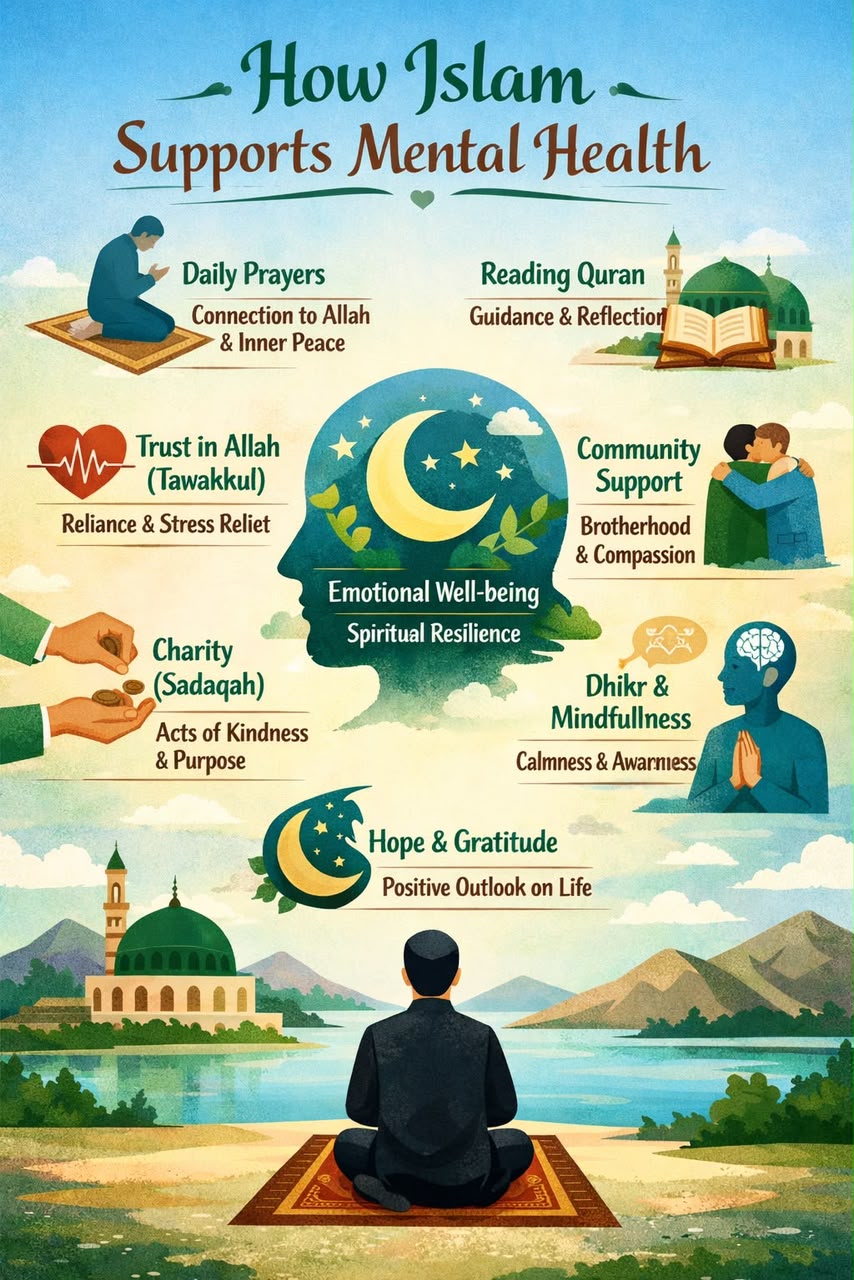
Islam offers spiritual practices that may help people find perspective and calm, including Salah, Dhikr, Du’a, reflection, and seeking wise counsel.
Allah says:
“Unquestionably, by the remembrance of Allah hearts are assured.”
— Qur’an 13:28
Dhikr can provide a meaningful anchor when your thoughts feel scattered. Repeating familiar phrases of remembrance, reflecting on their meanings, and turning your attention toward Allah may help you become more grounded.
You can also combine spiritual practices with practical coping strategies:
- Write down your worries instead of carrying every thought in your mind.
- Separate problems you can act on from uncertainties you cannot resolve immediately.
- Take slow, comfortable breaths when you feel overwhelmed.
- Maintain a consistent sleep routine where possible.
- Speak with someone trustworthy instead of isolating yourself.
- Seek professional help if anxiety persists or interferes with daily life.
Remember that having an unwanted thought does not automatically make you sinful, and experiencing anxiety does not mean you have failed to trust Allah.
Thoughts can arise involuntarily. What matters is how we respond to them, while recognising that some mental health conditions require specialised treatment.
You do not have to fight every thought until it disappears before you can live meaningfully.
Sometimes, the next step is simply to acknowledge the thought, seek Allah’s help, and return your attention to what you need to do now.
6. THE PROPHET ﷺ AND EMOTIONAL COMPASSION
The life of Prophet Muhammad ﷺ provides important examples of emotional vulnerability, compassion, and care.
When his son Ibrahim died, the Prophet ﷺ wept. He explained that the eyes shed tears and the heart grieves, while affirming that believers should speak only in ways that please their Lord.
This narration is recorded in Sahih al-Bukhari and Sahih Muslim.
Notice the lesson: grief and faith can exist together.
The Prophet ﷺ did not present tears as evidence of weak belief. He acknowledged the pain of losing someone he loved while maintaining his devotion to Allah.
This example challenges the idea that Muslims must always appear strong, composed, and unaffected by hardship.
There is a difference between patience and emotional suppression.
Patience does not require pretending that nothing hurts. It involves responding to hardship in a way that remains consistent with faith and good character, even when the heart is grieving.
A person can cry and still practise Sabr. They can feel afraid and still take courageous action. They can admit that they are struggling and still place their hope in Allah.
We should extend the same compassion to ourselves and others.
When someone shares their emotional pain, we do not always need to provide an immediate solution. Sometimes, listening without judgment is one of the most meaningful forms of support we can offer.
7. SEEKING PROFESSIONAL HELP IS NOT A LACK OF TAWAKKUL
Some Muslims hesitate to seek psychological support because they fear that doing so demonstrates insufficient reliance on Allah.
Others worry that therapy or medication conflicts with religious belief.
These concerns deserve a compassionate and clear response.
Seeking treatment does not mean that a person has abandoned faith. It can be a practical expression of caring for the health Allah has entrusted to them.
The Prophet ﷺ encouraged seeking treatment. In a narration recorded in Sunan Abi Dawud, he taught that Allah has not sent down a disease without also providing a remedy for it.
The narration encourages seeking remedies; it does not mean that every illness has an easy or currently available cure.
Just as a Muslim may consult a doctor for persistent physical symptoms, they may consult a qualified psychologist, psychiatrist, or other appropriate health professional for mental health concerns.
Depending on the condition, support may involve psychotherapy, medication, lifestyle changes, social support, or a combination of approaches.
A Muslim may also benefit from speaking with a knowledgeable and compassionate imam or Islamic counsellor, particularly when religious questions contribute to their distress.
Ideally, spiritual guidance and professional mental health care can complement each other.
You can make Du’a and attend therapy. You can pray Tahajjud and take prescribed medication. You can trust Allah and ask someone for help.
These actions are not contradictions.
They are different ways of responding to human needs.
Never stop prescribed medication abruptly or replace necessary treatment with spiritual practices without discussing it with an appropriate healthcare professional.
8. WHEN GUILT BECOMES A SPIRITUAL BURDEN
Guilt can sometimes encourage positive change. When we recognise that we have harmed someone or neglected a responsibility, sincere repentance can help us correct our behaviour.
However, excessive guilt can become psychologically damaging.
Some people blame themselves for every difficulty they experience. They assume that their suffering must be punishment for a sin, that Allah must be displeased with them, or that their prayers are not being accepted because they are imperfect.
Islam teaches accountability and repentance, but we should not claim knowledge of Allah’s hidden reasons for a particular person’s suffering.
Hardship is not reliable proof that Allah hates someone. Nor does a person’s outward success prove that Allah is especially pleased with them.
The lives of the prophets show that righteous people can experience tremendous hardship.
If you have sinned, Islam offers the door of Tawbah. If you have hurt someone, you can seek forgiveness and make amends where possible. If you have fallen short, you can begin again.
But you do not need to interpret every painful experience as evidence that you are being punished.
Allah says:
“Do not despair of the mercy of Allah.”
— Qur’an 39:53
This verse is a powerful reminder of hope for those who have made mistakes and wish to return to Allah.
You are not required to remain trapped in shame to prove that you regret your past.
Sincere repentance involves turning back to Allah and making a genuine effort to do better.
9. BUILDING A MENTALLY AND SPIRITUALLY HEALTHIER MUSLIM LIFE
Mental well-being is influenced by many factors, and no single routine guarantees emotional health. However, a balanced lifestyle can provide a foundation for greater resilience.
Here are several habits worth developing.
Prioritise Salah without demanding emotional perfection
Salah is an essential act of worship and an opportunity to turn toward Allah throughout the day.
However, if you are struggling with mental health difficulties, do not assume that every prayer must produce an immediate feeling of peace. Continue approaching worship with sincerity, and seek appropriate guidance if your difficulties affect your religious practice.
Make Du’a honestly
You do not have to hide your pain when speaking to Allah.
Ask for strength, guidance, relief, and the ability to take the next step. Express your concerns in your own words and remember that you can seek human support as well.
Protect your sleep and physical health
Sleep, nutrition, movement, and medical care can all influence mental well-being.
Looking after your body is not a distraction from spirituality. It can support your ability to fulfil your responsibilities and engage in worship.
Maintain healthy relationships
Isolation can make emotional struggles more difficult to carry.
Reach out to trusted friends, relatives, or community members who can listen without humiliating you. Where appropriate, seek professional support from someone who respects your religious values.
Set realistic expectations for yourself
You do not have to become the perfect Muslim overnight.
Spiritual development involves learning, making mistakes, repenting, and continuing to grow. Give yourself room to improve without using every setback as a reason to condemn yourself.
Limit harmful distractions
Excessive social media use, constant comparison, and inadequate rest can contribute to stress for some people.
Consider creating boundaries that protect your attention and give you more time for meaningful activities, rest, worship, and relationships.
The objective is not to eliminate every difficulty from life. It is to build habits and support systems that help you navigate difficulties more effectively.
10. HOW TO SUPPORT A MUSLIM WHO IS STRUGGLING MENTALLY
Mental health awareness should not end with personal self-care. It should also change the way we treat people around us.
If a friend or family member tells you that they are experiencing depression, anxiety, or emotional exhaustion, take their concerns seriously.
Avoid statements such as:
- “Your Iman is weak.”
- “You just need to pray more.”
- “Other people have bigger problems.”
- “A good Muslim should never feel this way.”
- “You should be ashamed of thinking like that.”
These statements may increase shame and discourage people from seeking help.
Instead, try saying:
“I’m sorry you’re going through this.”
“Thank you for trusting me enough to tell me.”
“Would you like me to listen, or would you prefer help finding support?”
“Your struggles do not make you less deserving of compassion.”
“I can support you spiritually, and we can also look into professional help if you need it.”
Listen carefully. Respect their privacy. Do not pressure them to share more than they are comfortable sharing.
If someone expresses thoughts of suicide or immediate danger, take the situation seriously and help them access urgent professional or emergency support. Do not assume that religious encouragement alone is sufficient.
Muslim communities can become safer places for people to seek help when compassion is prioritised over judgment.
11. A GENTLE REMINDER FOR THE MUSLIM WHO IS STRUGGLING
If you are reading this while silently fighting a battle that nobody knows about, take a moment to remember a few things.
You are not required to explain every aspect of your pain to everyone.
You do not have to pretend to be happy when you are hurting.
You do not need to compare your healing journey with someone else’s.
You can acknowledge your limitations without abandoning hope.
You can seek treatment without feeling that you have betrayed your faith.
And you can turn to Allah even when you do not know what to say.
Some days, worship may feel easier than others. Some days, you may feel hopeful, while on other days you may struggle to see a way forward.
If your symptoms make daily life difficult, seek appropriate support rather than waiting until you can no longer cope.
Healing is not always a straight line. Progress may involve setbacks, new strategies, difficult conversations, and the courage to ask for help again.
Your struggles deserve attention, and your life has value beyond what you are currently able to accomplish.
CONCLUSION: FAITH, COMPASSION, AND THE COURAGE TO SEEK HEALING
Mental health and Islam should not be treated as opposing forces.
Islam offers spiritual guidance, meaning, worship, community, and hope. Mental health care offers evidence-informed ways to understand and treat psychological difficulties. For many people, these approaches can work together to support well-being.
We must stop assuming that every person who struggles emotionally has weak faith. We must stop treating silence as strength and professional help as spiritual failure.
The Qur’an acknowledges grief. The Prophet ﷺ expressed sorrow. Islamic teachings encourage seeking remedies. Together, these reminders invite us to approach human suffering with humility and compassion.
We may not always understand why we experience particular hardships, and we should be cautious about claiming to know the hidden wisdom behind them.
But we can respond with sincere worship, appropriate treatment, supportive relationships, and practical action.
If you are struggling, take the next step that is available to you. Speak to someone you trust. Arrange an appointment with a qualified professional if needed. Continue making Du’a, and allow others to help you carry what feels too heavy to manage alone.
And if someone around you is struggling, be a source of mercy rather than another source of pain.
A Muslim can have Iman and still need help. A believer can practise Sabr and still cry. A person can trust Allah and still seek treatment.
These truths are not contradictions. They are reminders of our humanity.
May Allah grant ease to those experiencing anxiety, relief to those living with depression, comfort to those carrying grief, and strength to those who feel exhausted by life’s difficulties. May He guide us toward beneficial treatment, surround us with compassionate people, and teach us to care for our minds, bodies, hearts, and souls.
Ameen.
A DU’A FOR EMOTIONAL DISTRESS
The Prophet Muhammad ﷺ taught the following supplication for anxiety and sorrow:
اللَّهُمَّ إِنِّي أَعُوذُ بِكَ مِنَ الْهَمِّ وَالْحَزَنِ
Allahumma inni a’udhu bika minal-hammi wal-hazan.
Meaning: “O Allah, I seek refuge in You from anxiety and sorrow.”
This is the opening of a longer supplication recorded in Sahih al-Bukhari (6369), which also seeks refuge from helplessness, laziness, cowardice, miserliness, the burden of debt, and being overpowered by others.
May this supplication remind us that we can turn toward Allah in our distress while also taking the practical steps necessary to care for ourselves.
May Allah grant us sound hearts, peaceful minds, sincere faith, and the wisdom to seek help when we need it. Ameen.
