


The recent heartbreaking passing of Dr. Hadiza Usman Abdullahi and her twin sister, Pharm. Aidah Usman Abdullahi, within days of each other following complications related to sickle cell disease has left many people deeply saddened.
May Allaah forgive them, have mercy upon them, elevate their ranks among the righteous, and grant their family patience and strength during this painful period. May Allaah also comfort their mother and everyone who mourns their loss.
It was gathered that the twin sisters were dedicated professionals who chose service to humanity despite the discomfort associated with sickle cell disease. Although they may have been known to many simply as a doctor and a pharmacist, those close to them described them as unsung heroes who remained committed to their work and were known for their professionalism and kindness.
Dr. Hidaya reportedly passed away on Friday, while her twin sister, Pharm. Aina, passed away on Sunday. Their deaths, following complications related to sickle cell disease, have left many deeply saddened and have once again brought attention to the importance of sickle cell awareness and genotype compatibility.
Beyond the grief, their passing has once again brought an important conversation to the forefront: the importance of knowing your genotype and considering genotype compatibility before marriage.
TAKING THE MEANS DOES NOT CONTRADICT QADR
As Muslims, we believe firmly in Qadr. Whatever Allaah has decreed will come to pass.
But believing in divine decree does not mean abandoning the means that Allaah has placed at our disposal.
Islam encourages us to take reasonable precautions, seek knowledge, protect ourselves from harm and make responsible decisions, while ultimately placing our trust in Allaah.
Knowing one’s genotype before marriage is therefore not a lack of tawakkul. It is part of taking the means.
A person who checks their genotype, seeks medical advice and carefully considers the implications is not challenging Allaah’s decree. Rather, they are making use of the knowledge and means available to them and then entrusting the outcome to Allaah.
WHY GENOTYPE MATTERS
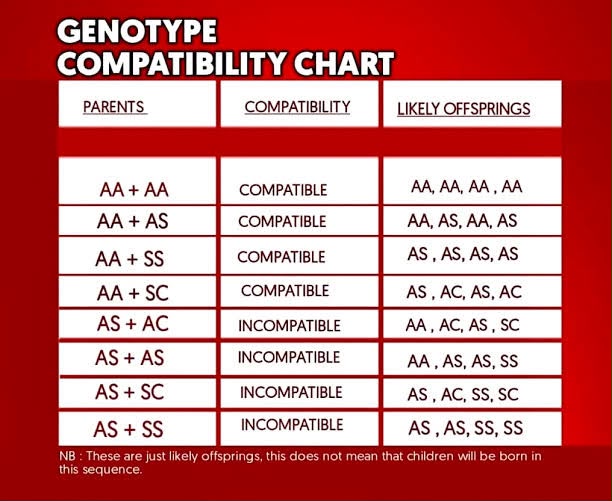
Sickle cell disease is an inherited blood disorder. A child’s risk of inheriting a sickle cell condition depends on the haemoglobin genes carried by both parents.
For example, when two people with AS genotype have children together, each pregnancy carries:
* 25% chance of AA
* 50% chance of AS
* 25% chance of SS
These percentages apply to each pregnancy independently; they do not mean that every family will necessarily have one child of each genotype.
This is why knowing one’s genotype before marriage is important.
And it is equally important to understand that genotype discussions should not be based on assumptions, social-media information or a test result that has never been properly confirmed.
Where there is a potential incompatibility or uncertainty, prospective couples should seek qualified medical and genetic counselling so that they can understand their individual circumstances and available options.
GENOTYPE IS NOT A REASON TO STIGMATISE ANYONE
This conversation must also be handled with compassion.
People living with sickle cell disease or those who carry the sickle cell trait are not lesser human beings, nor should they be blamed for a condition they did not choose.
Someone’s genotype is not their worth.
The purpose of premarital screening is not to shame, discriminate against or stigmatise anyone. It is to ensure that two people entering marriage understand the possible health implications and can make informed decisions.
BEFORE YOU SAY “I DO”
Marriage is a major decision, and Islam encourages responsibility and honesty between prospective spouses.
Before Nikāh, couples should have honest conversations about important matters, including:
• Genotype and other relevant health conditions
• Family medical history
• Fertility and reproductive health
• Financial responsibilities
• Expectations regarding children
• Other matters that may significantly affect married life
And where medical issues are involved, do not rely solely on what you read online. Speak to a qualified healthcare professional.
TAKE THE MEANS, THEN TRUST ALLAAH
There is a beautiful balance here.
We take the means because Allaah has commanded us to be responsible, and we trust Allaah because ultimately, nothing happens except by His permission.
Checking your genotype does not guarantee a particular outcome.
Not checking it does not mean Allaah cannot protect you.
But as Muslims, we are encouraged to act with wisdom, responsibility and foresight.
So, if you are preparing for marriage, know your genotype. Encourage your prospective spouse to know theirs. Confirm your results where necessary, seek proper medical advice, have the difficult conversations and make informed decisions.
Then place your trust in Allaah.
May Allaah grant us sound judgment in our choices, protect our families from preventable harm, grant ease and strength to everyone living with sickle cell disease, and grant mercy to those we have lost.
May Allaah guide us to take the right means while keeping our hearts firmly attached to Him.
Bārakallāhu fīnā wa fīkum.
