


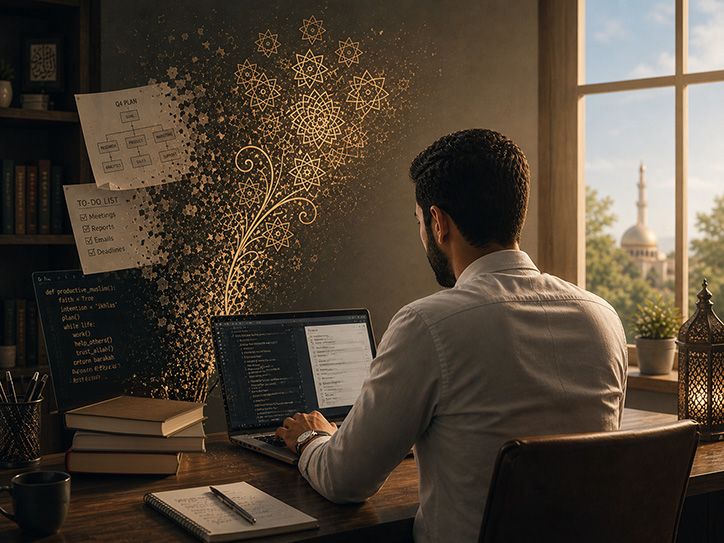
The weekend often gives people more freedom than the usual working week. There may be fewer responsibilities, more time with friends, more opportunities to go out, and more moments spent alone with a phone or computer. It is easy to behave well when people are watching, but the real test of character often comes when nobody is there to see what we are doing.
Islam teaches Muslims to develop a consciousness of Allah that does not depend on the presence of other people. Allah sees what happens in public and what happens in private. He knows the actions that receive praise from people and the actions that nobody ever hears about.
Allah says, “He knows the secret and what is even more hidden.” (Qur’an 20:7).
That awareness is at the heart of taqwa. A person with taqwa does not avoid sin only because someone might discover it. He avoids it because he knows that Allah knows.
This is especially important in a world where much of life happens behind screens. Someone can appear religious in public while privately consuming things they would never allow another person to see. Someone can speak about honesty while secretly engaging in dishonest behaviour. A person can be careful about their reputation while becoming careless about their relationship with Allah.
The absence of witnesses does not mean the absence of accountability.
Sometimes the private moments are where our sincerity is tested most strongly. When nobody is checking whether we prayed, will we still pray? When nobody knows what we are watching, will we still lower our gaze? When we have the opportunity to lie without being caught, will we still tell the truth? When nobody will know that we took something that does not belong to us, will we still leave it?
These moments reveal something important about our relationship with Allah.
The Prophet Muhammad ﷺ taught that Ihsan is to worship Allah as though you see Him, and if you cannot see Him, then know that He sees you. This principle can completely change how a Muslim approaches private life.
It means that faith is not simply about appearing good before people. It is about becoming good even when there is no audience.
The weekend can be a good time to examine this.
Perhaps you have more free time than usual. Perhaps you are spending more time online. Perhaps you are going out with friends or attending social gatherings. Perhaps you are alone at home for several hours. These situations can reveal habits that remain hidden during a busy week.
That does not mean a Muslim should spend the entire weekend feeling suspicious of themselves or afraid to enjoy life. Islam does not prohibit relaxation, lawful entertainment, family time or socialising. The issue is not whether you enjoy your weekend. The issue is whether you can enjoy it without crossing the boundaries Allah has set.
A believer should be able to have fun without forgetting Allah.
He should be able to rest without abandoning Salah.
He should be able to use social media without allowing it to control him.
He should be able to spend time with friends without being pressured into something sinful.
He should be able to enjoy privacy without turning privacy into an opportunity for disobedience.
This is where sincerity becomes important. There is a difference between avoiding a sin because people are watching and avoiding it because Allah is watching.
The first depends on reputation.
The second depends on faith.
And reputation can disappear very quickly. A person may successfully hide something from family, friends and colleagues. They may delete messages, clear browsing history, hide conversations or create another version of themselves for the public. But nothing is hidden from Allah.
Allah says, “Does he not know that Allah sees?” (Qur’an 96:14).
That verse is a powerful reminder for every private moment.
Before you do something this weekend that you would be ashamed for people to discover, stop and ask yourself a simple question: would I still do this if I genuinely remembered that Allah is watching me right now?
Sometimes that question is enough to make us reconsider.
And if you have already fallen into a private sin, do not allow shame to convince you that you cannot return to Allah. The purpose of recognising our mistakes is not to give up. It is to repent, correct ourselves and continue trying.
A private struggle can become the beginning of a private act of worship. The same person who once spent hours doing something harmful can eventually spend those hours reading Qur’an, making dhikr, learning something beneficial or simply resting in a lawful way.
The goal is not to become perfect overnight.
The goal is to become more conscious of Allah.
So as you enter the weekend, remember that your private life matters just as much as your public life. The person people see and the person you are when you are alone should gradually become the same person: a servant of Allah trying sincerely to do what is right.
Nobody may know what you did this weekend.
But Allah knows.
And perhaps the greatest sign of sincere faith is choosing what pleases Him even when there is no one around to applaud you, praise you or hold you accountable.
Make that your goal this weekend.
Do something good that nobody needs to know about. Leave a sin that nobody would have discovered. Pray when nobody is reminding you. Make du’a when nobody is listening.
Because the One who sees you in private is the same One who sees you in public.
And that awareness can change everything.
