


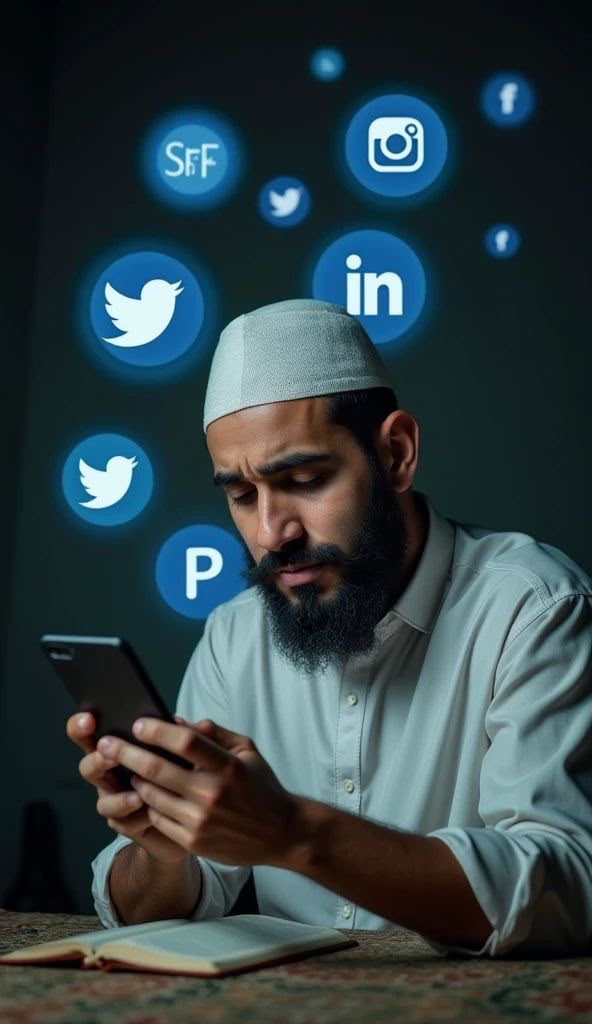
Social media has become part of everyday life. We wake up and check our phones, communicate with people through different platforms, follow news, watch videos, promote businesses, learn new things and spend our free time scrolling through content created by people we may never meet.
For a Muslim, social media is not automatically good or bad. It is a tool, and like every tool, its effect depends on how it is used. The same phone that can help someone listen to Qur’an, learn about Islam, maintain family relationships and earn a halal income can also become a source of distraction, envy, backbiting, inappropriate content and wasted time.
The real question is not whether Muslims should use social media. The more important question is whether Muslims are allowing social media to control their attention, influence their values and gradually affect their relationship with Allah.
YOUR PHONE CAN BECOME PART OF YOUR IBADAH
Technology itself is not the problem. What matters is what we choose to do with it.
A Muslim can use social media to remind others about Salah, share beneficial knowledge, promote a halal business, support charitable causes, reconnect with family members or encourage people towards something good. There are many beneficial opportunities that did not exist for previous generations.
But having access to beneficial content does not automatically mean we are using social media beneficially.
A person can follow hundreds of Islamic pages and still spend hours consuming content without actually changing their behaviour. They can watch reminders about Salah while repeatedly delaying their own prayer. They can share Qur’anic verses while spending most of their day in meaningless arguments.
Knowledge becomes valuable when it affects the way we live.
WHAT ARE YOU ALLOWING INTO YOUR HEART?
One of the most important questions a Muslim can ask is: what am I repeatedly allowing myself to look at?
The Qur’an commands believing men and women to lower their gaze and guard their modesty (Qur’an 24:30–31). In the digital age, this command also requires awareness of what appears on our screens.
Social media can expose a person to an endless stream of images, videos and conversations that they would never deliberately seek out in ordinary life. One scroll leads to another, and before long, the person has consumed content that affects the heart without ever stopping to think about it.
The problem is not only explicit or obviously inappropriate material. Constant exposure to materialism, vanity, arrogance, indecency, mockery and unhealthy lifestyles can gradually influence what a person considers normal.
The heart is affected by what it repeatedly consumes.
This is why a Muslim should not simply ask whether something is technically allowed to appear on their screen. They should also ask what repeated exposure to it is doing to their iman.
SOCIAL MEDIA CAN MAKE COMPARISON FEEL NORMAL
One of the most powerful effects of social media is the way it encourages people to compare their lives with other people’s carefully selected moments.
Someone posts a new car. Someone else posts a beautiful wedding. Another person announces a promotion. Someone is travelling. Someone has started a successful business. Another person appears to have a perfect family, perfect appearance and perfect lifestyle.
Meanwhile, you are looking at your own ordinary day.
The danger is that you begin comparing your reality with someone else’s presentation.
Islam teaches Muslims to appreciate what Allah has given them and not allow constant comparison to destroy gratitude. Allah says, “Do not wish for what Allah has given some of you over others.” (Qur’an 4:32).
This does not mean that Muslims should never admire someone else’s success or seek improvement. It means that another person’s blessing should not become a reason to despise your own life.
Social media often shows the result without showing the struggle, the photograph without showing the ordinary moments and the achievement without showing everything that happened behind it.
Do not measure the value of your life by somebody else’s highlight reel.
THE DANGER OF SEEKING VALIDATION
Another challenge is the desire to be noticed.
How many people saw the post? How many people liked it? Who commented? Why did this person not respond? Why did another person’s post receive more attention?
These questions can slowly turn social media into a search for validation.
Islam teaches Muslims that the value of their deeds is ultimately connected to Allah, not public applause.
This becomes especially important when doing something good. A person may begin with sincere intentions but gradually become more concerned about how others perceive them.
The Qur’an warns against doing acts of charity for the purpose of being seen by people (Qur’an 2:264). The principle extends beyond charity. A Muslim should regularly examine their intentions, particularly when their worship, generosity or religious activities become public.
Not everything good needs to be posted.
Some of the most valuable things a Muslim does may never receive a single like or comment.
WATCH YOUR TONGUE EVEN WHEN YOU ARE TYPING
Many people are careful about what they say when standing in front of another person, but become careless when sitti
