


By: Sefiu Ajape
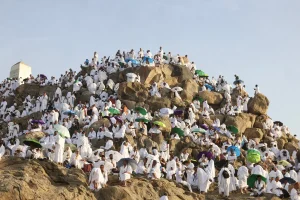
On Thursday, Muslim pilgrims gathered in prayer atop Mount Arafat, marking the peak moment of the annual hajj pilgrimage. Saudi authorities urged participants to avoid being outdoors during the hottest parts of the day.
Thousands of pilgrims assembled before dawn around the hill and nearby plain, the site where Prophet Mohammed is said to have delivered his final sermon.
While some arrived early to take advantage of the relatively cool morning, carrying colorful umbrellas, many pilgrims will remain for hours of prayers and Koran recitals until the evening in the most arduous portion of the hajj.
After sunset they will head to Muzdalifah, halfway between Arafat and the sprawling tent city of Mina, where they will gather pebbles so they can perform the symbolic “stoning of the devil.”
“This is something that I used to see every year on the TV screen during hajj, and I always thought, ‘I wish I could be here’,” said 33-year-old Ali from Pakistan, one of 1.5 million pilgrims who had arrived in Saudi Arabia for the pilgrimage.
“I’ve been trying to get here… for the past 3 years,” he added as he gazed at the mount. “I feel very blessed.”
Hundreds of pilgrims dressed in white dotted the mount itself, with many more at its foot praying or taking pictures.
Earlier this week, Saudi authorities called on pilgrims to stay inside their tents between 10:00 am and 4:00 pm on Thursday, when the desert sun is at its harshest.
Fans spraying mist and providing cool air were dispersed at the foot of the mount.
Temperatures this year have already exceeded 40 degrees Celsius (104 Fahrenheit) as one of the world’s largest annual religious gatherings, bringing together devotees from around the globe, kicked off earlier this week.
Officials have beefed up heat mitigation efforts, aiming to avoid a repeat of last year’s hajj, which saw 1,301 pilgrims die as temperatures reached 51.8°C.
“I came here early to avoid the sun, and later I will pray inside my tent,” said 54-year-old Adel Ismail, from Syria.
To make this year’s pilgrimage safer, authorities have expanded infrastructure, deployed thousands of extra personnel, and relied on an arsenal of high-tech tools to help better manage crowds.
Authorities have mobilized more than 40 government agencies and 250,000 officials, doubling their efforts against heat-related illness following the lethal heatwave of 2024.
Shaded areas have been expanded by 50,000 square meters (12 acres), thousands more medics will be on standby, and more than 400 cooling units will be deployed, the hajj minister has told AFP.
Through tears of joy, Iman Abdel Khaleq said she had wanted to perform the hajj for 10 years and was overwhelmed with emotion as she arrived at Arafat.
“It’s a big dream for me that I had almost given up hope of realizing,” the woman in her fifties told AFP from the foot of the mount.
Authorities said a majority of the deaths in 2024 were among unregistered pilgrims who lacked access to amenities like air-conditioned tents and buses.
This year, they have also cracked down on unregistered pilgrims looking to sneak into Mecca, relying on frequent raids, drone surveillance, and a barrage of text alerts.
Hajj permits are allocated to countries on a quota basis and distributed to individuals by a lottery.
But even for those who can obtain them, the steep costs prompt many to attempt the hajj without a permit, even though they risk arrest and deportation if caught.
