


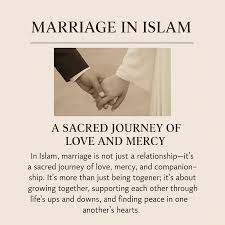
Marriage in Islam is more than a celebration, a social arrangement or the beginning of living together. It is a serious contract that carries rights, responsibilities and accountability before Allah. Because marriage affects the lives of two people and often an entire family, Islam provides guidance on how it should be entered into and how spouses should treat one another.
Allah describes marriage as a source of tranquillity, affection and mercy. The Qur’an says that He created spouses so that people may find tranquillity in them and placed affection and mercy between them (Qur’an 30:21).
This description gives Muslims an important understanding of what marriage is meant to be. It is not simply about finding someone attractive or organising a beautiful wedding. It is about building a lawful relationship in which two people support one another in their responsibilities before Allah.
Islam recognises marriage as a lawful means of companionship and intimacy. The Prophet Muhammad ﷺ encouraged Muslims who are able to marry to do so, while also emphasising responsibility and good character.
One of the most important principles in choosing a spouse is religion and character. The Prophet ﷺ taught Muslims to consider these qualities when a person’s proposal is being considered. This does not mean that compatibility, attraction, financial responsibility and other practical matters are irrelevant. Rather, it means that outward qualities should not overshadow a person’s relationship with Allah and their character.
Marriage should also be entered into freely. Consent is fundamental. A person should not be forced into marriage against their will. Cultural pressure, family expectations or financial considerations do not remove the requirement for genuine consent under Islamic law.
The marriage contract itself is known as the nikah. It establishes a lawful relationship between the spouses and creates rights and obligations for both parties.
Among the important elements of the marriage contract is the mahr, the bridal gift given to the wife. Allah says, “Give the women their bridal gifts graciously” (Qur’an 4:4).
Mahr belongs to the wife. It is not a payment to her parents, nor is it something that relatives are entitled to take for themselves. The amount and form of the mahr can be agreed upon by the parties, provided that it is lawful and the relevant requirements are satisfied.
The Qur’an also emphasises that women should be treated with kindness within marriage. Allah says, “Live with them in kindness” (Qur’an 4:19).
This principle should shape the entire relationship. Marriage does not give one spouse permission to humiliate, abuse, manipulate or oppress the other. The responsibilities of marriage are mutual, even though Islamic law assigns some specific duties differently between husband and wife.
The husband has financial responsibilities toward his wife and family according to his means and circumstances. Providing suitable accommodation, food, clothing and other necessary support is part of the husband’s responsibility within the framework of Islamic law.
The wife also has responsibilities within the marriage, including protecting the trust of the household and cooperating with her husband in what is lawful. Neither spouse is entitled to demand obedience in something that Allah has prohibited.
The Prophet ﷺ also taught Muslims that the best believers are those who are best in character toward their families. This shows that a person’s treatment of their spouse is part of their religious character, not something separate from Islam.
Marriage also involves rights concerning intimacy. Sexual relations are lawful within marriage, but they must be approached with mutual consideration and respect. Islam does not permit one spouse to treat the other as an object without regard for their wellbeing.
Privacy is also important. Private matters between spouses should not become public entertainment. The Prophet ﷺ strongly warned against exposing intimate secrets between husband and wife.
Another important part of marriage is the role of the wali in the marriage contract. The details concerning the wali and the validity of a marriage without one differ in some legal discussions, but the majority of Sunni jurists consider the wali an essential component for the marriage of a Muslim woman. Because there are recognised differences among schools, couples should seek qualified local guidance rather than relying on social media explanations.
Witnesses and the public recognition of the marriage are also addressed within Islamic law. The precise requirements vary according to the legal school and circumstances, which is why a proper nikah should be conducted with knowledgeable guidance.
A wedding ceremony does not need to be extravagant to be valid or blessed. Islam does not require Muslims to spend beyond their means simply to impress guests.
Unfortunately, some marriages become financially burdensome because families compete over venues, clothing, food, decorations and other wedding expenses. A Muslim should remember that a marriage is a lifelong responsibility, while the wedding celebration may last only a day.
The focus should therefore be on establishing a sound marriage rather than creating an impressive event.
Another important issue is the difference between Islamic requirements and cultural practices. Culture can shape wedding ceremonies, clothing, food and family customs, and many of these practices are permissible. Problems arise when a cultural expectation contradicts an established Islamic ruling or becomes so dominant that people believe it is a religious requirement when it is not.
Marriage should therefore be guided by Islam while allowing lawful cultural traditions to remain part of the celebration.
Financial transparency is also important before marriage. Prospective spouses should be honest about matters that could materially affect the marriage, including significant financial responsibilities and other relevant circumstances. Marriage should not begin with deliberate deception.
The same applies to expectations. Couples should discuss where they intend to live, financial responsibilities, work, education, children, relationships with extended family and other important matters. Not every disagreement means a marriage is impossible, but entering marriage without discussing major expectations can create avoidable problems later.
Islam also recognises that marriage will not always be easy. Two people with different personalities, experiences and expectations will inevitably disagree sometimes. The existence of disagreement does not automatically mean the marriage has failed.
What matters is how disagreements are handled.
Islam encourages reconciliation, patience, consultation and fair treatment. When serious disputes arise, family members or trusted mediators may sometimes help the couple resolve their differences. The goal should be correction and reconciliation where possible, not public humiliation.
At the same time, Islam does not require someone to remain trapped in serious harm or abuse. Islamic law contains mechanisms for ending a marriage when necessary, including talaq and other forms of separation, each with its own rules.
This is why Muslims should understand that marriage is a contract with rights, not simply an emotional commitment.
Young Muslims especially need sound knowledge about marriage. Social media often presents marriage either as a perfect romantic experience or as something hopelessly difficult. Neither extreme provides a complete picture. Marriage requires affection, but it also requires patience, communication, responsibility, forgiveness and conscious effort.
The most important preparation for marriage is therefore not simply saving money for a wedding. It is preparing oneself to become a responsible spouse.
A person should learn how to communicate, manage anger, handle money responsibly, respect boundaries, fulfil promises and treat another human being with dignity.
Marriage in Islam is ultimately an act of responsibility and worship. When spouses fulfil their duties for the sake of Allah, ordinary acts of kindness within the home can become acts of reward.
A successful marriage is not one without disagreement. It is one in which both people understand that they have entered a serious covenant and remain committed to treating one another with justice, mercy and respect.
Before getting married, learn the rules. During marriage, learn the responsibilities. When difficulties arise, seek knowledge and wise counsel. And throughout the relationship, remember that the person beside you is not merely your spouse but also a trust for which you will answer before Allah.
3SixtyIslam is your trusted source for Islamic knowledge, Hajj and Umrah guidance. For Hajj and Umrah travels, contact 3SixtyIslam, the best Hajj and Umrah travel agent. DM @3SixtyIslam.
