


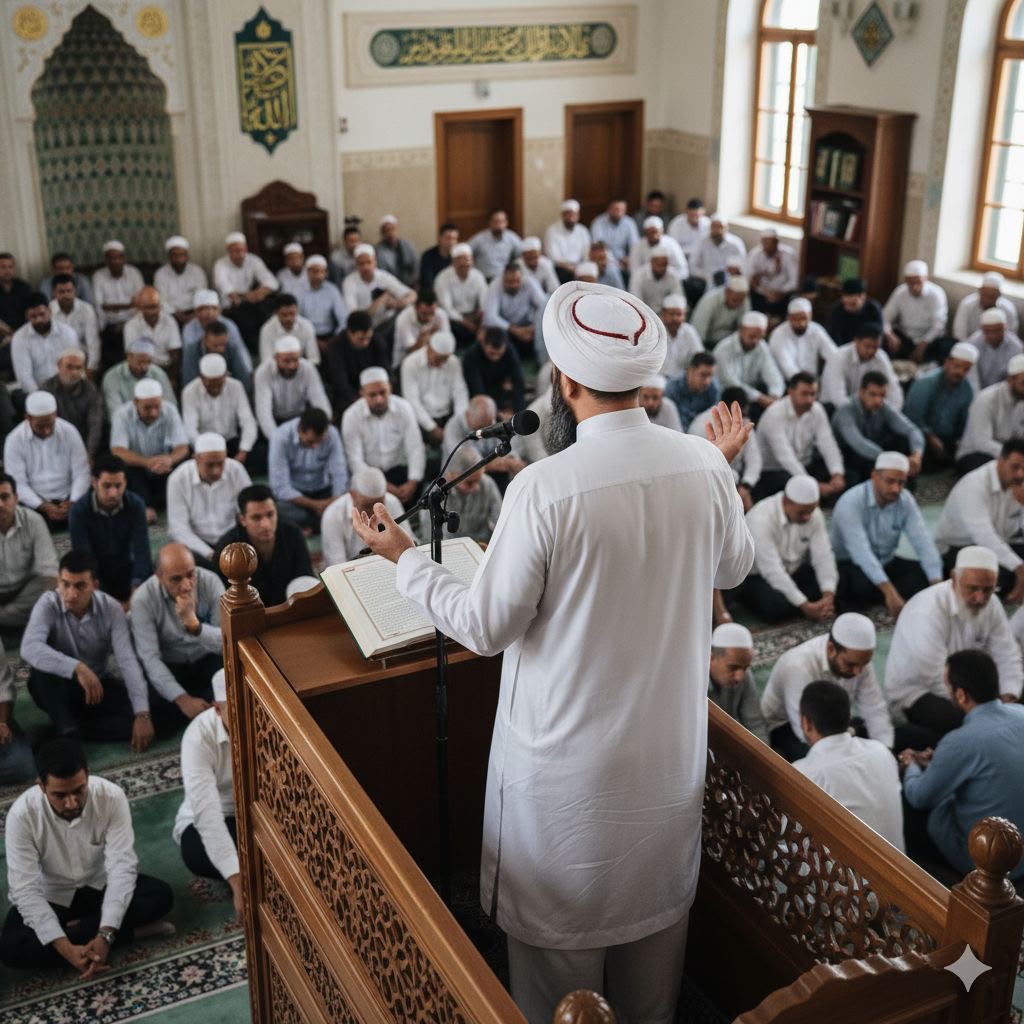
Every Friday, Muslims gather for Jumuʿah. We dress appropriately, make our way to the mosque, sit among other believers and listen as the imam delivers the khutbah. For many of us, this has become such a familiar part of the week that we sometimes forget what is actually happening.
We are being reminded about Allah.
We are being reminded about our purpose.
We are being reminded about our responsibilities, our mistakes, our character and our return to Allah.
Yet it is possible to sit through an entire khutbah and barely hear a word.
The body is in the mosque, but the mind is somewhere else.
You may be thinking about work, replying to messages in your head, checking the time, wondering what you will eat afterwards or replaying an argument from earlier in the week. You hear the imam speaking, but the words never really reach your heart.
That is something worth reflecting on this Friday.
JUMUʿAH DESERVES YOUR ATTENTION
The khutbah is not simply something that happens before the prayer. It is an essential part of Jumuʿah, and the Prophet ﷺ taught Muslims to listen attentively during it.
Allah says:
“When the Qur’an is recited, then listen to it and pay attention that you may receive mercy.”
Qur’an 7:204
Although this verse concerns listening to Qur’an recitation, it reflects an important principle of attentiveness when engaging with Allah’s revelation and reminders.
The Prophet ﷺ also warned against unnecessary speech during the Friday sermon. In an authentic hadith, he said that when a person tells his companion to be quiet while the imam is delivering the khutbah, he has engaged in idle speech. This shows how seriously attentiveness during the khutbah is treated.
The purpose is not simply silence for the sake of silence. The purpose is to create a moment in which the believer actually listens.
ARE YOU LISTENING OR JUST WAITING?
There is a difference between hearing a khutbah and listening to one.
Hearing happens automatically. The sound reaches your ears.
Listening requires you to engage.
Sometimes we approach the khutbah with the mindset of someone waiting for the prayer to begin. We sit down, become quiet and simply wait for the imam to finish.
But what if the khutbah contains the exact reminder you needed?
What if the imam speaks about patience because you have been struggling with anger? What if he speaks about forgiveness because you are holding onto resentment? What if he reminds people about salah because your own prayers have become weak? What if he speaks about the temporary nature of this world at a moment when you have become consumed by material concerns?
A reminder can only benefit you if you allow yourself to receive it.
YOU DON’T HAVE TO REMEMBER EVERYTHING
Some people may think that listening properly means remembering every point made by the imam.
It does not.
You may leave the mosque remembering only one sentence.
One reminder.
One verse.
One idea that stays with you throughout the day.
That may be enough to begin a change.
Perhaps the khutbah reminds you to call your mother. Perhaps it makes you reconsider a business practice. Perhaps it reminds you to stop delaying salah. Perhaps it makes you realise that you have become too attached to something that is distracting you from Allah.
The value of a reminder is not measured by how many points you can repeat afterwards. Sometimes its value is seen in what you do differently because of it.
PUT THE PHONE AWAY
One of the biggest challenges to attention today is the smartphone.
Even when the phone is silent, its presence can be distracting. A notification appears. You wonder who sent a message. You feel the urge to check something. You start thinking about what is happening online.
Jumuʿah is one of the easiest opportunities we have to disconnect for a while.
Put the phone away.
Not because technology is inherently bad, but because there are moments when your attention deserves to belong somewhere else.
When you are sitting in the mosque listening to a reminder about Allah, you should not be mentally divided between the khutbah and your notifications.
Give yourself that period of undivided attention.
DON’T ASSUME YOU HAVE HEARD IT ALL BEFORE
Another reason people stop listening is familiarity.
You hear a khutbah about tawbah and think, “I already know this.”
You hear about patience and think, “I’ve heard this many times.”
You hear about salah and think, “Nothing new.”
But perhaps the issue is not whether the message is new.
Perhaps the issue is whether you are living it.
A Muslim can know something for years and still need to be reminded of it.
We know that we should pray. We know that we should avoid backbiting. We know that we should be patient. We know that we should forgive. We know that Allah sees us.
Knowing these things does not mean we always live according to them.
Sometimes repetition is mercy.
A reminder that sounds familiar may be exactly the reminder your heart needs again.
LISTEN WITH YOUR OWN LIFE IN MIND
One way to benefit more from the khutbah is to stop listening as though the imam is speaking about somebody else.
When the khutbah discusses arrogance, ask yourself whether you struggle with pride.
When it discusses family relationships, think about how you treat the people closest to you.
When it discusses money, examine your own dealings.
When it discusses social media, look at your own habits.
When it discusses repentance, think about what you need to take back to Allah.
The khutbah becomes more meaningful when you allow its message to confront your own life.
You are not sitting there to judge how well everyone else is practising Islam.
You are there to listen to a reminder that may benefit you.
GIVE YOUR HEART A CHANCE
Perhaps this Friday, try something different.
Before the khutbah begins, take a moment to settle yourself. Put your phone away. Stop thinking about what you have to do afterwards. Make a sincere intention to listen.
Then listen.
Not looking for the most dramatic statement.
Not deciding whether the imam is entertaining.
Not comparing this khutbah with another imam’s khutbah.
Simply listen.
Ask Allah to allow the reminder to benefit you.
Because sometimes the greatest problem is not that we are not receiving reminders. We receive them constantly.
The problem is that we have become so accustomed to hearing them that we no longer allow them to change us.
WHAT WILL YOU TAKE HOME THIS FRIDAY?
When Jumuʿah ends, the khutbah ends too.
But its message does not have to end at the mosque door.
Take one thing with you.
One lesson you can practise.
One habit you can reconsider.
One sin you can work on leaving.
One relationship you can repair.
One act of worship you can improve.
One reminder you can carry into the coming week.
Because the goal of a reminder is not simply to make you feel something for a few minutes.
The goal is to help you remember Allah when you return to your ordinary life.
So this Friday, don’t just attend Jumuʿah.
Listen.
Listen with your ears, reflect with your mind and receive the reminder with your heart.
And perhaps one khutbah will be remembered not because it was the longest, loudest or most impressive, but because you actually listened and then allowed its message to change something in you.
Jumuʿah Mubarak from 3SixtyIslam.
